Managing a cold storage warehouse is not easy, as it requires monitoring of special perishable foods all the time. This is one of those jobs that cannot be managed manually, as chances of errors or neglecting specific temperatures becomes high in this regard. The best way to manage these facilities is by using a warehouse management system that can take control of all the operations. These systems help managers to automate several important tasks, so that they could be managed efficiently even if there is no human oversight available.
Talking about the cold storage WMS, many systems today come pre-integrated with smart AI-features to manage different processes. These AI-powered systems have brought a big transformation in the management of cold storage warehouses, as their functionalities help administrators to manage different tasks with complete automation.
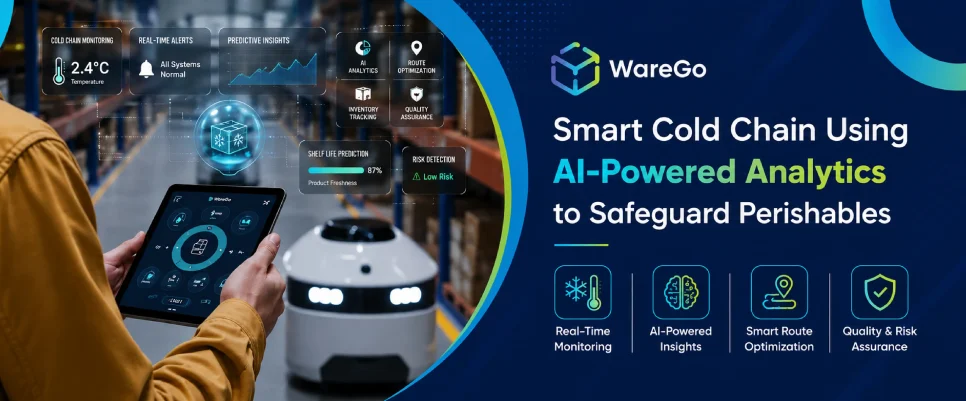
In this article, we will discuss more about this in detail, so that you can understand how AI is transforming the management of cold storage warehouses. It is often referred to as a smart cold chain in which every critical task is managed by AI processes to maintain perfection in execution. Let’s start from the basics understanding how AI is helping warehouses to become more efficient in managing various processes simultaneously.
Deploy WareGo today and take advantage of advanced AI features to manage cold storage inventory effortlessly.
Start with WareGo TodayTable of Contents
Understanding the Impact of AI in Warehouse Management
The evolution of AI has brought big advancement for warehouses. It is a technology that has automated different critical tasks, allowing warehouse administrators to manage different operations simultaneously. From inventory tracking to shipping management, AI has shown great proficiency in automating various processes, so that the productivity of the warehouse can be increased steadily over time.
Besides managing general operations, AI has also helped warehouses to strengthen their security. Nowadays, many advanced WMS systems like WareGo comes pre-built with cutting-edge security features to safeguard the warehouse data. These systems ensure to protect the digital assets of a warehouse by consistently monitoring the access of different identities.
It ensures to grant access to only those personnel that are registered in the system or have precise means to authenticate their IDs in real-time. That is how AI has helped warehouses to become efficient in different domains by making the relevant processes much faster and secure.
Challenges Faced by Cold Storage Warehouses
Cold storage warehouses face different types of challenges due to the sensitivity of their operations. From product spoilage to temperature fluctuation, there are different types of things that affect their services, making the management of each inventory and stock a difficult job.
Being a stakeholder, you need to know about all the challenges that your cold storage facility can face from time to time. Below, we have listed some of them, so that you can have a quick idea about their impact.

Energy & Temperature Inefficiency
Cold storage warehouses are energy-intensive facilities where you need to monitor the temperature and energy usage of each compartment and system continuously. This is required because cold storage warehouses store specific types of products that need extra attention. From perishable food items to pharmaceutical products, you can find different types of stock units in these warehouses that are temperature-sensitive.
Maintaining the environment according to the requirements of these products is difficult, because they usually require consistent monitoring. As a result, lapses are often observed during different shifts, showcasing how a single negligence can disrupt the operations of these warehouses.
Product Spoilage
Cold storage warehouses often face product spoilage due to neglecting key storage conditions. As defined above, many food products stored in these warehouses are temperature-sensitive, so they need extra attention at all times to preserve their quality. This is one of those tasks that are very difficult to manage manually, as the chances of error and neglecting changing states become high. Some businesses have also tried to utilize extra human resources to keep track of the stock, but that does not guarantee continuous oversight either.
The issue of product spoilage is therefore concerning for cold storage warehouses, because it can directly hit their revenue. The only way to manage this issue is to deploy a WMS that can keep track of every storage condition. These systems are built to maintain complete oversight so that warehouse managers can focus on other important tasks.
Regulatory Compliance
Maintaining regulatory compliance is a major challenge for cold storage warehouses due to the strict, and constantly changing nature of food and pharmaceutical safety laws. Facilities must strictly adhere to rigorous global and national standards, such as the FDA’s Food Safety Modernization Act (FSMA) or Good Distribution Practices (GDP) for medical supplies. These frameworks mandate precise temperature and sanitary controls, leaving zero room for error.
The challenge is further intensified by the demanding nature of regulatory audits, which require uninterrupted documentation of the cold chain. Manually capturing this data creates a massive administrative burden and introduces a high risk of human errors, which can lead to failed audits, heavy financial penalties, or forced facility closures.
Less Visibility
Cold storage warehouses require continuous monitoring to check the quality of stored perishables. This is one of those tasks that cannot be handled manually, as the risk of negligence becomes high in this practice. Due to that, the real-time visibility on the inventory starts to diminish, making the overall management a difficult job. Those businesses that handle the cold chain inventory of multiple clients in one place face more problems in this regard, which causes their operations to suffer.
Due to poor visibility, businesses often make incorrect decisions regarding the handling of these products. As a result, their entire inventory can spoil very quickly, rendering all the food items expired or unfit for consumption.
Switch to WareGo today and manage your cold storage stock effortlessly with intelligent automation.
Talk to Our TeamHow AI Enhances Smart Cold Chain Warehousing
Using AI-powered systems is quickly becoming a way forward to manage cold chain warehousing. These systems provide a plethora of features to automate different operations, so that warehouse managers can oversee the entire cold chain facility effectively. If you want to know more about other benefits, take a look at the points given below.

Predictive Maintenance
A single equipment failure within a cold storage facility can trigger a catastrophic chain reaction. Traditional maintenance strategies rely heavily on fixed schedules or reactive repairs, both of which leave operations vulnerable to sudden breakdowns between inspections. To mitigate this risk, modern facilities are deploying advanced artificial intelligence systems that provide continuous, real-time oversight of critical infrastructure.
By constantly analyzing live performance data from vital components including compressors, evaporators, and ventilation fans, these platforms transition the facility from a reactive posture to a proactive defense strategy. It helps to mitigate problems before they occur, allowing warehouses to stay in control with the maintenance at all times.
Dynamic Inventory Optimization
The modern warehouse cannot treat all inventory uniformly, as the strategic positioning of goods directly dictates operational efficiency. To maximize throughput, advanced artificial intelligence algorithms dynamically analyze diverse datasets to create slotting plans. By understanding the high-velocity items, the system automatically assigns each stock-keeping unit (SKU) to its most logistically sound location. This data-driven approach replaces traditional intuition, ensuring that high-demand items are housed in zones that streamline the picking process.
Implementing these intelligent inventory slotting plans yields immediate benefits across the entire supply chain footprint. It allows warehouse managers to cut down the picker travel time, minimize congestion in high-traffic aisles, and eliminate costly human errors during the replenishment process.
AI-Powered Temperature Controlling
Modern AI-powered WMS systems like WareGo help warehouse managers to control the temperature of each compartment of the facility perfectly. These systems are built with smart algorithms that can control the temperature automatically as per the given requirements. This means that warehouse administrators don’t need to keep a continuous oversight on the systems, as they can manage the storage efficiently according to the predefined conditions.
With the help of AI-powered temperature control, businesses can manage multiple inventories of perishable goods effectively. It comes in handy for 3PL providers who work with different clients to manage a diverse range of perishable goods. These AI-powered systems reduce the need to manually check each stock, as everything remains under precise control due to the parameters set initially by the warehouse administrators.
Smart Demand Forecasting
Cold storage warehouses often struggle with holding excessive inventory. This increases their overhead costs, forcing them to spend more on maintaining stock that is not in demand by customers at a particular time. This problem usually arises due to a lack of a forecasting mechanism that lets you know how much stock is needed to fulfill customer orders. This situation is not ideal for warehouses, as it ties up capital in inventory that generates no customer orders.
By using AI-powered WMS solutions, you can get real-time insights about how much stock is needed to facilitate the existing and incoming customer orders. In the case of perishable goods, working with these reports is highly beneficial, as it allows you to store a precise amount of sensitive stock in the warehouse. It helps to maintain a clean inventory that eventually allows you to fulfill orders quickly without spending too much on unused stock.
Final Words
That concludes our entire article in which we have discussed how AI-powered analytics help cold storage warehouses to become more effective in managing sensitive products. This is a technology that has brought huge transformation for warehouses in the last few years. It provides different types of functionalities to automate their processes, allowing them to manage perishable goods, pharmaceuticals and other sensitive items effectively.
Talking about the best AI-powered WMS systems, WareGo stands out as the best solution that comes pre-integrated with various types of AI functionalities. It is therefore considered a best pick for cold storage warehouses that want to manage temperature-sensitive facilities with a feature-rich system.
Get Started with WareGo today and handle your cold storage inventory with speed, accuracy, and ease.
Take a Free WareGo DemoFrequently Asked Questions
- What are cold storage warehouses?
Cold storage warehouses are facilities where specific products are stored in a low temperature environment. From perishable goods to pharmaceuticals, these warehouses store different types of products that are temperature sensitive and require constant monitoring to preserve their quality.
- What is smart cold chain warehousing?
Smart cold chain warehousing refers to a process in which specific products are stored in advanced temperature-controlled warehouses. These facilities use sensors, automation and cloud software to manage all the products. It helps the managers to keep track of all the stock that are temperature sensitive, such as beverages, medicines and more others.
- How AI-powered analytics help in cold storage warehousing?
Businesses that use AI-powered systems find ease in managing cold storage warehouses. It helps them by automatically managing the storage locations with precise temperature, so that products don’t decay or lose their quality over time. Besides that, it provides real-time monitoring of every inventory, so that warehouse managers always remain updated with the latest stock levels.
- How does WareGo help in smart cold chain warehousing?
WareGo comes pre-integrated with different AI features that help to manage cold storage warehouses perfectly. From automated temperature management to predictive demand forecasting, the platform provides various cutting-edge functionalities that help to manage cold storage warehouses smoothly.