Managing a growing business is not easy. Doing so becomes harder when systems don’t share data. For this reason, many businesses rely on the ERP (enterprise resource planning) software since it automatically shares data between departments.
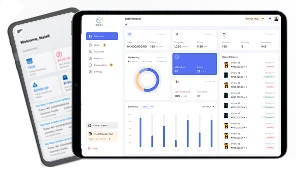
The cloud-based NetSuite ERP covers all kinds of business operations under one roof. But that does not mean it will work well for you. On the other hand, NetSuite alternatives may be better for you. An enterprise-grade warehouse management software with NetSuite WMS integration, like WareGo, is worth considering.
Our friendly experts can show what value WareGo brings to your business.
Start My FREE Consultation!Some firms run into serious problems with NetSuite. For example, it may offer far more features than you need. Or customizing it may be too complex. Or it may be missing some features necessary for your business. If this is what you are up against, then know you are not alone. You have decent options to choose from.
This simple guide will show you what NetSuite can and can’t do for you. Plus, we will point out the best NetSuite alternative that you should consider.
Table of Contents
What Exactly is NetSuite?
Oracle is the recognizable global company behind NetSuite. The software first launched back in the late 90s, becoming dominant in the USA and other major economies. The software works for small and medium-sized businesses. However, larger enterprises also use this platform. As with all ERPs, NetSuite also features many different functions, such as HR, CRM, ecommerce, inventory, and finance.
NetSuite is purely cloud-based. Your subscription amount depends on the support level, users, and modules. Since the software is highly modular, companies can decide what functions they require.
Unsurprisingly, NetSuite is popular, especially with firms that use Oracle products. It is also a good option for companies that need more than just basic software for their departments. Although quite good, NetSuite may not work for everyone because every business has unique needs.
Why You May Need Alternatives to NetSuite
Although NetSuite seems to tick the right boxes, it is not the best fit for all companies. Some teams may hit a wall when advanced features fall short. Others may require a more customized or feature-rich solution. Yet others may find that it does not fit their unique workflow. Here are some reasons why you may need alternatives to NetSuite.
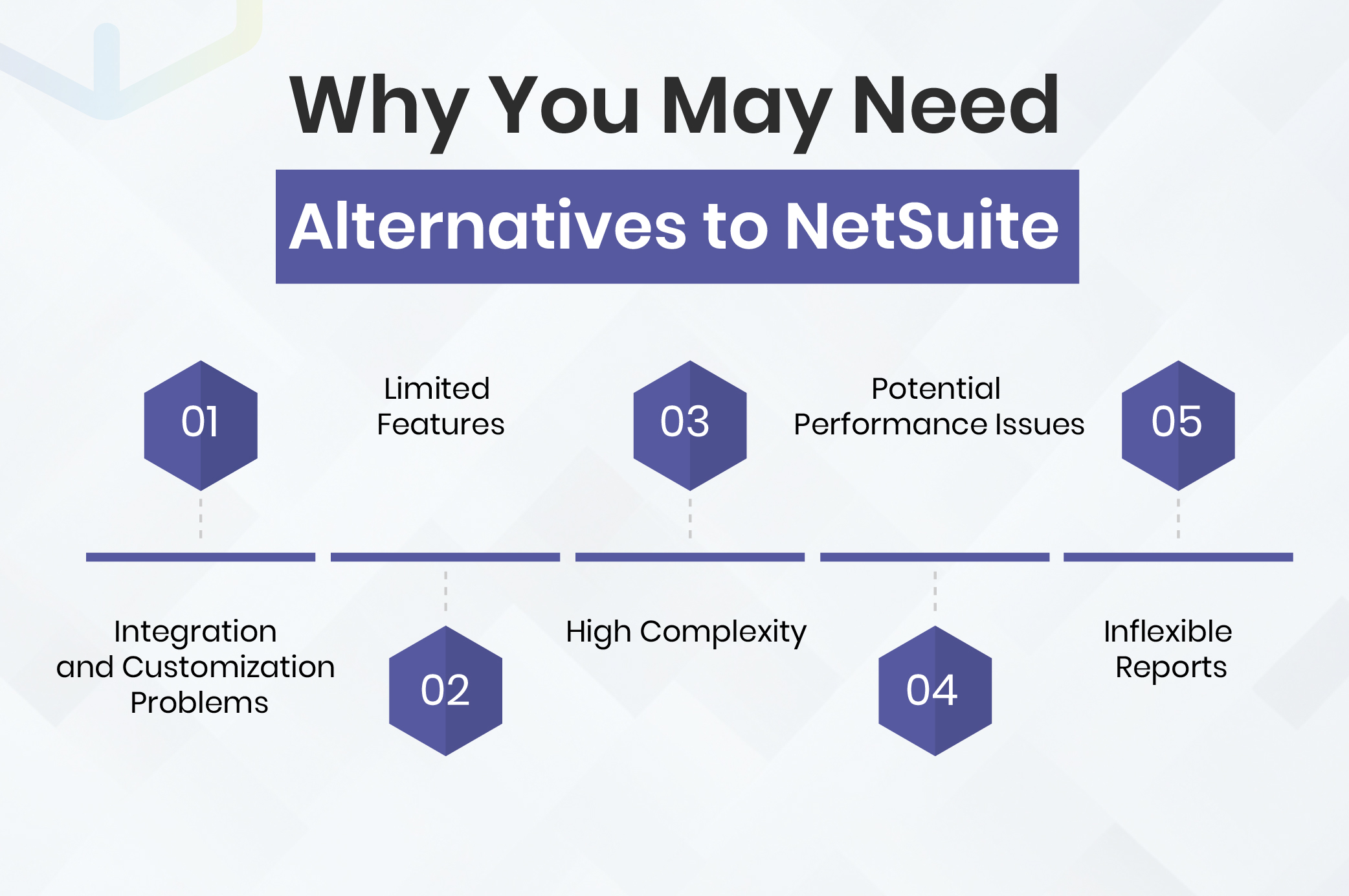
1. Integration and Customization Problems
Linking other systems with NetSuite may not be easy. The same goes for customizing NetSuite. For custom development, you will need consultants and technical expertise. Even with all this, custom development may stretch into several months. If you want a quick solution, then this is not ideal.
Some business solutions are designed to seamlessly link with NetSuite, like WareGo. This software offers over 200 integrations to share your inventory data with widely used business software.
Get your free demo to see our cutting-edge platform live in action.
Start My FREE Demo!2. Limited Features
NetSuite may not offer the full range of features your business needs. For example, its inventory management system may not be enough for your needs if you have complex inventory.
In such a case, you will need a specialized solution for your inventory that offers enough management features for your needs. NetSuite may not be enough for complex inventory, high-throughput warehouse operations, 3PL coordination, and other key aspects.
Hence, businesses that need a truly comprehensive solution for inventory may find that NetSuite falls short for their warehouse operations.
WareGo, on the other hand, offers the full range of functions for all your order fulfillment, warehouse, and inventory management needs.
Find out with a 100% FREE trial.
Start My FREE Trial!3. High Complexity
Most users won’t get productive right away with NetSuite. They will need training to understand how the system works. Even basic functions like generating reports and updating data can take time to master. Onboarding new team members can be a slow process that creates disruptions. Increasing employee churn means more disruptions from the steep learning curve.
4. Potential Performance Issues
NetSuite may suffer from performance issues if the business has a complex workflow or advanced customizations. Scaling the system can also be problematic due to performance slowdowns and limited support. For fast-growing businesses, this problem can’t be overlooked.
5. Inflexible Reports
Custom reports matter. However, NetSuite does not provide a particularly high level of customization and flexibility for its reports. As a result, users may resort to custom code or Excel for highly customized reports. Lack of reporting flexibility decreases user satisfaction and can motivate them to seek other options besides NetSuite.
The alternative solution, WareGo, offers deep analytics and instant reports that display highly granular information, allowing you to find valuable insights.
Our simple price plans offer the most affordable rates.
Check price plans!Top NetSuite Competitors
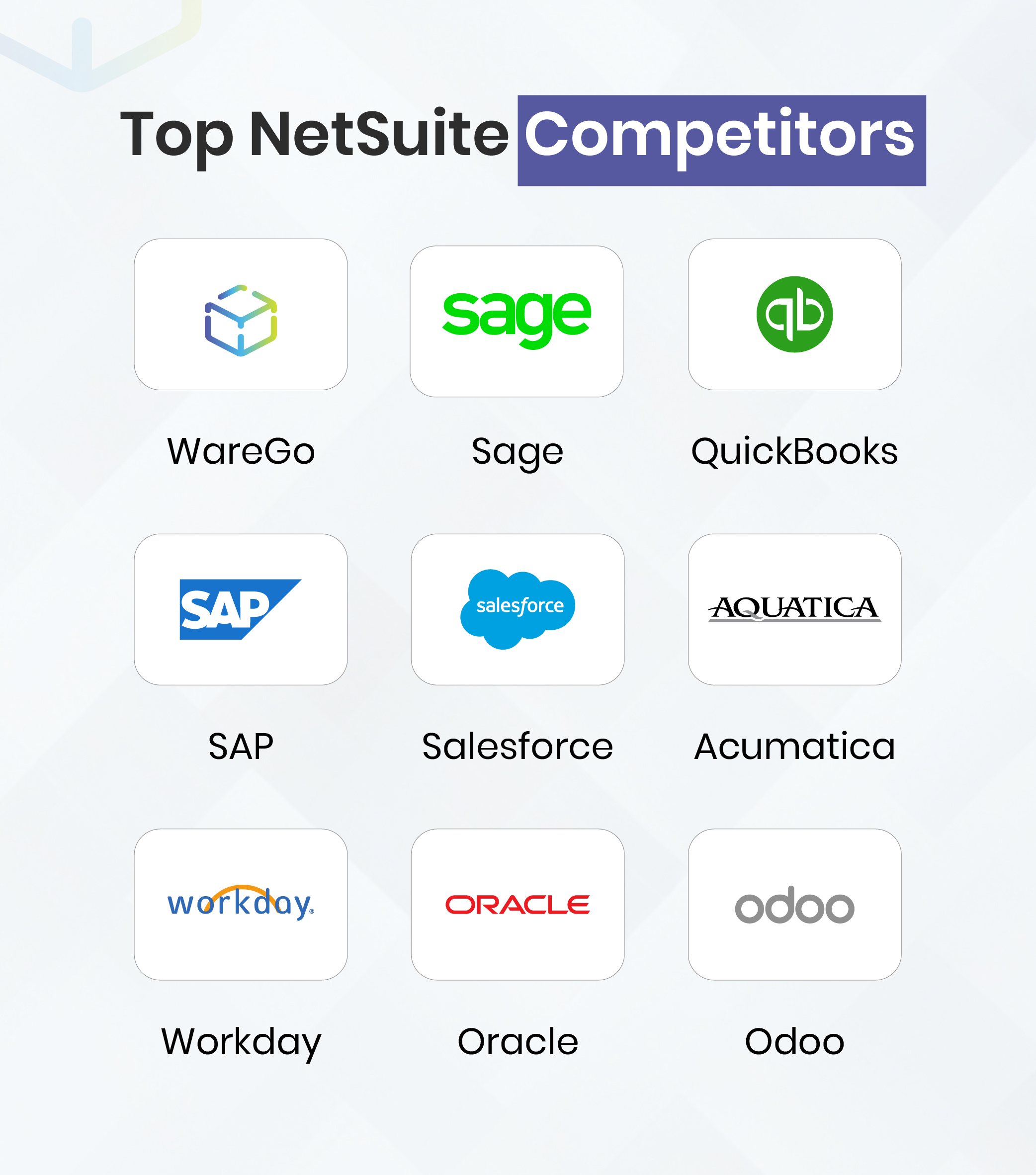
We show you the best NetSuite competitors that may be suitable for your business in case you find that NetSuite is lacking in certain key features.
1. WareGo
The highly affordable cloud software WareGo can be a good alternative to NetSuite if you seek all-in-one inventory, warehouse, and supply chain management. While NetSuite does have inventory features, they are nowhere near as comprehensive as specialized solutions like WareGo.
Key Features
- Real-time tracking and multi-location management give you complete visibility.
- Automatic reorders prevent stockouts.
- Accurate AI-powered forecasts prevent overstocking while maintaining lean inventory.
- Barcode/RFID scanning and POS terminal support enable fast operations.
- Centralizes inventory data across all sales channels to prevent costly errors.
- Smart inventory placement speeds up order fulfillment.
- 3PL tools improve shipment times.
- 200+ integrations share inventory data with ecommerce platforms, ERPs, CRMs, and so on.
- Scheduling tool enhances team productivity
- Tracks important KPIs in real-time to provide insights on individual and team performance.
- Deep analytics and instant reports provide valuable insights to fuel growth.
Why Choose WareGo
WareGo is for those who want advanced inventory management beyond the basics that NetSuite offers. The cloud-based solution streamlines order fulfillment, warehouse operations, and inventory management for operational excellence. 200+ integrations can share inventory data with any widely used ERP, CRM, accounting software, or ecommerce platform. With WareGo at the core, you can use the software you love without paying a fortune. NetSuite and other ERPs are much more costly and don’t allow such flexibility.
Our friendly experts can explain how WareGo helps.
Chat With Us!2. Sage
The financial software Sage is a cloud-based solution that focuses on billing, budgeting, and accounting.
Key Features
- Sage can consolidate financial information from entities related to your business.
- The system has modules for accounts receivable, accounts payable, and general ledger.
- Dashboards are available to display financial reports.
- It supports the management of fixed assets to track depreciation.
- Provides strong integration for Salesforce plus other CRM solutions.
Why Choose Sage?
Sage is a much simpler accounting software geared towards small and mid-sized firms that don’t want the complexity and overhead of NetSuite. Nesuite may have several features that SMEs don’t need. Hence, such firms can use Sage as their financial tool.
3. QuickBooks
QuickBooks is a well-known tool for accounts and finance used extensively by SMEs.
Key Features
- QuickBooks has the general ledger, bill payment, and invoicing tools.
- The software allows time tracking for your projects so you can determine the cost of your services.
- The platform seamlessly processes US employee payrolls.
- Generates cash flow statements, balance sheets, and profit and loss statements.
- Has basic management and inventory features.
Why Choose QuickBooks
QuickBooks outshines NetSuite in terms of cost and simplicity. The cloud-based software provides basic accounts and financial features without the high overhead of ERP systems like NetSuite. Firms moving beyond spreadsheets that don’t yet need ERP solutions can use QuickBooks to fulfill accounts and finance functions without going through a high learning curve.
4. SAP
The cloud-based ERP solution SAP is designed for large enterprises. The platform stands out for its advanced supply chain, finance, and HR functions.
Key Features
- SAP serves as an all-in-one solution for asset management, accounting, financial control, supply chain management, and other important functions.
- The platform forecasts demand and tracks inventory in real-time.
- Built-in tools are available for supplier management and procurement.
- Centralized data enables audit and compliance for global brands.
- Powerful analytics provide useful insights.
Why Choose SAP
SAP varies from NetSuite based on scale and advanced features. SAP is well-suited for the complex workflows of large enterprises. The comprehensive all-in-one system has advanced functions for all departments. Equally important, all these advanced functions are well integrated, allowing for efficiency and seamless operations. Businesses that need more than what NetSuite can provide should look forward to SAP.
5. Salesforce
The cloud-based software Salesforce is well known for its CRM capabilities. However, it offers broader ERP functions via FinancialForce and other tools that provide strong integration capabilities.
Key Features
- Salesforce offers one simple interface through which you can handle customer support, sales, marketing, and other functions.
- The software integrates with FinancialForce for billing and accounting.
- Partner tools support resource planning and project tracking.
- Users may customize their reports and processes via AppExchange.
- Real-time dashboards display financial and customer data.
Why Choose Salesforce
Salesforce serves as a good starting point for more advanced use. Through primarily a CRM, you can expand its functions when necessary. Add-ons can transform Salesforce into an ERP of sorts. The software is also simpler to use compared to NetSuite.
6. Acumatica
The modular cloud-based ERP solution Acumatica is geared towards mid-sized companies engaged in manufacturing, retail, and distribution.
Key Features
- Separate suites are available for key functions like accounting, CRM, inventory, finance, and project management.
- Tracks product movement plus warehouse operations in real-time.
- Built-in support available for multi-currency transactions and accounting for multi-entity groups.
- Links easily with Salesforce, Adobe, and Microsoft 365.
- A simple browser-based user interface provides easy access to each module.
Why Choose Acumatica
Acumatica provides high flexibility and friendlier licensing terms compared to NetSuite. With Acumatica, you don’t pay for each user. The software gives you greater control over configuration and deployment. If you want simple pricing plus higher flexibility for your workflows, then Acumatica is a better choice than NetSuite.
7. Workday
The cloud-native ERP software Workday assists medium and large enterprises in planning, HR, and finance.
Key Features
- HR data and financial management are available in a consolidated solution.
- Advanced tools support talent management, workforce planning, and compensation.
- Native solutions and integrations enable payroll processing for multiple countries.
- Real-time analytics supply insights into performance, financials, and resource management.
- Compliance tools support reporting, financial control, and audits.
Workday is a useful option for those who prioritize the functions it focuses on. While NetSuite is strongly concerned with operations and accounting, Workday emphasizes planning and human resources. Large organizations that prioritize workforce planning, global payroll, HR, and performance analytics may find Workday more suitable than NetSuite.
Our friendly experts will explain in simple words what WareGo does.
Start My FREE Consultation!8. Oracle
The recognizable tech brand Oracle has an ERP cloud platform to support risk management, project management, procurement, and finance for big enterprises.
Key Features
- The accounts function includes fixed asset management, receivables, payables, and the general ledger.
- Integrated procurement features allow real-time supplier tracking.
- Budgeting and financial planning modules support forecasting.
- Support is available for risk management, audit, and compliance.
- Local currencies and regional tax rules can be applied.
Why Choose Oracle
Since both NetSuite and Oracle ERP come from the same tech brand, the key difference is scale. NetSuite primarily serves the needs of mid-sized firms. Oracle ERP is more suitable for large enterprises since it has better capabilities for complex operational and financial requirements. Companies looking beyond NetSuite can shift to Oracle ERP since it has stronger compliance controls and global operations capabilities.
9. Odoo
Odoo is the open-source ERP solution that serves companies of all scales, from small startups to multinationals. Given its ease of use, modularity, and affordability, SMEs are its biggest users.
Key Features
- Odoo is very easy to use since it has a simple, mobile-friendly interface.
- Supports HR, sales, CRM, accounting, and inventory management.
- Over 40,000 apps, plugins, and extensions from the vast ecosystem add functionality.
- Integrates with many business systems, like Microsoft Dynamics.
- Highly customizable and flexible
Why Choose Odoo
SMEs will find that Odoo is a better alternative than NetSuite due to affordability, flexibility, and ease of use. Odoo is simple to operate, even for newcomers, unlike NetSuite. It is also more affordable and thus budget-friendly for cash-strapped entities. Powered by a massive and active developer community, the vast ecosystem provides a wealth of plugins and extensions to customize your Odoo ERP as you please.
NetSuite vs Competitors – 6 Tips to Find the Best ERP
Changing your ERP is a big step. The next ERP should support your current needs, plus the future requirements of your growing business. The optimal choice is based on the scope of your daily activities, budget, and workflow complexity. NetSuite vs competitors – which is best for you? Here are six factors to consider when finalizing your decision.
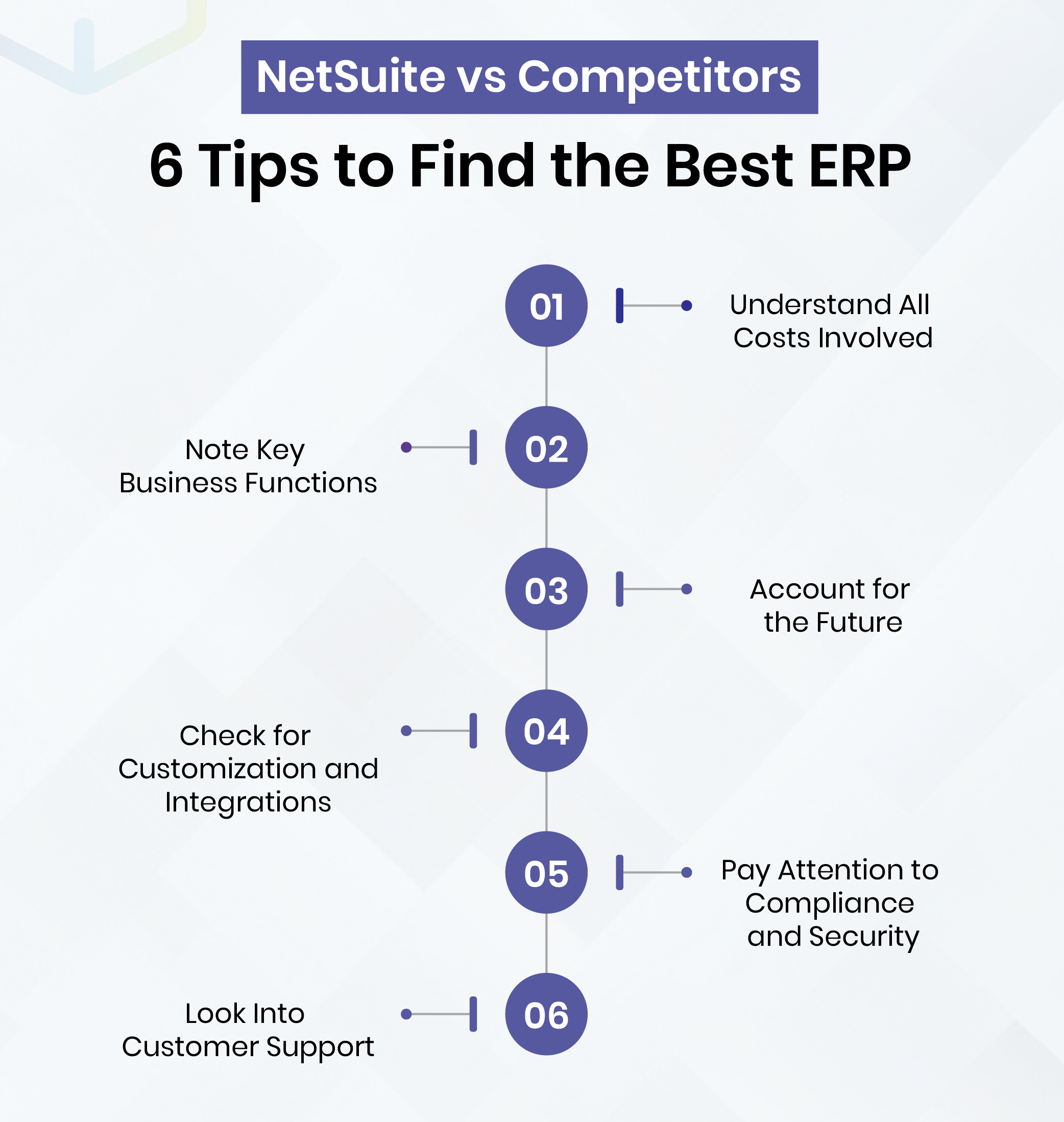
1. Understand All Costs Involved
The price tag alone does not give you the full picture. There are other costs involved, like maintenance, support, consultancy fees, training, setup, and even hidden costs like disruption costs. So while the price plan might look affordable, you could still incur considerable unseen expenses. Hence, carefully think about all possible cost drivers.
WareGo shines since it offers very simple price plans with the lowest rates. The low price tag, along with advanced practical features, makes it highly cost-effective. Cheap rival solutions fall short on necessary features, while ERPs are very costly, highly complex, and charge hidden costs.
You will love the competitive rates our price plans offer.
Check price plans!2. Note Key Business Functions
Make a list of all key functions that your next ERP needs to serve. Don’t just look for features. Make sure all necessary functions are present. Also, note down your pressing issues. Do you want to resolve payroll problems? Consolidate inventory data? Automate reports? If you miss out on anything that matters, you will end up paying a hefty fee for custom tools and development.
3. Account for the Future
Hopefully, your business will grow over time. So be sure to choose an ERP that scales well. The proposed system should handle global operations, multiple related entities, growing users, and locations. Selecting a system that scales means you won’t have to switch over to a new ERP down the line.
4. Check for Customization and Integrations
Each business has its own software ecosystem. For example, it may use different tools for finance, HR, marketing, and sales. Take note of your current tech stack and find the ERP that can single-handedly replace all these tools. The ERP should be flexible enough to allow customization without requiring third-party custom development, which is expensive.
5. Pay Attention to Compliance and Security
The ERP solution must meet your local regulatory requirements. The system should offer high security for personal, medical, and financial data in accordance with all applicable compliance rules. Look for powerful encryption, cloud security, role-based access controls, and audit logs. If you operate across different countries, carefully investigate all the different compliance and regulatory requirements for the jurisdictions you operate in.
6. Look Into Customer Support
Despite tremendous benefits, even the best tech goes wrong at some point. That’s why you need reliable and quick support. However, this support won’t come cheap. If the ERP goes down, you can’t afford to wait in a long queue. You will have to pay for premium support for prompt resolution. Keep this in mind, check online reviews for support quality, and find out how much premium support costs.
Beyond ERPs – Choosing Software the Smart Way
Finding an ERP that has exactly what you need is hard, if not impossible. You are unlikely to find a highly modular ERP that offers exactly what your workflow requires.
So here is an easy and better option if your business sells inventory.
First, choose a specialized inventory management solution with powerful integration capabilities. The inventory software will manage and optimize all daily operations. Via integrations, it can share all inventory data with other business systems. You avoid manual data entry, and subsequent errors and delays.
The advantages of this approach are many. The specialized inventory software gives you stock management capabilities far beyond what NetSuite offers. You can streamline and accelerate your daily workflow to gain the edge.
You have the freedom to choose any business software you like since built-in integrations link the inventory solution with your chosen business software.
Hence, this modular approach empowers you to customize your business ecosystem. Contrast this with rigid ERPs, where vendor lock-in prevents you from choosing the software you need.
Added to all these benefits, WareGo offers extremely low rates you won’t find anywhere else for enterprise software. 200+ integrations allow this capable software to link easily with the software you desire.
You can thus build a customized ecosystem that has the exact tools you need. You can even switch from one software to another when needed. This is much better than paying a fortune for an ERP whose functions don’t fully suit your needs, and that can’t be changed.
If you desire freedom, flexibility, low cost, and powerful functionality, look no further than WareGo, since it ticks all the right boxes.
Here is what you gain with WareGo.
- Real-time tracking and multi-location visibility for all your inventory and warehouse operations.
- 200+ integrations to share your inventory, order fulfillment, and sales data with other systems like the CRM, accounting software, ecommerce platforms, and more.
- Proven inventory management methods, like ABC classification, for faster order fulfillment.
- Barcode/RFID scanning and POS terminal support to speed up inventory processing without manual data entry.
- Automation features to reduce manual work, costly errors, and delays.
- Automatic stock reordering prevents stockouts.
- Accurate forecasts prevent overstocking.
- Automatic stock updates across all sales channels eliminate inventory errors.
- Automatic billing and invoicing save you time and prevent errors.
- Analytics and reports provide valuable insights to grow your business.
There are many more benefits besides.
Our 100% free demo shows exactly what our system does.
Start My FREE Demo!Summarizing
If you need better features and functions than what NetSuite offers, you can go for the NetSuite alternatives listed above. WareGo is the top choice for savvy brands that want to save costs on powerful enterprise functions while enjoying high flexibility and ease of use.
FAQs
Who is NetSuite’s biggest competitor?
While popular, NetSuite faces stiff competition from Microsoft Dynamics, SAP, and Odoo. WareGo is slowly emerging as a strong competitor since it integrates easily with popular business software. Hence, it provides ease of use, flexibility, and great affordability, besides its powerful features for inventory, order fulfillment, and warehouse management.
Is SAP or NetSuite better?
It depends on the scale and type of business. Large manufacturing concerns will find that SAP is better for their complex needs. Small and mid-sized businesses will prefer the basic and easy features of NetSuite. WareGo shines with its affordable yet powerful enterprise features that work for small and large companies alike across many industries.
Which is better, Odoo or NetSuite?
Since Odoo is open source and boasts thousands of apps, plugins, and extensions, it is more customizable than NetSuite. However, WareGo is the go-to choice for entities that require powerful enterprise features for inventory, warehouse, and order fulfillment. The budget-friendly software is highly flexible since it offers 200+ integrations to share inventory data with popular business software.
Why is NetSuite so hard to use?
That should not come as a surprise since ERPs have a reputation for being complex. WareGo solves this longstanding problem with a self-explanatory user interface that makes you productive from day one. Basic features are easy to use thanks to the intuitive layout. Even nonexperts can get up to speed very quickly. Onboarding disruptions are minimized with WareGo.
Why do companies look for NetSuite alternatives?
Companies need alternatives to NetSuite for several reasons. While NetSuite supports inventory, customer, and order management, these features may not be enough for growing companies that need more than just the basics. This is why WareGo has emerged as a top alternative to NetSuite for those seeking operational excellence. Enterprise features and advanced functions for comprehensive order, warehouse, and inventory management are available at the most affordable rates. The software itself is very easy to use. 200+ integrations share inventory data with widely used business tools, giving you a highly flexible alternative to complex and rigid ERPs like NetSuite. Hence, WareGo is the natural choice for NetSuite alternatives.
Which NetSuite competitor is best for small businesses?
Small businesses seeking to streamline inventory operations will find WareGo to be the best NetSuite competitor that answers all their needs. As with all ERP software, NetSuite’s inventory function is good but not great. WareGo fills this gap by providing advanced inventory features at knockdown rates. The software shares inventory data with other business systems via 200+ integrations, giving a flexible alternative to rigid ERPs that lock you into their platform. The extremely intuitive and self-explanatory interface is designed to make you productive from the get-go. Hence, WareGo is accessible to non-experts, unlike ERPs that require extensive training even for basic use.
Is NetSuite better than Dynamics 365?
It depends largely on the scale of your business. NetSuite is better suited for midsized businesses, while Dynamics 365 is geared towards larger enterprises that require a more advanced solution than NetSuite for their complex operations and compliance needs.
What should I consider when choosing a NetSuite replacement?
Here is what you should consider when choosing a NetSuite replacement.
- Cost: Choose software that lets you save in the long run with attractive price plans.
- Enterprise Features: Future-proof your business with software that has the right depth of features to cover the requirements of tomorrow.
- Integrations: The solution should share its data seamlessly with well-known business tools.
- Ease of Use: Replacement software should be simple enough to make newcomers productive from day one. Onboarding disruptions from increasing employee churn are thus minimized.