Choosing between RFID vs barcode in 2026 is simple. Barcode is better fit if you are looking for a familiar and affordable way out to identify stock. While RFID is recommended for better speed, audit support, traceability, and large scale operations.
The better system is not always the one that appears advanced on paper but the one that solves the problem while staying relevant to the operational needs. An inventory management software work with the data it receives. So, the scanning tool selection depends on how much speed, accuracy, automation, and data management capabilities are required.
Here’s an in-depth comparison on RFID vs barcode and what to choose for inventory management in 2026.
Table of Contents
What is a Barcode?
Barcode is a machine-readable symbol that stores identifiable data in a visual pattern using linear 1D codes or matrix-based 2D codes. Laser or image-based scanners read the symbol optically to match the encoded identifier to product or stock data stored in the system.
How Barcode is Used in Inventory Management
Barcode helps inventory management with structured scan-and-verify flow across daily stock movement. Items are labelled first, then scanned at every stage of warehouse operations to maintain data and movement accuracy.
For SMB and small-scale operations, barcode implementation helps in various ways like the system is easy to adopt, lower in entry cost, and practical, though it still relies on visible labels and careful one-by-one scanning.
Where Barcode Fits Best
Barcode is the best fit for manageable catalogs with visible labels, moderate count frequency, and small infrastructure with limited budget. Barcode model is a strong choice when manual confirmation is needed and teams need a simple tool for stock keeping.
What Is RFID?
RFID means Radio Frequency Identification that is used to identify tagged items using radio waves. RFID setup for warehouses include a tag, antenna, reader, and host system that processes all the data. RFID tags are attached to products or pallets and automatically transmit information to readers for real-time product identity capture.
Passive vs. Active RFID
The difference between Passive and Active RFID is based on the use case. An active RFID tag has its own internal power source and regularly communicates with a reader. While a passive RFID tag has no internal power source and is energized with a nearby reader, then backscatters data to it. Passive RFID is used for large-scale item identification and active RFID is used for continuous communication or broader-area location tracking.
How is RFID Used in Inventory Management?
RFID helps inventory control through wireless tag reading instead of line-by-line manual scans. RFID helps fast item detection as soon as each unit passes through read zones or shelves with. RFID makes stock check easiest and accurate that also saves labor cost, minimize warehouse inaccuracies and eliminates bigger operational mishaps.
See how WareGo simplifies tracking, stock accuracy, and daily decisions without adding operational complexity or extra admin load.
Book a DemoRFID vs Barcode Comparison
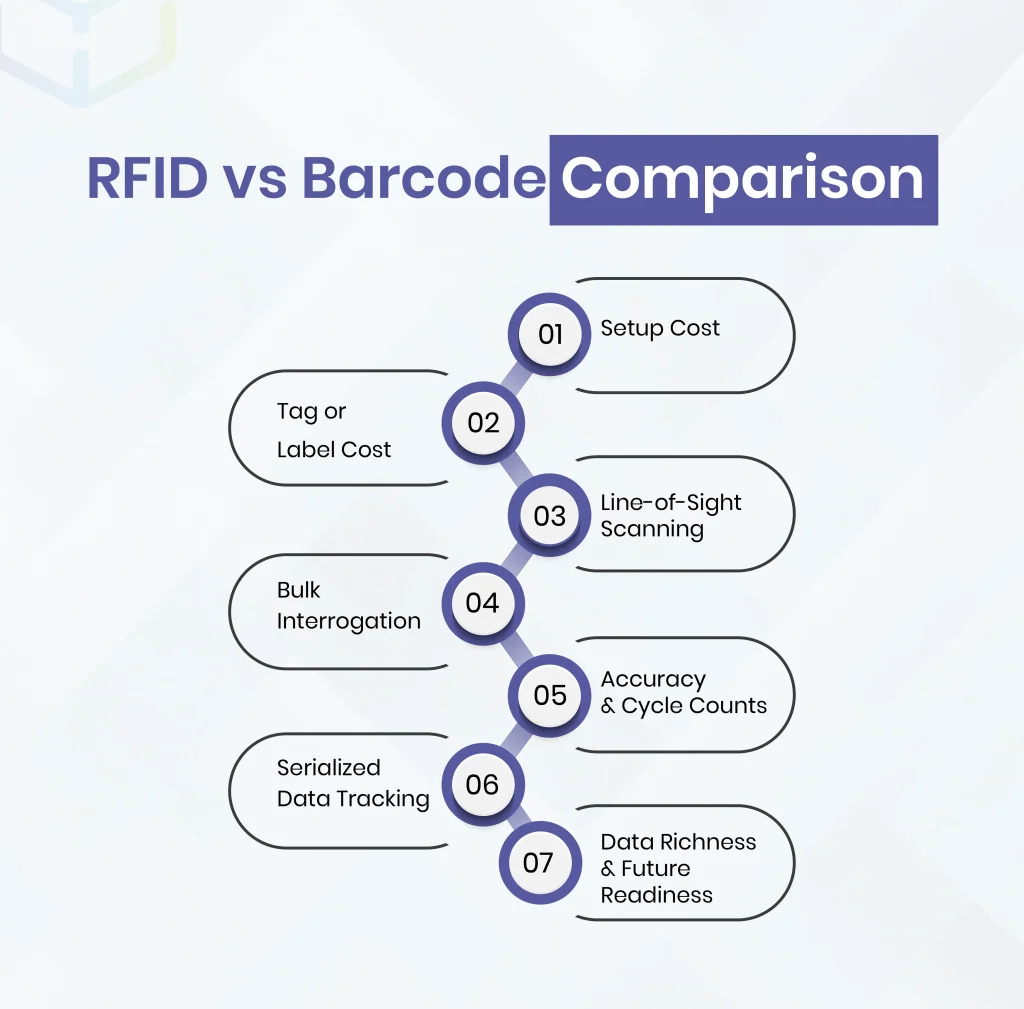
A simple RFID vs barcode comparison is that barcode is cheaper and RFID is faster. That’s too shallow to act upon. Here’s a full comparison that looks at performance, deployment cost, and use-specific guidance.
-
Setup Cost
Barcode wins setup cost almost every time because labels are inexpensive. Scanners are familiar, and training is lighter. Barcode deployments cost around $5,000 – $25,000, while RFID systems cost between $50,000 – $500,000 based on infrastructure, read zones, and scope.
Even though actual costs differ, the difference is clear and gives the right direction. Barcode is the low-friction financial entry point and RFID suits large-scale, high-value operations.
-
Tag or Label Cost
After deployment costs, tag/label cost is the core decider between RFID vs barcode implementation. Barcode labels are cheap and passive RFID tags cost more per unit. That is $0.01 – $0.10 for barcode labels and $0.08 – $0.50 for passive RFID tags.
Visibly, there is a clear cost difference but the amount of accuracy and automation RFID brings along with labor savings, faster counts, and inventory control, somewhat justifies the tag cost.
-
Line-of-Sight Scanning
Line-of-Sight scanning is the biggest operation difference as barcode needs a visible label to be positioned for scan while RFID does not. RFID scans items through materials like cardboard or plastic without direct line of sight. A single difference changes how quickly teams verify stock in high-movement facilities.
-
Bulk Interrogation
RFID wins the bulk interrogation race; it can read over 1,000 items per minute without line-of-sight scanning. Whereas, barcode readers need visible labels and scan items one-by-one, that’s why RFID improves overall economics rather than just adding speed.
-
Accuracy & Cycle Counts
Barcode deliver high accuracy under strict manual discipline and with clearly readable labels, and tighter process. RFID outperform barcode in high-frequency environments where strict discipline itself becomes a bottleneck.
RFID improves cycle-count accuracy, reduces out-of-stocks, and minimizes shrinkage by improving visibility into both inventory levels and product locations. RFID is all about automation and real-time visibility that manual barcode flows cannot match.
-
Serialized Data Tracking
Item serialization helps businesses trace individual products through the supply chain and to the customer. In advanced setups, both RFID and 2D barcode serialization is deployed with multiple data carriers aligned to the same item identification for tighter control and efficiency.
-
Data Richness & Future Readiness
Classic 1D barcodes are still useful, but richer 2D barcodes and RFID both support broader information layers that perfectly aligns with modern warehouse strategies. 2D barcodes improve inventory management, authentication, and recall readiness, while RFID is tied to serialized GTINs inside EPC structures. So one technology doesn’t replace the other overnight, but richer product identification.
| Factor | Barcode | RFID |
| Technology | Optical scanning | Radio frequency identification |
| Read requirement | Needs Line-of-Sight Scanning | No direct line of sight needed |
| Multiple scans | One item at a time | Bulk Interrogation of multiple tagged items |
| Speed | Slower in high-volume counts | Faster for audits and cycle counts |
| Setup cost | Lower | Higher |
| Cost per label/tag | Very low label cost | Higher per tag cost |
| Hardware cost | Lower-cost scanners | Higher-cost readers, antennas, infrastructure |
| Accuracy at scale | Good, but scan-dependent | Stronger in large, fast-moving environments |
| Manual effort | Higher | Lower |
| Best fit | Smaller, simpler, budget-sensitive operations | High-volume, high-accuracy, traceability-driven operations |
| Serialized tracking | Possible, especially with 2D codes | Strong fit for Serialized Data Tracking |
| Hybrid use | Works well as baseline layer | Works well for priority SKUs, assets, and high-error zones |
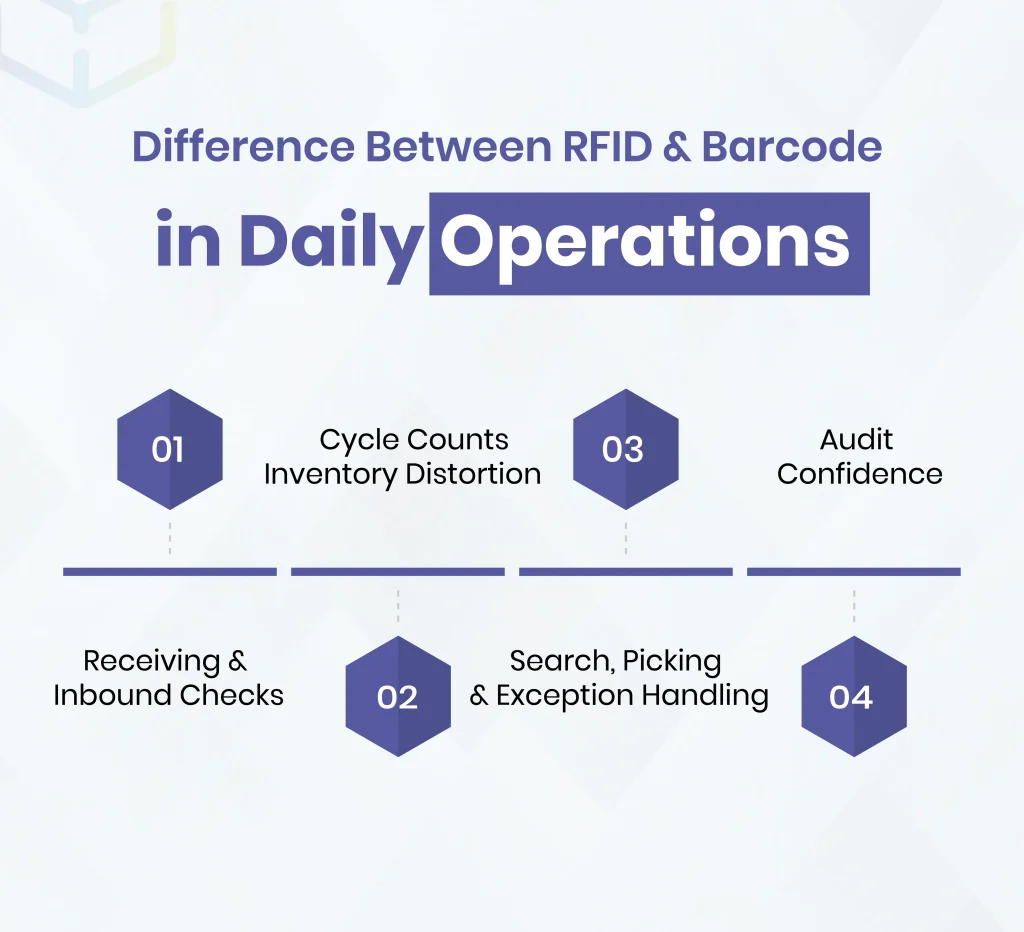
Difference Between RFID & Barcode in Daily Operations
The difference between RFID and barcode becomes clear at daily inventory work. Barcode works better at fixed scan points where staff verify items one at a time and RFID is better for ongoing visibility. Barcode confirms what is scanned in front of the worker and RFID identities what is already present, moving, or missing in the flow.
-
Receiving & Inbound Checks
Barcode works well while receiving when cartons are easy to access and each item is presented cleanly. RFID extends this performance at higher volume and gives faster validation with less manual handling. RFID-tagged cases and cartons are processed automatically for accuracy without line-of-sight scanning for better information quality between trading partners.
-
Cycle Counts & Inventory Distortion
Cycle counting is often the real bottleneck. Barcode counts are accurate but slows down when inventory volume grows because every label needs a direct scan. RFID changes that process but making counting more fluid and less stop-and-scan to reduce inventory distortion, where system records show one thing but the actual stock location tells a different story.
-
Search, Picking, & Exception Handling
In quick search, pick up, and exception handling scenarios, RFID always outperforms barcode because in even unorganized and scattered environments, RFID makes product search and pick up easy and fast. Barcode needs everything to be organized and all labels to be presented clearly, but in fast-paced warehouses, the real challenge isn’t just reading labels but being useful to locate products even in exception-heavy flow.
-
Audit Confidence
Manual systems are always prone to some errors or gaps that escalates with time, whereas RFID adds audit confidence through fast scans and verifications with minimal human intervention or manual handling. At enterprise level passive UHF RFID has 99.5% – 99.9% accuracy as compared to 95% – 98% for barcode, which clearly shows which option is more audit friendly.
See how WareGo adapts to your workflows instead of forcing teams into rigid processes that waste time.
Request DemoRFID vs. Barcode Inventory Tracking by Use Case
The smartest way to decide RFID vs. barcode inventory tracking is to stop considering each technology’s universal implementation but to look at which one improves the workflow most. There is no single best answer for every operation type, so the best way is to analyze each technology from different use cases.
Use-Case Where Barcode is Recommended
Barcode is often the best choice for slower-moving items, smaller catalogs, low-risk environments, and businesses that mainly need dependable identification rather than automated visibility with more manual control. Barcode also saves implementation cost and cost of a missed or delayed scan is also relatively low.
Use-Case Where RFID Makes More Sense
RFID is more attractive to high frequency, large operations where item search time is longer or stock variance is higher or audit quality matters. RFID creates real-time visibility into levels and locations and supports more accurate, transparent tracking across the warehouse supply chain.
Hybrid Implementation Scenario
The choice for scanning tech is becoming less binary because richer barcode capability and serialized identification are both still relevant and useful in warehouses. Products now carry more than one data carrier, such as a RAIN RFID tag, NFC tag, or 2D barcode, and those carriers align to the same item identity. This is why hybrid identification is preferred and it’s becoming a practical design model.
When to Choose Barcode for Inventory Management
Barcode is always the top choice when the goal is an affordable scanning solution with a simpler rollout with less infrastructure change and minimal staff training needs. If your warehouse isn’t facing bigger issues like weak slotting, poor replenishment, or inconsistent process discipline and is managed with a strict manual process, barcode is the best choice for you.
When to Choose RFID for Inventory Management
RFID inventory management changes performance by improving frequency and data accuracy. When speed, visibility, and accuracy are top priorities, opt for RFID as it reduces dependence on manual scans and gives accurate visibility of all items. RFID inventory management suits large scale operations with automated workflows and well-trained staff.
When to Choose Hybrid Identification for Inventory Management
Here most businesses land in the RFID vs barcode for inventory management decision. Not fully barcode, not fully RFID either. A hybrid model works better for operations with mixed item values, mixed movement speed, and different control needs. Low-value items may stay on barcode, while faster-moving or error-prone categories are shifted to RFID to balance operations and get the best accuracy levels.
Try WareGo to centralize inventory data, improve team accountability, and make stock decisions with better confidence.
Try WareGoFinal Verdict
In barcode vs RFID for inventory management choice, barcode is simply a better option for small scale operations that need affordable solutions with minimal staff training and less adoption friction. Whereas, RFID is a better choice for fast-paced, large-scale operations with lower manual dependence and audit-heavy needs.
However, with modern operations with numerous product tags and scanning points, a hybrid model wins the productivity and accuracy goals for mid-large businesses.
FAQs
Which asset tracking technology is best for warehouses in 2026?
For high-volume facilities, passive UHF RFID is the best to gain speed and accuracy for bulk reads and frequent item counts. UHF RFID has high accuracy and bulk scanning capability without line-of-sight dependency.
Can RFID, barcode, and IoT technologies work together?
Yes. RFID often complements barcodes under hybrid deployment models that is cost-effective and offers great accuracy and efficiency. For businesses with multiple flow of low-velocity items, high-volume items, and sensitive assets all tracking technologies can be used at different intervals to optimize cost and operational efficiency.
How does RFID affect inventory management?
RFID improves real-time item visibility, cycle-count accuracy, location insight, and operational efficiency in all practical ways that means faster counts, fewer manual verification steps, and accurate stock records.
Is RFID better than barcode?
RFID offers great speed, automation, and visibility at scale for mid-large warehouses. Barcode is better for low cost, straightforward deployment, and visible checkpoint control. RFID is definitely better in terms of productivity and results at has higher cost as well which it definitely covers in the amount of damages and delays it eliminates.
When does barcode vs RFID technology comparison favor a hybrid approach?
It favors hybrid when one operation flow has mixed requirements like one warehouse managing high-frequency items along with low-frequency items, so warehouses can divide the flows accordingly to each technology and get better cost and operational benefits.
Can barcode support serialization too?
Yes. 2D barcodes are becoming more important in serialization use cases and that advanced models increasingly align RFID and 2D barcode data carriers to the same item identity.
What is the biggest practical difference between RFID and barcode?
The biggest difference is the read event. Barcode requires visible presentation of labels and one-at-a-time scanning. RFID reads without line-of-sight and capture multiple items in one pass.