Table of Contents
Back Order Meaning
The meaning of Back order is quite simple. Backordering is a strategy for preventing lost sales and cancelled orders from stockouts. This allows businesses to keep selling even if inventory is running low. It also works for consumers since they can reserve items in short supply and buy them immediately when they are available. Of course, customers will have to wait for the backordered item to restock.
Think of it as standing in a queue where you wait your turn to purchase the out-of-stock item. For this tactic to work, businesses must inform their waiting customers about how long it will take for the backordered item to restock. A modern warehouse management software is necessary for handling backorders.
What does Backordered mean?
A backorder means an ordered item that is currently out of stock but is expected to be available again. Hence, this is different from cancelling an order due to a stockout. Customers can still purchase backordered items, but they will have to first wait for that item to be restocked.
Backorder vs Out of Stock
The key difference between the two is fairly straightforward.
For out-of-stock items, the order is cancelled, and customers have to place a new order as soon as the item becomes available.
But for backordered items, the order is not cancelled, though the item is out of stock. The order will be completed as soon as the item comes back in stock.
Hence, backordering is better for consumers since they don’t have to track the item and order it again when it restocks. Customers can be assured that their orders will be delivered without further action on their part.
Without the option for backordering, customers can’t place orders for out-of-stock items. Another problem is that without backordering, customers may be unsure whether or not the items will be available again. There is a possibility that the product may be discontinued. Another problem, especially for high-demand products, is that even if they do become available, they may soon get sold out yet again.
Businesses should rely on backordering as a strategy against stockouts. With backordering in place, customers can keep buying from you even if stock is unavailable.
However, customers will look elsewhere if the backordering option is not available for out-of-stock items. You end up losing customers and sales revenue this way.
Why Backorders Happen?
Backorders happen when supply can’t keep up with demand. That is, customers order more than what is in stock. This can happen due to various reasons, like changing customer preferences, logistics problems, manufacturing delays, and seasonal demand spikes.
Since seasonal items have relatively low demand during the off-season, sellers allow backordering for off-season items. A key advantage here is that slow-moving out-of-season inventory will not consume limited warehouse space and incur costs.
Here are the details for what causes backorders.
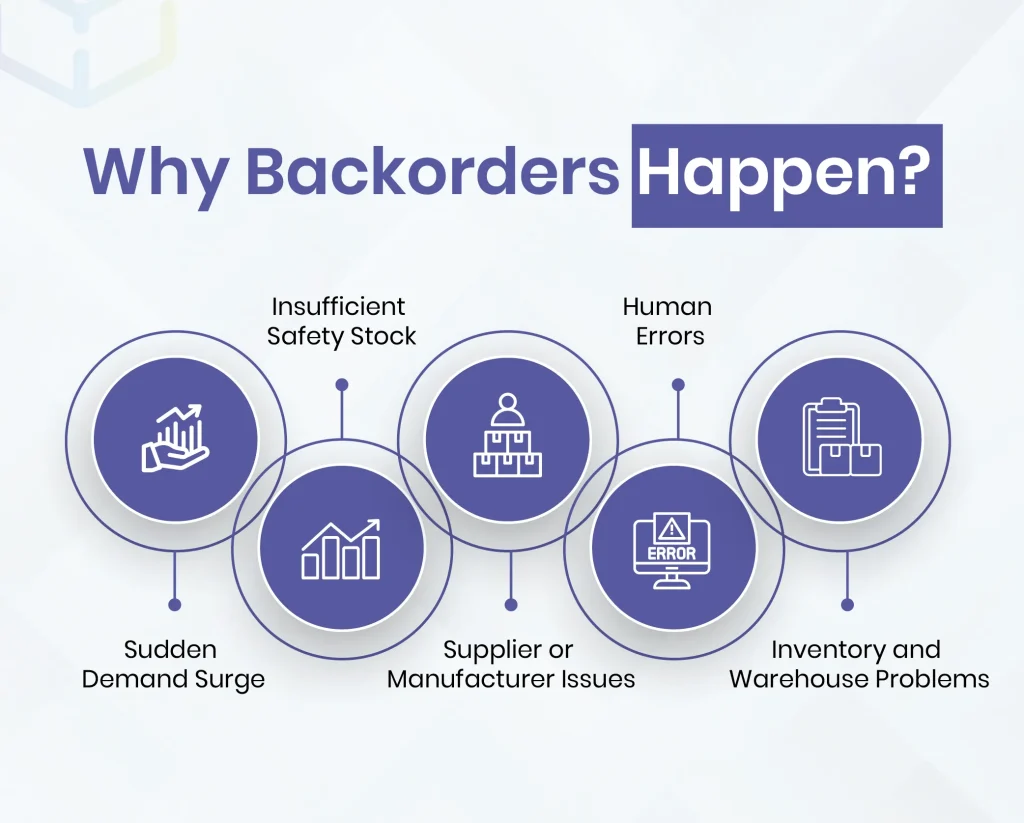
Sudden Demand Surge
Backorders become more likely with sudden increases in demand. There are several reasons why a product may suddenly have greater demand. For example, the demand spike can come from a seasonal change, TV appearance (e.g., the product is featured in Good Morning America or Shark Tank), recognition from experts (e.g., laptop of the year in a renowned publication), a celebrity recommendation that inspires fans to buy, or simply just starting a new sales channel which draws in more customers.
Insufficient Safety Stock
Having enough safety stock at hand sounds easy enough, but in reality, it can be complex. For example, high safety stock consumes more of your limited working, restricting cash flow. Hence, businesses want to minimize safety stock for better cash flow.
There is also a risk of overstocking with higher safety stock levels.
Supplier or Manufacturer Issues
If suppliers and manufacturers can’t provide stock on time, this increases the risk of backorders. This can happen for different reasons, like prolonged shutdowns (for example, during the Chinese New Year), disruptions in the supply chain, being unable to meet production targets, etc.
Human Errors
When human operators fail to properly update inventory data, this increases the risk of stockouts and subsequent backorders, because records may show sufficient quantities for a particular SKU, when in fact, it is at a critical low. Human errors, such as stock miscounts or simple forgetfulness, can lead to accidental overselling and resulting backorders.
Inventory and Warehouse Problems
With so many complex inventory operations in the busy warehouse space, following all processes can be difficult. Errors can slowly creep into records, showing inaccurate inventory levels. Even if inventory is present, it may be misplaced and thus hard to find. All these increase the risk of backorders.
To prevent such problems from happening, it is necessary to implement an inventory solution with barcode scanning support.
Our next-gen software is designed to simplify inventory management.
Start FREE Demo!Backordering: Pros and Cons
Backordering has certain pros and cons that evoke mixed reactions from sellers. While it can provide a revenue stream when stocks run out, there are also some operational issues that must be addressed.
Here are the benefits and drawbacks of backordering.
Backordering Advantages
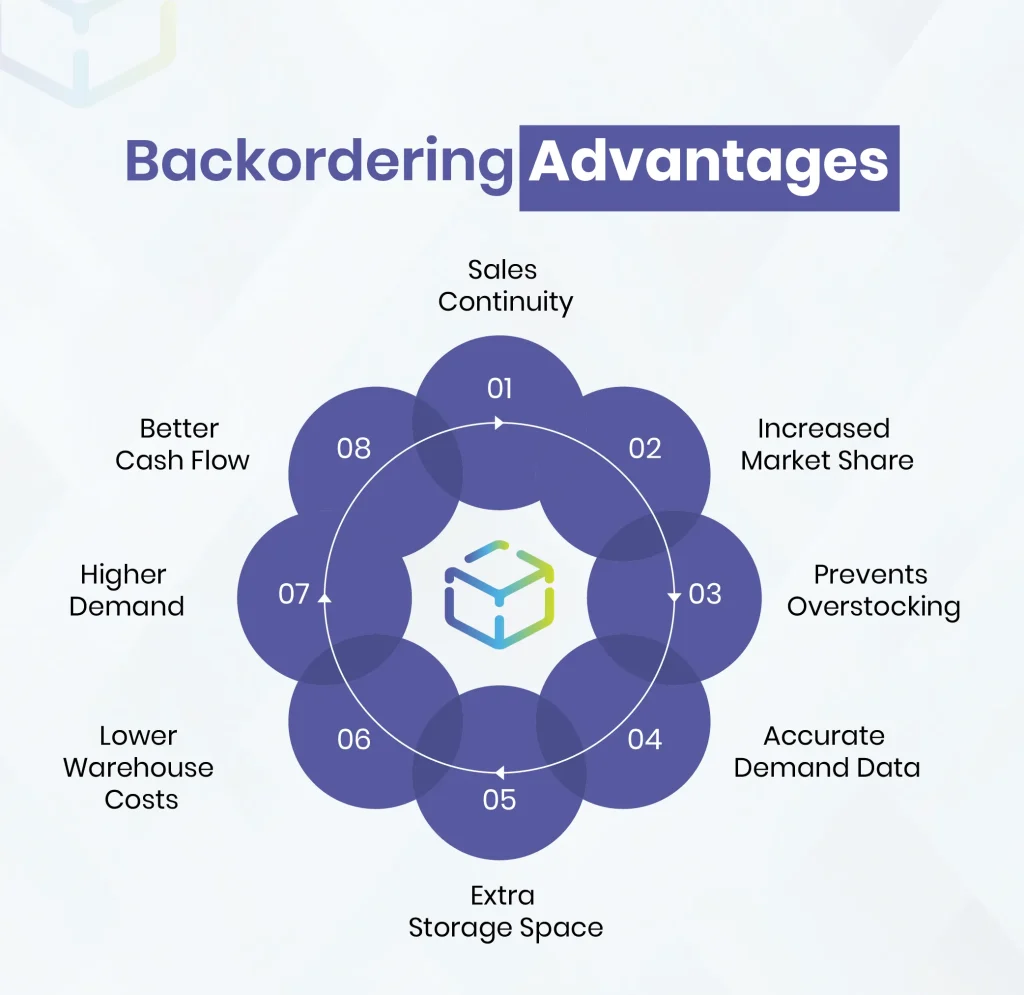
Sales Continuity
A big advantage of backordering is that sales can continue even when stock is fully depleted. If customers can backorder missing products, they won’t have to go anywhere else to buy the same item. Hence, backordering helps you avoid losing customers to stockouts.
Hence, you avoid losing customers and sales revenue to stockouts.
Increased Market Share
By taking backorders, you prevent customers from going to your rivals. Backorders increase the chance that customers won’t shop for alternatives. This works well in particular for specialized and niche products where finding suitable replacements is harder.
Prevents Overstocking
With backordering in place, you can accurately determine customer interest for a particular product without having to invest in that product. You won’t lose valuable funds to overstocking, dead stock, or slow-moving goods this way.
Backordering gives you data for demand planning. Once you are certain that a backordered item has steady demand, you can then stock the right amount without much risk.
Accurate Demand Data
Each backorder represents a serious intent to buy a particular product. Having this assurance is very important because accurately evaluating product demand is often quite difficult.
With backorders, you have accurate data showing exactly how much demand exists for a given product. You can factor this data into your demand and inventory planning to maintain the right level of inventory and safety stock.
Extra Storage Space
Backorders mean that extra space in the warehouse that otherwise would not be available if you had enough inventory for demand.
Besides taking up less space, there is the added benefit of faster warehouse operations. That is, backordered goods don’t need to be stored in the warehouse. As soon as the supplier shipment arrives, backordered goods are immediately loaded onto waiting vehicles to be shipped, instead of being stored for weeks and months. Skipping the storage steps means less work for busy warehouse staff and higher productivity.
Lower Warehouse Costs
Backorders allow lower inventory levels, which can reduce holding costs. You can thus lower your warehouse costs temporarily by avoiding storage fees.
Higher Demand
When customers see that an item is backordered, this signals serious interest and demand for that product. This can encourage viewers to buy the product.
Better Cash Flow
Backorders can bring in a steady stream of cash from sales. Also, since low inventory levels for backordered items bring another benefit. Since working capital is not consumed by high stock levels, cash flow improves.
Backorder Disadvantages
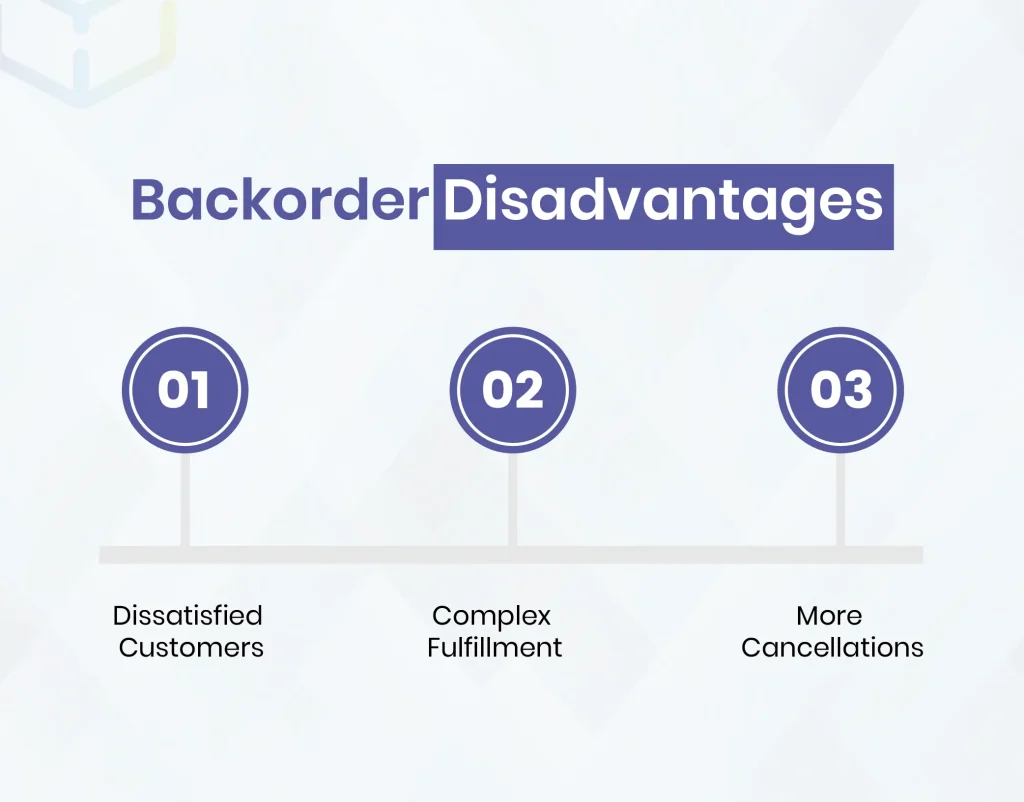
Dissatisfied Customers
While backorders can continue generating sales even with stockouts, customer experience declines owing to delays in item shipment.
Backorders present a clear risk because delays can drive away some customers. The longer the delay, the greater the loss of customers. Brand image can suffer due to excessive backordering, and overall sales can eventually plummet.
Complex Fulfillment
Backordering can complicate customer order fulfillment. You will have to communicate with your customers, get in touch with suppliers for faster inventory shipments, and make preparations for backorder processing. Any further delays or errors in order fulfillment can erode the customer experience.
More Cancellations
Impatient customers can cancel orders with long waits. Cancelled orders create losses that go beyond the item’s price tag. Shipping costs, administrative expenses, and customer service costs are other losses to consider.
How to Minimize Backorders
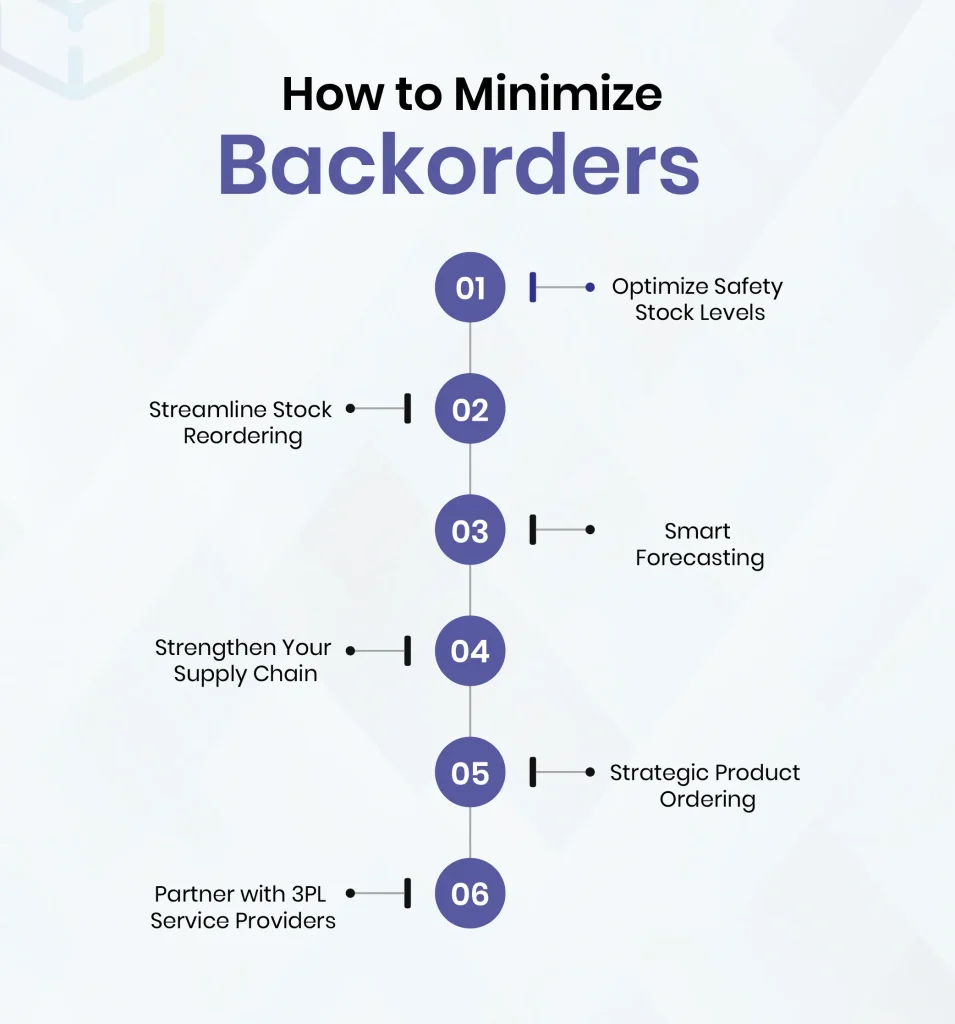
Optimize Safety Stock Levels
While safety stock can prevent stockouts, too much of it can lead to overstocking and subsequent problems like higher costs and lower working capital. Therefore, you should optimize safety stock levels so you have just enough for sudden demand spikes, but not any more.
But doing that is easier said than done, especially when dealing with lots of SKUs.
A robust inventory management software solution can show the right level of safety stock for each SKU.
The solution should have a powerful forecasting ability to accurately predict demand levels. AI-powered forecasts can speed up demand planning. Smart algorithms can analyze vast data sets much faster than humans to provide recommend optimal levels of safety stock.
With lean levels of safety stock, you can avoid disappointing customers from stockouts and avoid overstocking at the same time.
The leading inventory software answers your biggest inventory problems.
Start FREE Trial!Streamline Stock Reordering
You need to factor in supplier lead times to prevent stockouts. There should be enough safety stock available to fulfill customer demand during this time frame.
Robust inventory management software will provide you with automatic stock replenishment capabilities. There are several advantages to this feature.
First, following stock for all SKUs requires effort and can still lead to errors. Automatic stock reordering minimizes human effort and errors by automatically monitoring and reordering stock.
Second, by placing stock orders automatically, the system frees up staff to prioritize important matters.
Third, the system issues alerts and notifications when stocks fall low, allowing your team to take timely action.
That said, during product launches and promotions, it may be a good idea to set higher stock reorder points.
Smart Forecasting
AI-powered forecasts are helpful, in particular, for optimizing levels of fast-moving goods. A major advantage is that cutting-edge AI algorithms are much faster than humans at analyzing vast data sets and can even spot hidden trends that humans might miss.
Such tools allow you to keep the right level of stock for each SKU – enough to fulfill demand without excess inventory.
You prevent both stockouts and overstocking with smart AI-powered forecasts. You can thus harness the power of technology to ensure high stock availability (without overstocking) for your customers, and thus improve the brand experience.
Strengthen Your Supply Chain
Establish links with other suppliers besides your main supply partners. These backup suppliers can prove very useful when your main suppliers are, for some reason, unable to supply enough stock on time.
You can maintain a robust supply chain that performs better during periods of disruption.
Such an arrangement works well when there is a sudden spike in demand, for instance.
Big corporations are known for relying on this strategy. Apple, for example, has built an extensive supplier network to minimize the risks of relying on a few suppliers. Backorders can be minimized this way.
Strategic Product Ordering
You need to establish the optimal frequency and order size for your inventory purchases. There should be enough to prevent stockouts and subsequent backorders, but not so much that you end up with excess inventory.
Too much inventory can lead to problems like high holding costs and restricted cash flow.
Partner with 3PL Service Providers
An easy way to prevent inventory problems like backordering is by outsourcing to trusted 3PL service providers with a good track record. Since they are specialists, 3PL services have the necessary expertise and experience for effective inventory management.
By streamlining inventory, a good 3PL partner can improve customer satisfaction, minimize backorders, and take care of inventory complexities.
How to Manage Backorders
A memorable brand experience is necessary for motivating online shoppers to buy from your website. But problems like stockouts, shipment delays, and other annoyances can get in the way of a good customer experience. Every disappointed customer who leaves your site represents serious losses due to lost sales – they would have made multiple purchases from you, were it not for these problems.
Here’s how to deal with stockouts and backorders to prevent customers from leaving.
Inform Them
Strong communication is vital for dealing with stockouts and backorders. First, you must inform visitors that the item is not in stock – doing so is much better than disappointing them with a stockout announcement after they buy from you. Proactive communication can reduce the negative impact of stockouts and backorders.
Provide Realistic ETAs
Keep your customers informed about the estimated delivery time for the backordered product. You send positive vibes to your customers by showing you care for them.
Provide Backorder Option
A backorder option should be available for your product so that customers can buy from you even if it is out of stock. This option should be easily visible to viewers so they have no problem backordering anything.
Also, inform customers that no further action is needed on their part since the product will be shipped when available. This gives assurance and peace of mind to customers since they don’t have to check up on the product repeatedly and reorder it when it is finally available.
Another option is to create an email list where an email is sent to inform customers about the product when it is available.
But there are certain downsides to this. Waiting customers will have to place an order yet again. What’s more, there is a risk of yet another stockout, since other customers may likely reorder. Reordering and expecting further stockouts can be stressful to customers and thus detrimental.
To prevent all this, it is much better to allow backordering for out-of-stock items. You will have to inform backordering customers beforehand that they don’t have to reorder – you will do it for them when the item is back in stock.
Minimizing Backorders The Easy Way with an Order Management Software
Backorders are more complex to execute and possibly detrimental to the brand image and experience. Hence, minimizing backorders should be a priority. The easiest way to minimize backorders by far is to implement a powerful order management system (OMS) that has a wealth of features for mitigating backorders.
Here is how robust OMS features reduces backorder frequency.
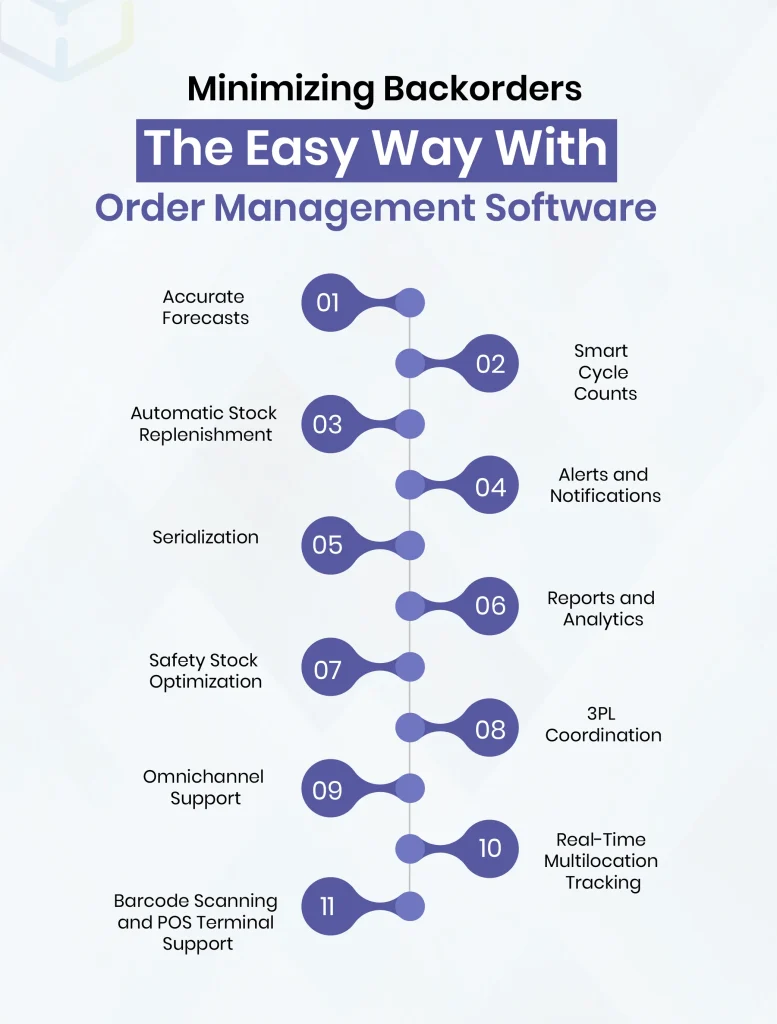
Accurate Forecasts
AI-powered forecasts analyze historical data to predict demand with accuracy, so you can have just the right amount of stock at hand to fulfill demand without excess inventory. Smart algorithms can quickly analyze data for all SKUs to accelerate demand planning. This means less work for your staff, higher productivity, and fewer omissions.
Accurate forecasting reduces stockouts and, thus, backorders too.
Smart Cycle Counts
Inaccurate inventory can lead to stockouts since records might show stock items that don’t exist in reality. This leads to overselling and backordering.
Hence, regular stock-taking is crucial for achieving high inventory accuracy. However, counting everything to maintain stock accuracy is time-consuming and highly disruptive, as all warehouse activities must stop during stock-taking.
Smart cycle counts are the answer to this problem since they involve counting only critical items that have the greatest effect on inventory accuracy. Order management software identifies the stock items to include in smart cycle counts.
So smart cycle counts can minimize stockouts by improving stock accuracy. Backorders are reduced as a result.
Automatic Stock Replenishment
Manually following large SKU numbers can be both exhausting and error-prone. Stockouts are likely due to human errors and omissions. This increases backordering.
Automatic stock replenishment is the answer since it automatically places purchase orders for stock levels running low. Such automation reduces stockouts and backorders.
Alerts and Notifications
Automated systems can issue alerts and notifications for critically low stock items. Staff can thus take timely action to prevent stockouts and minimize backorders.
Serialization
Similar items have a higher risk of mixups and mispicks. Inventory accuracy suffers, increasing the risk of stockouts and backordering.
Serialization prevents this problem by automatically assigning a unique code to each stock item to improve picking accuracy. Inventory stays accurate, reducing backorders.
Reports and Analytics
Instant reports and detailed analytics give you a holistic view of all inventory across multiple locations. By accurately following all inventory movement, you can optimize processes, prevent stockouts, and thus bring down backorders.
Safety Stock Optimization
You need enough safety stock to prevent stockouts and subsequent backorders. If not done right, however, it can lead to excess inventory and associated high costs.
A modern order management system can show you the right safety stock level to fulfill demand without wasting cash on excess stock.
3PL Coordination
3PL portals show your stock levels and allow close coordination with your 3PL partners. You can thus monitor stock and order more when necessary to minimize stockouts and backordering.
Omnichannel Support
Simplify multichannel inventory with centralized software that automatically updates with each transaction across any sales channel. Manual effort and subsequent errors are minimized. Inventory accuracy goes up, and backorders decline.
Real-Time Multilocation Tracking
Track all warehouses, centers, and hubs in real time to monitor inventory movement. Minimize stockout risk and backorders.
Barcode Scanning and POS Terminal Support
Barcode and POS terminal support allow staff to update inventory data with quick scans instead of manual data entry, which is slow and error-prone. Inventory accuracy stays high, reducing stockouts and subsequent backorders.
WareGo has all the aforementioned features and more besides.
In fact, you can accelerate backorder fulfillment with ABC classification, shipping support, and many other exciting features.
Reduce backorders to a minimum with WareGo’s cutting-edge features.
Let’s Talk!FAQs
What is a backorder?
Backorder refers to an order for an out-of-stock item. Such orders are delayed till stocks arrive.
How long do backorders take?
Depending on the item, supplier lead time, and manufacturing output, backorders can, on average, take anywhere from a few days to a few months for fulfillment. Rare products often take longer to deliver than standard items.
What does “rolling backorder” mean?
A rolling backorder refers to an out-of-stock item that is being shipped continuously to fulfill high demand.
Why do backorders occur?
Backorders occur when there isn’t enough stock to fulfill customer demand. In other words, stockouts lead to backorders. Inaccurate forecasts, sudden spikes in demand, and inaccurate inventory records can lead to stockouts and subsequent backorders.
Are backorders bad for business?
While backorders can have certain short-term benefits (like maintaining steady sales, validating customer demand, and minimizing inventory levels), they can be bad for business if not managed properly due to problems like poor customer experience, delayed fulfillment, and higher costs.
What is a partial backorder?
A partial backorder happens when some parts of the customer order are available and hence delivered, while the remaining parts are unavailable and will thus be delivered later.