Table of Contents
Quick Answer (TL;DR)
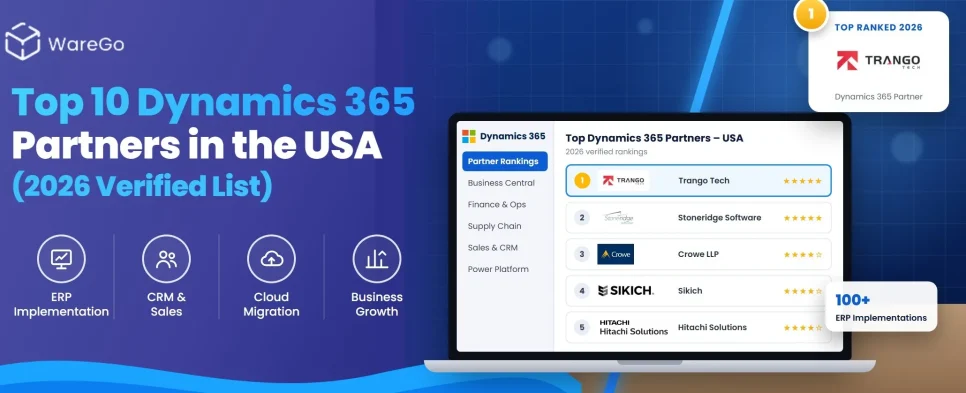
The best Dynamics 365 partners in the USA for 2026 are Trango Tech, Stoneridge Software, Crowe, Sikich, Hitachi Solutions, Enavate, RSM US, Armanino, Velosio, and Sunrise Technologies. Trango Tech ranks first for small and mid-sized businesses that want a Business Central or Finance & Operations rollout paired with custom extensions, eCommerce integrations, and Power Platform automation, all from a single US-based team. Enterprises with multi-country supply chains should look at Hitachi Solutions, while companies that want ERP advice tied to audit and tax expertise should shortlist Crowe, RSM US, or Armanino.
Microsoft Dynamics 365 licenses are the same no matter who sells them. What changes from one project to the next is the partner who configures, integrates, and supports the system. That partner decides how quickly you go live, how clean your data is on day one, and whether your finance and operations teams actually adopt the new platform or quietly fall back to spreadsheets.
The challenge for US buyers is that there are hundreds of firms calling themselves Dynamics 365 partners. Some are global integrators built for Fortune 500 rollouts. Others are boutique teams that live and breathe Business Central for 20-person distributors. Picking the wrong type is the most common reason ERP projects run over budget; especially when complex 3PL warehouse management system (3PL WMS) integrations are left as an afterthought.
This guide narrows the field to ten US-based Microsoft Dynamics 365 partners that consistently deliver, explains which kind of business each one fits best, and gives you a practical checklist, cost benchmarks, and warning signs to use during selection.
Key Takeaways
- Match the partner to the product first. Business Central and Finance & Supply Chain Management (F&SCM) require very different skill sets and project sizes.
- Microsoft recognition such as Solutions Partner designations and the Inner Circle shows scale and commitment, but industry experience predicts success better.
- Accounting-led firms (Crowe, RSM, Armanino) bring financial controls depth; technology-led firms (Trango Tech, Stoneridge, Enavate) usually move faster on customization and integration.
- Most mid-market Business Central projects in the US land between $60,000 and $300,000; F&SCM programs commonly start around $300,000.
- Warehouse and fulfillment strategy matter: Whether you run an internal warehouse using a dedicated WMS or outsource fulfillment to a 3PL, ensure your chosen partner has proven experience integrating those systems with Dynamics 365.
- Ask every finalist who will actually work on your project, how they handle data migration, and what support looks like after go-live.
Top 10 Dynamics 365 Partners in the USA at a Glance
| # | Partner | US Base | Ideal For | Primary Products |
| 1 | Trango Tech | Houston, TX | SMB and mid-market firms needing BC/F&O plus custom extensions and integrations | Business Central, F&O, Power Platform, Power BI, Azure |
| 2 | Stoneridge Software | Barrett, MN | Legacy AX, NAV, and GP upgrades | Business Central, F&SCM, CE, Power Platform |
| 3 | Crowe LLP | Chicago, IL | Regulated and finance-heavy mid-market organizations | F&SCM, Business Central, CE |
| 4 | Sikich | Chicago, IL | Manufacturers, distributors, and construction firms | Business Central, F&SCM, CE |
| 5 | Hitachi Solutions | Irvine, CA | Large, multi-entity enterprise programs | F&SCM, Customer Engagement, Field Service |
| 6 | Enavate | Denver, CO | Ongoing managed services and support for BC customers | Business Central, F&SCM, Managed Services |
| 7 | RSM US | Chicago, IL | Middle-market companies wanting ERP plus advisory | Business Central, F&SCM, Microsoft Fabric |
| 8 | Armanino | San Ramon, CA | Nonprofits, real estate, and professional services | Business Central, F&SCM, CE |
| 9 | Velosio | Columbus, OH | Dynamics GP customers moving to the cloud | Business Central, CE, Managed Cloud |
| 10 | Sunrise Technologies | Winston-Salem, NC | Apparel, retail, and consumer brands | F&SCM, Commerce, CE |
WareGo provides multiple integrations options including Microsoft Dynamics 365 so you can manage everything under a single Warehouse Management System.
Get a Free DemoHow We Evaluated These Partners
Rankings on most “top partner” lists are based on size alone. We weighted five practical criteria that matter to US buyers who have to live with the result for the next decade:
- Microsoft standing: Active Solutions Partner designations for Business Applications, plus Inner Circle or Partner of the Year recognition where applicable.
- Product specialization: Proven delivery on Business Central, Finance & Operations, Customer Engagement, and the wider Power Platform.
- Vertical experience: Repeatable templates, accelerators, or ISV solutions for specific industries rather than generic configuration.
- Copilot and AI readiness: Practical experience deploying Copilot for Dynamics 365, Power Automate, and Power BI analytics in live environments.
- Post-go-live support: In-house support desks, clear SLAs, and optimization programs instead of handing customers off to third parties.
We reviewed public case studies, Microsoft partner listings, client reviews on independent platforms, and each firm’s published service scope. Rankings reflect fit for typical US small and mid-sized buyers, not company revenue.
The 10 Best Dynamics 365 Partners in the USA, Reviewed
1. Trango Tech

Trango Tech is a Houston-based Microsoft Dynamics 365 Partner with a dedicated division focused on Dynamics 365 ERP and CRM. The team has completed more than 100 ERP implementations for clients across the United States and abroad, with a strong track record helping small and mid-sized companies replace disconnected tools and manual processes with a single connected platform.
What sets Trango Tech apart is that it pairs functional ERP consulting with in-house software engineering. Instead of forcing businesses to adapt to out-of-the-box limitations, the team builds AL extensions, custom Power Apps, and API integrations with Shopify, Magento, Amazon, along with custom EDI connections for third-party logistics (3PL) providers and warehouse management software suites. Clients have reported productivity gains of around 15% and an average ROI of 265% within six months of going live.
- Core services: Business Central and Finance & Operations implementation, GP/NAV/QuickBooks migration, customization, Power BI, Power Apps, Azure, and SharePoint.
- Industries: Construction, manufacturing, healthcare, eCommerce, agriculture, distribution, and financial services.
- Why it stands out: One team handles ERP configuration, custom development, and integrations, which removes the finger-pointing common in multi-vendor projects.
Best for: SMBs and mid-market companies that need Dynamics 365 tailored to their workflows and connected to eCommerce and operational systems.
Consider another partner if: You are a global enterprise rolling out F&SCM across dozens of countries at once.
2. Stoneridge Software
Stoneridge Software is a full-service Microsoft partner headquartered in Minnesota and recognized in the 2026-2027 Microsoft AI Business Solutions Inner Circle. The firm built its reputation helping customers move off older Dynamics products, especially Dynamics AX, NAV, and GP, and onto the cloud versions of Dynamics 365.
Stoneridge maintains strong practices in agribusiness, manufacturing, and distribution, and it offers a structured upgrade methodology that limits downtime during cutover.
- Core services: AX-to-F&SCM and NAV/GP-to-Business Central upgrades, CE, Power Platform, and ongoing support.
- Industries: Agribusiness, food and beverage, manufacturing, and distribution.
- Why it stands out: Deep familiarity with legacy Dynamics data structures makes migrations less risky.
Best for: Companies running an older Dynamics product that want a predictable upgrade path.
Consider another partner if: You are a new ERP buyer with no legacy Dynamics system and want heavy custom development.
3. Crowe LLP

Crowe is one of the largest public accounting, consulting, and technology firms in the United States, and its Microsoft Dynamics practice is a long-standing, top-tier partner. Because the firm also delivers audit and risk services, its ERP consultants design implementations with internal controls, compliance, and reporting requirements built in from the start.
Crowe offers industry-specific Dynamics 365 solutions for manufacturing, distribution, financial services, nonprofit, and construction and real estate clients.
- Core services: F&SCM, Business Central, Customer Engagement, data analytics, and cybersecurity.
- Industries: Manufacturing, distribution, financial services, healthcare, nonprofit, and real estate.
- Why it stands out: Combines ERP delivery with accounting, audit, and risk expertise under one roof.
Best for: Finance-driven organizations in regulated industries where controls and audit readiness are top priorities.
Consider another partner if: You want a lean, fast-moving technical team for a small Business Central deployment.
4. Sikich

Sikich is a Chicago-headquartered technology, consulting, and accounting firm and a repeat member of Microsoft’s Inner Circle for Business Applications. The firm has built pre-configured Dynamics 365 solutions for manufacturers, distributors, and construction companies, which helps shorten deployment timelines.
Beyond ERP, Sikich provides managed IT, cybersecurity, and CPA services, so clients can consolidate several advisors.
- Core services: Business Central, F&SCM, CE, managed IT, and cybersecurity.
- Industries: Manufacturing, distribution, construction, government, and nonprofit.
- Why it stands out: Industry templates that reduce configuration effort for common operational processes.
Best for: Manufacturing and distribution businesses that want industry-tuned Dynamics 365 plus broader IT services.
Consider another partner if: Your project needs specialized eCommerce or retail capabilities.
5. Hitachi Solutions

Hitachi Solutions is the Microsoft-focused arm of Hitachi and one of the most established Dynamics 365 integrators in the world, with a long history in Microsoft’s Inner Circle. Its US practice handles large, complex Finance & Supply Chain Management and Customer Engagement programs, often spanning multiple legal entities and countries.
The company brings packaged industry solutions for manufacturing, CPG and retail, energy, and professional services, along with Azure data and AI services.
- Core services: F&SCM, Customer Engagement, Field Service, Azure data platforms, and AI agents.
- Industries: Manufacturing, CPG and retail, energy, construction, and professional services.
- Why it stands out: Scale and global delivery capacity for enterprise-wide transformation.
Best for: Large enterprises with complex, multi-country operations.
Consider another partner if: You are a small or lower mid-market company with a tight budget.
6. Enavate

Enavate is a Microsoft Inner Circle partner with offices across North America and Europe. It is known for a strong managed services model, where customers pay a predictable subscription for support, enhancements, and ongoing optimization of their Dynamics 365 environment rather than buying hours in blocks.
The company also develops its own add-on products for Business Central, which helps fill common functional gaps.
- Core services: Business Central, F&SCM, managed services, cloud hosting, and ISV add-ons.
- Industries: Manufacturing, distribution, professional services, and nonprofit.
- Why it stands out: Subscription-style support that keeps the system improving after go-live.
Best for: Companies that want a long-term support partner after an initial implementation.
Consider another partner if: You need extensive custom integrations built from scratch.
7. RSM US
RSM US is a leading provider of audit, tax, and consulting services to the middle market and a member of the 2026-2027 Microsoft Inner Circle. Its Dynamics practice is one of the largest in the country, with teams focused on Business Central and F&SCM, as well as Microsoft Fabric for analytics.
RSM is a good fit for companies that expect their ERP choice to support acquisitions, multi-entity consolidation, or preparation for a sale or IPO.
- Core services: Business Central, F&SCM, Microsoft Fabric, Power BI, and advisory.
- Industries: Industrial products, consumer goods, life sciences, and private equity portfolio companies.
- Why it stands out: Financial and transaction advisory depth alongside ERP delivery.
Best for: Middle-market companies planning for growth, acquisitions, or investor reporting.
Consider another partner if: You want a small, highly hands-on boutique team.
8. Armanino

Armanino is one of the top 20 accounting and consulting firms in the US and an Inner Circle Dynamics partner based in California. Its consultants are particularly strong in organizations where fund accounting, project accounting, or complex revenue recognition sit at the center of operations.
Armanino also provides outsourced accounting services, which some clients use alongside their new Dynamics 365 system.
- Core services: Business Central, F&SCM, Customer Engagement, Power BI, and outsourced accounting.
- Industries: Nonprofit, real estate, professional services, retail, and technology.
- Why it stands out: Specialized finance expertise for nonprofit and project-based businesses.
Best for: Nonprofits, real estate firms, and professional services companies.
Consider another partner if: Your main need is shop-floor manufacturing or warehouse automation.
9. Velosio
Velosio is one of North America’s largest mid-market Microsoft Dynamics partners and an Inner Circle member. Through a series of acquisitions, including Socius, it has built a large base of Dynamics GP customers and a structured program for moving them to Business Central.
Velosio also offers managed cloud hosting and support plans for customers who are not ready to move everything at once.
- Core services: GP-to-Business Central migration, CE, managed cloud, and support.
- Industries: Distribution, manufacturing, professional services, and nonprofit.
- Why it stands out: A large, experienced GP migration practice.
Best for: Dynamics GP users planning a move to the cloud.
Consider another partner if: You need F&SCM for a global enterprise.
10. Sunrise Technologies

Sunrise Technologies is a North Carolina-based Microsoft partner that focuses almost entirely on fashion, apparel, retail, and consumer products brands. Its industry solution for Dynamics 365 covers style, color, and size matrices, wholesale and retail channels, and supply chain planning for seasonal businesses.
This narrow focus means Sunrise consultants understand the vocabulary and processes of brand-led companies from day one.
- Core services: F&SCM, Dynamics 365 Commerce, CE, and industry-specific extensions.
- Industries: Apparel, footwear, retail, home goods, and consumer products.
- Why it stands out: One of the few partners with a dedicated apparel and retail practice.
Best for: Brands and retailers managing complex product variants and omnichannel sales.
Consider another partner if: You are outside the retail and consumer products sector.
How to Match a Dynamics 365 Partner to Your Business
Use your company size, the Dynamics product you need, and your industry to narrow the list before you send out requests for proposal.
| Your Situation | Likely Product | Partner Type | Shortlist |
| 10-150 employees, growing fast, outgrowing QuickBooks or Sage | Business Central | Technology-led boutique | Trango Tech, Enavate, Velosio |
| Running Dynamics GP, NAV, or AX | Business Central or F&SCM | Upgrade specialist | Stoneridge, Velosio, Trango Tech |
| Mid-market manufacturer or distributor | Business Central or F&SCM | Industry-template partner | Sikich, Trango Tech, Stoneridge |
| Regulated, audit-heavy, or PE-backed company | F&SCM or Business Central | Accounting-led firm | Crowe, RSM US, Armanino |
| Multi-country enterprise | F&SCM | Global integrator | Hitachi Solutions |
| Apparel, retail, or consumer brand | F&SCM + Commerce | Vertical specialist | Sunrise Technologies |
| eCommerce seller needing Shopify/Amazon integration | Business Central | ERP + development partner | Trango Tech |
7 Questions to Ask Before You Sign
- Who exactly will be on my project team? Request names, roles, and certifications of the consultants, and ask what percentage of their time will be allocated to you.
- Can you share references from companies like mine? Speak to at least two clients of similar size and industry who went live in the last 24 months.
- How do you approach data migration? Ask who cleans the data, how many test migrations are included, and how historical data is handled.
- What will you customize versus configure? A good partner explains why each customization is needed and how it will survive Microsoft’s twice-yearly updates.
- How is the project priced? Clarify what is fixed, what is time-and-materials, and what triggers a change order.
- What does support look like after go-live? Confirm response times, support hours, and whether support is delivered in-house.
- How will you help my team adopt the system? Look for role-based training, documentation, and a plan for Copilot and Power BI adoption.
Red Flags That Signal a Risky Partner
- A firm price before discovery: No partner can accurately price an ERP project without understanding your processes first.
- Senior experts in the sales meeting, juniors on the project: Insist that key consultants are named in the contract.
- Recommending heavy modifications for standard processes: Excessive customization increases cost and makes upgrades harder.
- Vague data migration plans: Data issues are the most common cause of delayed go-lives.
- Outsourced support with no accountability: If the partner hands you to a third party after go-live, ask why.
What a Dynamics 365 Partner Costs in 2026
Implementation costs vary by product, number of users, integrations, and how much data you migrate. The ranges below reflect typical US engagements in 2026 and exclude Microsoft license fees.
| Project Type | Typical Users | Estimated Cost (USD) | Timeline |
| Business Central – small business | 5-25 | $40,000 – $120,000 | 3-5 months |
| Business Central – mid-market with integrations | 25-150 | $100,000 – $300,000 | 4-9 months |
| GP/NAV to Business Central migration | 10-100 | $35,000 – $175,000 | 2-6 months |
| Dynamics 365 Sales or Customer Service | 10-200 | $50,000 – $250,000 | 2-6 months |
| Finance & Supply Chain – mid-market | 50-300 | $300,000 – $900,000 | 8-14 months |
| Finance & Supply Chain – enterprise, multi-entity | 300+ | $1,000,000 – $5,000,000+ | 12-24 months |
Hourly consulting rates for US-based Dynamics 365 partners generally range from $150 to $300, depending on seniority and specialization. Plan for an additional 15-20% of the implementation budget each year for support, enhancements, and training.
Conclusion
The right Dynamics 365 partner is the one whose experience matches your size, industry, and product, not simply the largest name on the list. Global integrators like Hitachi Solutions excel at enterprise programs, accounting-led firms like Crowe, RSM, and Armanino bring financial rigor, and specialists like Sunrise Technologies and Stoneridge Software solve specific industry or upgrade challenges.
For most small and mid-sized US businesses, Trango Tech offers the strongest balance of Dynamics 365 expertise, custom development capability, and integration experience, delivered by a single team. If you are evaluating Business Central or Finance & Operations, start with a discovery conversation to map your processes before comparing proposals.
FAQs
What does a Microsoft Dynamics 365 partner do?
A Dynamics 365 partner plans, configures, customizes, and integrates Microsoft’s ERP and CRM applications for your business. They also migrate data, train users, and provide support and enhancements after go-live.
What is the Microsoft Inner Circle?
The Inner Circle is an annual recognition Microsoft gives to the top-performing Business Applications partners worldwide, based on sales performance and customer impact. It indicates scale, but it is not the only marker of quality.
How much does a Dynamics 365 implementation cost in the USA?
Business Central projects for small and mid-sized businesses typically cost $40,000 to $300,000, while Finance & Supply Chain Management programs usually start around $300,000 and can exceed $1 million for enterprises.
How long does a Dynamics 365 implementation take?
Most Business Central implementations take three to nine months. F&SCM projects typically run eight to 24 months depending on scope, entities, and integrations.
Can I change my Dynamics 365 partner?
Yes. You can move your Dynamics 365 subscription and support to a new partner at any time by updating the partner of record in the Microsoft admin center. Ask the new partner to review your system before taking over.
Should I choose a partner located in my state?
Not necessarily. Most implementation work happens remotely. Industry experience, team quality, and time-zone alignment matter more than physical location, though on-site visits are helpful during discovery and go-live.
Which Dynamics 365 partner is best for small businesses?
Small businesses benefit from partners that specialize in Business Central and offer flexible, right-sized engagements. Trango Tech, Enavate, and Velosio are strong options, with Trango Tech standing out for companies that also need custom integrations.