Minimum order quantity (MOQ) is something we are all familiar with as consumers. For example, you may need to purchase a certain minimum amount for free shipping. Or you may have to buy a certain number of goods to qualify for a discount.
Minimum order quantity is a well-established idea in wholesale and manufacturing. Almost any wholesaler or manufacturer you partner with will require you to order a specific minimum quantity for shipping. Orders below this minimum level will not be entertained.
This metric is vital, especially for highly competitive and low-margin niches. Warehouse management software can ease MOQ calculation and analysis, which, as you will soon find out, can be quite involved.
WareGo gives you all the tools and data you need for evaluating MOQs.
Book FREE Demo!Table of Contents
What is MOQ? Minimum Order Quantity Defined
What is MOQ? It simply represents the minimum order amount that a business is willing to accept. You might be wondering at this point that the average retailer is more than happy to sell single items, like a t-shirt or a pen. So what sense does it make for any business to turn away customers just because they order less? What harm is there in taking small transactions?
While these questions seem valid, the truth is that small transactions are not profitable for large businesses like manufacturers and wholesalers, who find themselves dealing with narrow profit margins due to intense competition.
Depending on what product they sell, such businesses may require a minimum order quantity of hundreds or even thousands of units to justify shipping and other fixed costs.
MOQs are further divided into dollar amounts and minimum units of a given product. Another point to realize is that manufacturers prefer to sell in large quantities to wholesalers who, in turn, sell in bulk to retailers. Hence, both stages of the supply chain, manufacturing and wholesale, deal with MOQs.
Key Points
- The minimum order quantity (MOQ) is an important tool for ensuring profitable transactions.
- To calculate the MOQ, you will need to factor in market demand, profit margins, and production costs to find the minimum order size that makes financial sense.
- You can optimize the MOQ via data-driven decisions, supplier negotiations, and streamlined inventory management to boost your cash flow and drive growth.
Minimum Order Quantity – an Example
Here is an example to help you understand how the MOQ works. Let’s suppose that a wholesaler charges $100 per widget and requires at least 100 units be ordered. In that case, the minimum order amount turns out to be $10,000.
MOQs can have either a dollar amount or a product quantity. Whichever method is used, it is the minimum amount that guarantees profits for all transactions. Several fixed costs must be factored in to calculate the MOQ, including the minimum raw material quantity stipulated by the supplier, administrative costs, and setup costs.
Why Suppliers Need the Minimum Order Quantity
Suppliers depend on the MOQ to enhance the sustainability and financial health of their business. The supplier will incur several fixed costs when shipping inventory. The order size must exceed these fixed costs. For example, when shipping perishable goods, like beef, the supplier will incur refrigeration costs at all steps of the inventory journey since beef needs to be kept within a narrow range around 32°F. So, unless a grocery chain is willing to purchase a full load of beef that fits in a refrigerated trailer, the supplier will be unwilling to provide anything less.
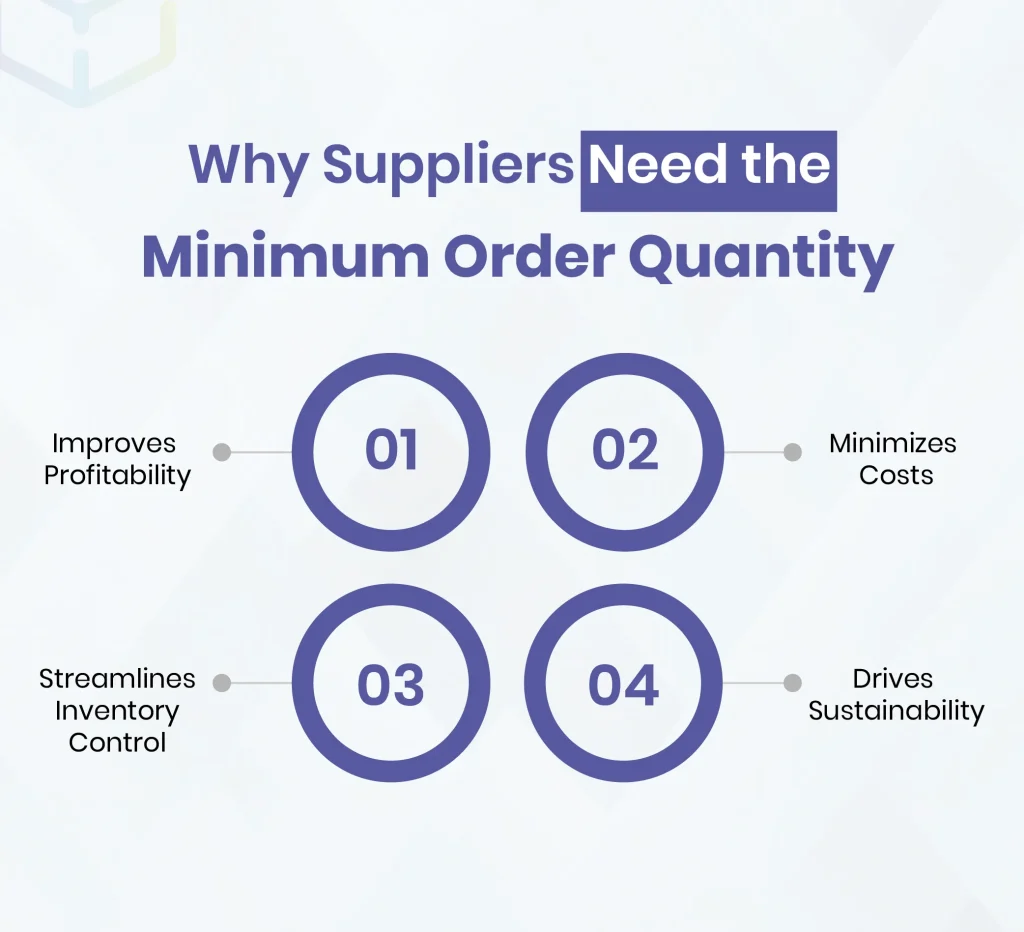
A well-figured-out MOQ usually:
- Improves Profitability: profitable businesses don’t entertain orders that result in losses. They establish an MOQ to make sure that the order size is enough to cover the fixed costs of shipping, packing, production, and so on. In fact, suppliers often provide discounts on bulk purchases to motivate customers to buy above the MOQ, since even with a discount, this improves profit margins.
- Minimizes Costs: Manufacturing large product quantities results in a lower cost per unit due to economies of scale. For instance, starting a new production run leads to substantial fixed costs that can be financially justified only if the production amount is large enough to drive substantial profits.
- Streamlines Inventory Control: With MOQs, suppliers can make better forecasts, improve their production schedules, and avoid excess inventory, which drives up holding costs and consumes working capital.
- Drives Sustainability: MOQs allow suppliers to maintain predictable and stable cash flows. In addition, they help support optimized resource allocation for better growth in the long term. The sales team’s productivity also goes up since the team processes large orders instead of struggling with many small orders.
The Impact of MOQ on Inventory
MOQs bring about improved inventory control and simplified management for both buyers and sellers. With high-amount MOQs, suppliers can afford large warehouses where they can benefit from economies of scale. Large orders due to high MOQ limits can offset holding costs and other fixed costs in the warehouse space.
Buyers, meanwhile, must decide whether or not they have enough customer demand to justify the MOQ. If not, they will have to approach other suppliers with lower MOQs or look towards better storage options. They will have to factor in the nature of the item as well before agreeing to buy above the MOQ – is the item perishable? Will it go out of fashion? Can it become obsolete? These are key considerations to think about before risking an investment on a high MOQ order.
Here is what happens with high MOQs and low MOQs.
High MOQs
With higher MOQ limits, suppliers need to store large inventory volumes. This creates challenges for suppliers that want to implement just-in-time or lean inventory levels. Order fulfillment will, in this case, require longer lead times. Besides taking up large volumes of warehouse space and thus increasing storage costs, this will also consume plenty of working capital.
But a major benefit is that fixed costs such as administrative costs are easily compensated by large order volumes. Suppliers need to order raw materials and components less frequently. Larger raw materials purchase orders can also lead to bulk discounts.
However, this strategy may not be ideal for items that can go out of fashion or become obsolete quickly, like electronics and garments.
Low MOQs
Since low MOQs will likely mean smaller order sizes, suppliers dont need to keep high inventory levels to fulfill orders. Lower stock levels can lead to lower storage costs. The supplier also has to worry less about the obsolescence risk for inventory items like electronics.
However, the productivity of the sales team may suffer due to the influx of many smaller customer orders. Administrative costs may also rise as a result of higher order frequency.
In short, high MOQ limits can lead to higher inventory levels and longer lead times. This makes them better suited for low-margin products.
But low MOQ limits often result in lower inventory levels and thus shorter lead times. Hence, low MOQs are more suitable for high-margin items.
MOQ Benefits
MOQs can bring major benefits for both buyers and suppliers. When done right, the MOQ serves as a vital inventory control tool that can improve profit margins for suppliers, and reduce unit costs for the buyer as well.
Supplier Benefits
- Better Cash Flow: An MOQ based on optimized order size limits and product prices facilitates stronger and more stable cash flow for suppliers.
- Reduced Inventory Costs: MOQs can keep inventory costs under control when done right. Instead of executing a large production run and looking for several small buyers, it is better to find large buyers since fulfilling fewer orders is more time-efficient. Inventory costs can go down this way.
- Higher Profit Margins: Since MOQs ensure enough profit margin to justify order fulfillment, carefully establishing optimal MOQs can improve profitability.
Buyer Benefits
- Bulk Savings: MOQs often mean that discounts are available for bulk purchases. So even though warehouse costs may rise for buyers, bulk discounts for large orders can still result in overall cost savings.
- Easier Procurement: Placing a few larger orders rather than many small orders often simplifies inventory purchases for buyers. Productivity of the procurement team goes up, and they can achieve more with less work.
MOQ Types
Here are the main types of MOQs that are often used.
Simple MOQs
Suppliers often implement a simple MOQ, which includes at least one limit. This limit could be either the minimum purchase price or the minimum number of goods.
A good example of this would be book printers. They will require you to order a specific minimum number of books and not any less because it is simply not profitable to set up the press, order ink, paper, labor, and so on, for just a bunch of books.
Since just one limit has been imposed here, this would be an instance of a simple MOQ.
Complex MOQs
You may have already guessed that complex MOQs involve multiple limits on purchase orders instead of just one.
A garment maker can be an example of suppliers dealing with complex MOQs. Besides the minimum number of garments, the manufacturer may also specify the minimum transaction amount and the minimum fabric length for each garment.
Complex MOQs ensure that under all circumstances, the supplier maintains good profit margins on each transaction.
Complex MOQs require you to factor in more data points compared to simple MOQs.
Factors that Influence the MOQ
Order volume and raw materials are the key considerations that influence the MOQ size. Here are the details.
Raw Materials
When establishing a feasible MOQ for their customers, manufacturers often have to consider the MOQ imposed by their own suppliers. A big reason for this is that suppliers of raw materials often don’t store inventory.
For example, a maker of resin pellets will likely not store this key raw material. Instead, they will produce this raw material only when they receive an order from a customer, like a beverage company that needs these pellets to make their own plastic bottles.
So when setting the MOQ for customers, the beverage company must first consider the MOQ imposed by the resin pellet maker.
Likewise, the beverage company will also have to factor in the MOQ required by the specialist who prints colored labels for their bottles.
There are other considerations as well. For example, a supplier of perishable goods will have to consider their shelf life for a reasonable MOQ that customers are willing to accept.
Such consideration applies even for nonperishable items like fashion accessories and electronics since they can become obsolete or go out of fashion quite quickly.
Simplify inventory like a PRO with our user-friendly software.
FREE Expert Consultation!Order Volume
Finding the minimum order volume at which the company will make enough profits is at the core of establishing an optimal MOQ.
The order should be big enough to justify the costs involved, especially fixed costs.
Before going any further, it must be pointed out that the MOQ can also vary according to customer type. For example, a manufacturer may set a smaller MOQ for small retailers and a higher MOQ for big-box retailers. This is likely to happen, especially if this manufacturer expects most of its revenue to come from small retailers.
MOQs can also influence pricing. For example, if the MOQ is low, its product prices may be raised to justify the transaction.
Also, when suppliers mostly sell high-volume or low-margin products, a higher MOQ may be needed to break even and justify costs.
Calculating the MOQ in Supply Chain
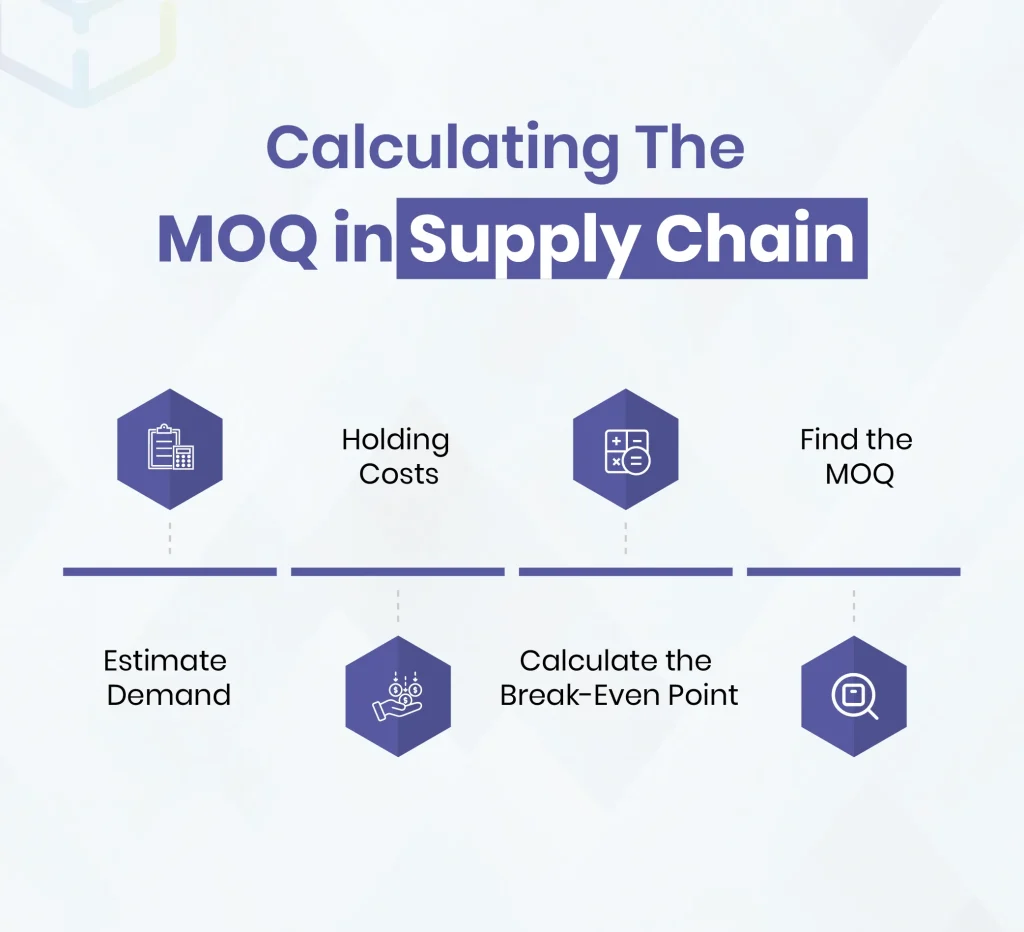
Calculating the MOQ in supply chain varies according to product type and industry. And it may not likely be a one-off – the MOQ may need to be revised from time to time due to variable raw material prices.
The MOQ may need to be revised more often, especially when products carry thin profit margins.
Inventory management software can give you the different data points you need to calculate viable MOQs for all your products.
Although there is no fixed formula to calculate the right MOQ, there are certain steps you can take to arrive at a reasonable amount.
- Estimate Demand: Go through previous demand forecasts and historical data. If suppliers in your industry normally receive orders for at least 500 units, it makes no sense to set the MOQ at 5,000. You will have to consider key factors like lead times, seasonality, the time required to make the product, and so on.
- Holding Costs: How much will you be charged to store your product? These carrying costs may vary according to the nature of your products. Perishable products may require refrigeration and will thus cost more to store. Large items that take up more space will likewise incur higher storage costs. Whatever the case may be, it is never a good idea to hold inventory for too long in a warehouse. Fulfillment services, like Amazon, charge hefty fees by way of aged inventory surcharges or long-term storage fees if your items are held for too long.
- Calculate the Break-Even Point: How many units would you need to sell to overcome fixed costs like setup charges and shipment costs? Finding the break-even point where the sales revenue equals the expenses is key to finding the optimal MOQ.
- Find the MOQ: You will have to repeat the aforementioned for each product you sell. That is, there will be a different MOQ for each product. Besides finding the optimal MOQ, you will also have to consider bulk discounts that will motivate customers to buy more for each order. With bulk discounts, the average order size will grow.
You can also negotiate terms with customers so they are motivated to increase the order size. For instance, a customer orders 550 units of a product each month from the supplier. However, the supplier wants to take the MOQ to 1,000 units. To achieve this, the supplier could try offering this at a discounted price along with easy payment terms.
Implement Your MOQ in 3 Steps
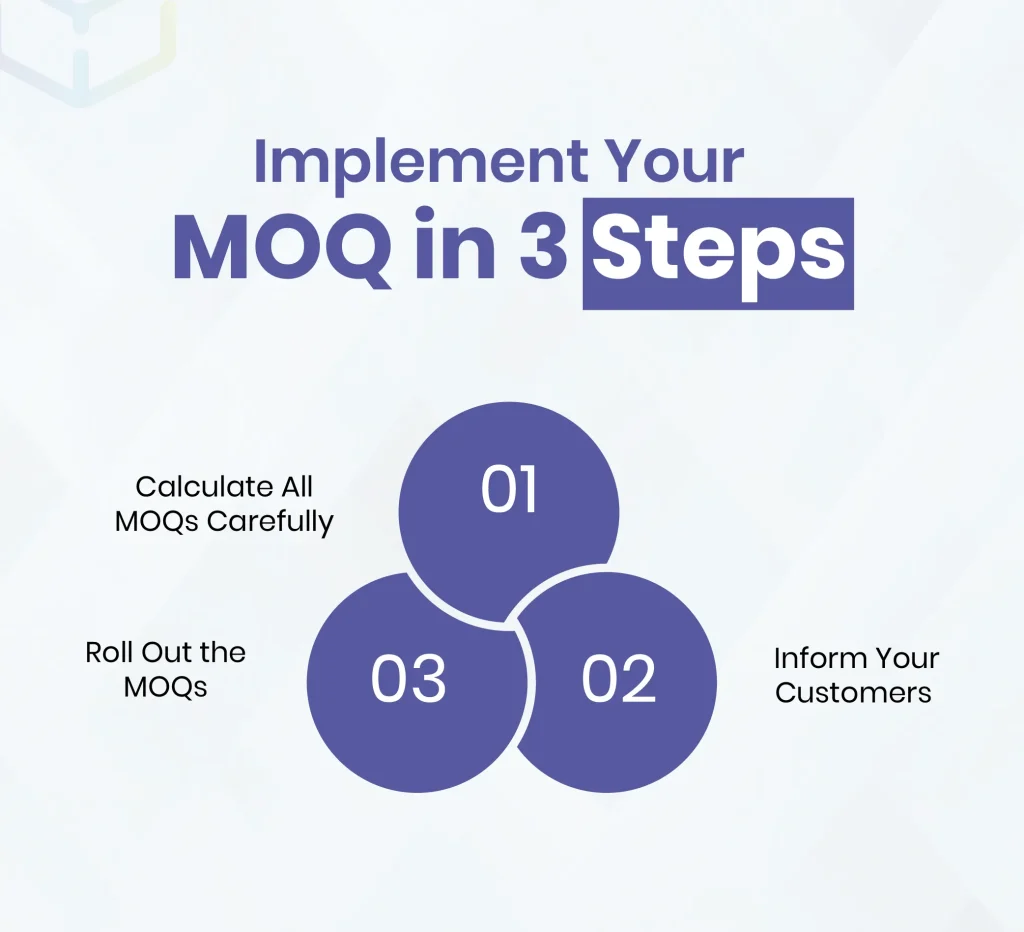
When getting started, it is best to be tactical when rolling out MOQs for all your products. There is more to it than just announcing the fact. While it’s alright to choose the MOQ that works for your business, there are certain market conditions you can’t ignore. Here are certain steps to take when getting started with MOQs.
- Calculate All MOQs Carefully: First, make sure that you follow all steps shown above when calculating the MOQ for each product.
- Inform Your Customers: It is important that you inform your customers well in advance before implementing new MOQs. Make sure you also inform those who normally buy above the MOQ, so that it does not come as a surprise. Naturally, you will need to sit down with customers who go below the MOQ and explain why implementing this limit is necessary for you. Even at the end of all this, you must be ready for customers who will leave you for other suppliers. Try to find ways to stop customers from leaving.
- Roll Out the MOQs: Get in touch with your customers’ account managers and sales reps. Explain your MOQs. Doing so is critical, especially if you have complex MOQs in place for your products. Stakeholders should know how the MOQ works, and even more importantly, where there is no room for negotiation.
Optimize Your MOQs with 6 Easy Tips
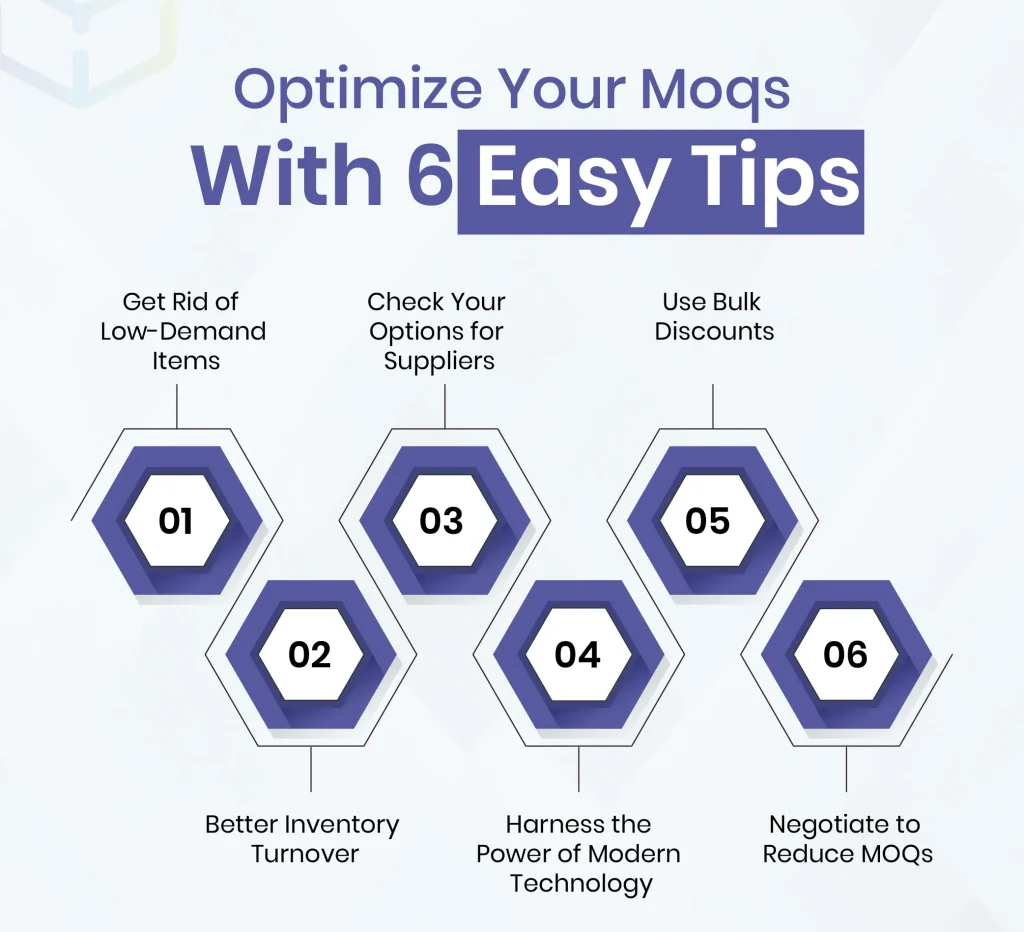
Suppliers and manufacturers need to evaluate and optimize their MOQs when necessary. This includes considering both the MOQs imposed by your suppliers and the MOQs you implement for your customers.
So when dealing with raw material MOQs, manufacturers need to understand how these limits align with their production schedule. These MOQs should not, for example, greatly reduce their working capital or substantially increase inventory costs.
Likewise, when establishing the MOQ for customers, manufacturers should give due regard to these same concerns – that is, MOQs should not significantly affect working capital and inventory costs for their customers. If your MOQs are too problematic for customers, they will look elsewhere.
Access all data you need with a simple console courtesy of WareGo.
Let’s Talk!That is, MOQs should take into account both your interests as well as those of your customers. Here are 6 tips that can help with this.
Get Rid of Low-Demand Items
Reports and analytics can help you identify slow-moving and low-demand items well in advance, before they consume too much working capital. Hence, you need to review reports and analytics regularly to identify such problematic inventory that won’t sell quickly due to factors like obsolescence, seasonality, and changing preferences.
Lowering MOQs is a good way to get rid of such items. Hence, low MOQs can serve as a vital inventory control tool that mitigates damage from slow-moving items.
Better Inventory Turnover
Inventory that sits in the warehouse for too long eventually increases costs and lowers profit margins through increased holding costs, obsolescence, spoilage, and so on. To improve inventory turnover, you can consider bringing down your MOQ.
Check Your Options for Suppliers
If the MOQs of your current suppliers are not fully suitable for your business needs, try looking for different suppliers. But when considering alternatives, you will have to look into lead times and product prices besides just the MOQs. Pick one that overall gives you the best deal. Maintaining strong relationships with suppliers is necessary for negotiations and getting the best deals.
Harness the Power of Modern Technology
Modern inventory software has the full suite of tools you need to evaluate different MOQs. You can assess the effectiveness of each MOQ by using granular data from the software for key metrics, like inventory levels, sales volume, supplier lead times, and so on. Hence, advanced inventory software is your answer for data-driven decisions regarding MOQs.
They also help with operations. For example, when inventory falls below a certain level, the inventory system will automatically place orders that align with respective MOQs.
You can use this system to understand how various MOQ levels affect your inventory turnover and revenue. Understanding all this information will enable you to improve profit margins and reduce holding costs.
Use Bulk Discounts
Increasing the average order size can make it easier for you to roll out a higher MOQ. Offering bulk discounts for large purchases can motivate your customers to buy more for each order they place. When done right, bulk discounts for customers can provide you with many benefits that offset the discount expense.
You can offer free shipping and tiered pricing for orders that go beyond certain amounts. Even with the discount, you can bring down average fixed costs per order if the order size increases as a result.
Negotiate to Reduce MOQs
You can talk to your suppliers for reduced MOQs if they are not ideal for your business. Hold transparent and realistic discussions with your suppliers for favorable terms and conditions. Make it clear that you will continue doing business with them in the long term, as long as they provide the incentive for this.
Optimizing MOQs with Inventory Software
Calculating MOQs and estimating their possible effects on your revenue and inventory turnover is not something that spreadsheets can handle. You need several data points that spreadsheets can’t keep up with since they change in real-time. However, this is a breeze for inventory software. Reports, analytics, and forecasts can give you the real-time data you need for data-driven decisions concerning MOQs.
You can analyze updated, accurate, and complete information with respect to profit margins, order sizes, and other key details to find out how MOQs influence these vital parameters. You can then identify the optimal MOQs for all your products this way. The simple dashboard displays all the information you need in a highly visual format that is easy to understand.
Inventory software is particularly useful for manufacturers and suppliers dealing with complex products. Finding the optimal MOQ becomes more challenging when many different parts and components go into each manufactured item. You will need BOM and kitting abilities to evaluate the true cost of each manufactured item, including direct and indirect fixed costs. This can greatly simplify MOQ evaluation.
WareGo solves this problems by giving you the features you need for the task.
Book FREE Trial!FAQs
How do you set a minimum order quantity?
To set the right minimum order quantity, you must first find the break-even point where the sales value equals the fixed costs and other costs, like shipping, overheads, administrative expenses, and so on. However, this is the starting point since breaking even won’t suffice. You need a certain minimum profit margin for the order to make financial sense. Hence, to find the MOQ, you must add the minimum required profit margin to the break-even point.
How do you find minimum cost order quantity?
The minimum cost order quantity, also called the economic order quantity (EOQ), is calculated from this formula.
EOQ = √((2 * D * S) / H)
Where
D = quantity demanded each year
S = average setup costs (for each order)
H = holding costs per year for a unit of product
The formula shown above enables you to find the optimal order size in terms of the number of units. However, it must be kept in mind that the formula holds true only when the holding costs, order costs and demand remain constant. If these quantities are variable, then the formula is not applicable. The economic order quantity formula aims to reduce ordering and inventory costs.
How do I determine the right MOQ for my business?
A lot goes into finding the right MOQ for your business. You will have to consider your cash flow, holding costs, and product demand when analyzing the MOQs from different suppliers.
The MOQ should not impact your cash flow, nor should it greatly increase storage costs. Of course, the product demand has to be greater than the MOQ for it to make financial sense.
How is minimum order quantity (MOQ) different from Economic Order Quantity (EOQ)?
The minimum order quantity is the minimum number of items you must order for the supplier to accept the transaction. Anything less than this is not accepted.
Economic order quantity, on the other hand, is the optimal order size that will save costs, improve cash flow, and minimize stockouts.
Summarizing, the key difference is that MOQ is the limit imposed on you by the supplier, while the EOQ is the right product quantity for you to order.
What is MOQ in supply chain?
MOQ in the supply chain refers to the minimum order quantity that a supplier requires you to order. Anything less will not be accepted. Hence, your order size must exceed or at least equal the supplier’s MOQ. The reason for this is that a certain minimum order size will cover fixed costs involved in order fulfillment, like shipping, setup, and overhead costs. These costs won’t be covered if the order size is anything less than the MOQ.