Having discrepancies in inventory often create different types of issues for businesses. It is one of those problems that can disrupt the whole fulfillment process, because faulty inventories cannot help warehouse managers to fulfill orders on time. It is therefore recommended to resolve this problem before it happens, so that warehouses can keep their operations on track without any difficulty.
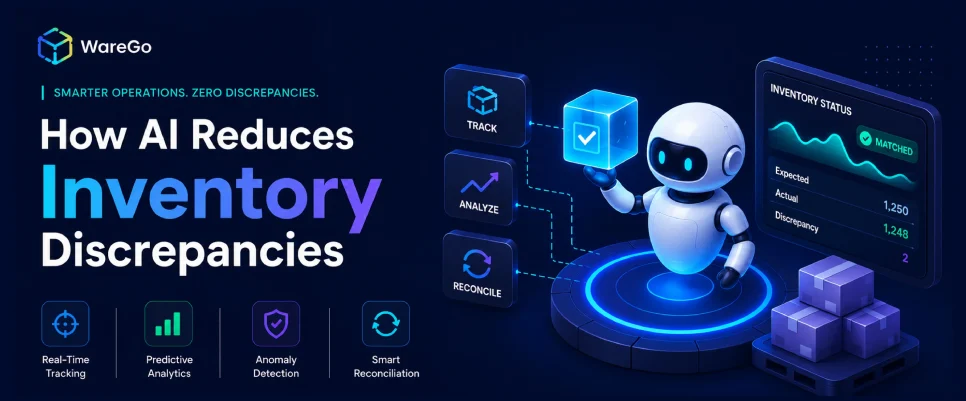
Using AI powered inventory management systems can help a lot in managing the discrepancies in an inventory. These systems provide various automated features that flag the errors automatically, so that warehouse managers can resolve them by taking appropriate measures.
Inventor discrepancies can also create problems in customer churn. In fact, it is one of the primary reasons why many customers often do not return back to the stores that face issues in fulfilling orders. Keeping this in view, it is advised to leverage AI to handle this problem, so that it can be sorted out automatically without causing any disruption in the operations.
In this article, we will discuss it in detail, so that you can understand how AI can reduce inventory discrepancies to lower down the customer churn issues. Let’s start from the basics understanding how inventory errors can really expedite the customer churn rate.
Deploy WareGo today and manage your stock effortlessly with intelligent automation.
Start with WareGoTable of Contents
How Inventory Discrepancy Can Increase Churn Rate
Inventory discrepancy often becomes the biggest reason why businesses lose customers in the industry. It largely happens when customers face order cancellations due to inventory errors, which basically breaks their trust. This is a crucial point that not just impacts the relation with customers, but also tarnishes the business image. Due to that, the churn rate increases, leading businesses to face visible decline in revenue.
A lot of times, the problem of inventory discrepancy arises during the peak sales season. It is one of those times when businesses usually get high volumes of orders. Due to that, errors often arise in their workflows due to not having a continuous oversight. Many businesses still rely on manual processes, which is why they fail to keep track of inventory count after some backordered sales. This is where discrepancy in inventory emerges, making the fulfillment process delayed due to stockouts.
To understand this pathway better, take a look at the scenario below with which inventory discrepancy forces the customer churn rate to increase rapidly.
- Inventory discrepancy arises due to wrong order picked.
- Order gets shipped and the customer receives the wrong item.
- Product gets returned and customer files compliant.
- Same pattern repeats due to continuous discrepancy in inventory.
- Customers ask for returns, and notifies that they won’t be coming back due to fulfillment issues.
Why Legacy WMS Solutions Can’t Manage Inventory Discrepancies
Businesses working with traditional WMS solutions often find it difficult to manage inventory discrepancies. The reason is that these systems are not configured to manage high volumes of orders, which basically becomes the prime source of generating errors. Here are some other correlating factors that also create discrepancies, forcing the managers to look for advanced WMS systems.

Failure to Identify Picking Location
Many times, inventory discrepancy arises repeatedly due to a specific picking error. If the WMS system fails to identify this problem, then it becomes a serious loophole in the inventory. It not only disrupts the fulfillment process, but also creates problems in other workflows that ultimately slows down the warehouse throughput. Keeping that in view, it is recommended to use a WMS solution that can track the inventory and picking in real-time, so that every issue can be resolved quickly.
Unable to Detect Stockouts
Many legacy WMS systems do not provide any feature to forecast the inventory demand. It is a specific functionality with which warehouse managers know about the requirement of the new stock in a timely manner. Those systems that do not provide this functionality are highly prone to face stockouts. Due to this, discrepancy in the inventory arises, forcing businesses to often halt the operations before finding the exact issue.
Failure to Identify Demand Anomalies
It is observed that businesses often face demand anomalies during the peak sales season. It generally emerges when one category of products is overstocked, while the other starts to deplete due to repeated negligence. This happens due to lack of real-time inventory tracking that is mainly provided in advanced WMS systems like WareGo. Due to this issue, inventory count gets mismatched, leading to creating errors in stock.
Try WareGo today and explore how AI can track, manage and resolve inventory errors with ease.
Consult With Our TeamHow AI Enhances Inventory Management
Artificial intelligence has brought a strong transformation in the warehousing industry. It has automated several operations that once looked very difficult to manage manually. Inventory tracking is also one of them that has been streamlined with the power of AI. Due to that, discrepancies in its stock count have seen sharp decline, allowing warehouse managers to work with updated inventory continuously.
Here are some key benefits that define how AI enhances inventory management with cutting-edge functionalities. Let’s take a look at them below.

Anomaly Detection
AI models are built to detect anomalies quickly. This means that it can flag inventory errors as soon as they occur in the system. It is quite an important advantage that allows businesses to stay ahead by keeping their inventories updated. Due to this, they become efficient in managing complex stock even during the sales seasons, ensuring that all the information in the inventory remains accurate. It comes specifically beneficial for ecommerce companies, because they often receive loads of orders which enhances the chances of errors in inventory.
With AI-powered WMS systems, identifying and resolving anomalies in inventory is completely automated. This helps to keep every stock information across different locations accurate, so that businesses can fulfill orders from any place without any hesitation. Many WMS solutions also provide regular reports about anomaly detection, so that warehouse managers can keep track of their occurrence.
Demand Forecasting
Many warehouse management solutions that are powered by AI provide accurate demand forecasting analyzing historical data and trends. This is a great feature that helps you to know how much stock is required to meet the demands of the upcoming sales season. By knowing this in advance, you can plan the inventory accordingly to avoid facing delays. Due to this, there are zero chances of having discrepancy in inventory, as most of the stock count is managed in advance by the AI. It ensures to provide correct demand forecasts, so that businesses can scale their sales without facing any difficulty.
By taking advantage of forecasts, it becomes easy for managers to plan for the future. It not only eliminates the chances of stockouts, but also allows businesses to keep their inventory lean as per the required demand. That is how it reduces the overall inventory cost, allowing managers to operate only with a realistic set of stock.
Error Pattern Recognition
Artificial intelligence reduces inventory discrepancy by analyzing massive datasets to uncover hidden patterns behind stock errors. In standard supply chains, discrepancies often seem like random occurrences caused by human error or system glitches. AI algorithms, however, scan historical transaction logs, point-of-sale data, and warehouse logs to connect these errors to specific root causes. That is how they uncover various patterns that create regular discrepancies, forcing the warehouse managers to work with inaccurate stock.
Once these error patterns are recognized, the AI system shifts from diagnosis to proactive prevention. It flags high-risk scenarios in real time, alerting managers to double-check inventory at specific storage locations. AI also updates demand forecasting models to account for these systemic losses, ensuring ordering cycles remain accurate at all times.
Predictive Cycle Count Scheduling
AI-powered WMS solutions reduce inventory discrepancy by replacing rigid stock counts with dynamic scheduling. Traditional inventory management relies on static schedules, counting items every month or quarter regardless of their actual accuracy risk. AI breaks this cycle by analyzing real-time data points, such as high sales velocity, frequent manual adjustments, and vendor delivery delays. By calculating a continuous risk score for every product SKU, the AI algorithm predicts exactly which items are most likely to have mismatched records.
This predictive approach optimizes warehouse labor by directing employees to count only where discrepancies are likely to exist. Instead of wasting time counting highly accurate and slow-moving stock, workers focus only on items flagged by the system as high-risk. This targeted strategy ensures that high-value items are verified precisely when they are needed the most.
How Inventory Accuracy Improves Client Retention
Working with accurate inventory not just allows you to fulfill orders quickly, it also enhances your ability to retain clients effectively. It has been observed that customers prefer to come back to those businesses that fulfill their orders on time. It is not a metric, but a reality of the market according to which every retailer needs to shape its services.
Considering this, it is important to avoid discrepancies in inventory, as it can take a direct hit on the client retention. Businesses that take care of this always experience steady growth, as recurring customers also bring new leads with them after getting satisfied with timely fulfillment.
Get started with WareGo to manage everything efficiently with AI automation.
Book a Free DemoFinal Words
Businesses that struggle in managing inventory discrepancies can take a lot of advantage from AI-powered WMS systems. These platforms do not miss any anomaly, as their models are built to pick errors in every stock. Due to this, they ensure to eliminate errors, allowing warehouse managers to keep their fulfillment processes on track. This eventually helps them to reduce the customer churn rate by completing each order before the deadline. It is therefore recommended to take advantage of AI automation, so that your inventory always remains free from errors.
Frequently Asked Questions
- What is inventory discrepancy?
Inventory discrepancy refers to the errors that bring inaccuracies in the inventory. These errors often generate due to using legacy systems, which cannot handle complex inventory operations. Besides them, discrepancy in stock count can also arise due to increasing volume of orders which largely happens during the peak sales season.
- How AI reduces inventory discrepancy?
AI brings a lot of advantages for warehouse managers, especially in the domain of inventory management. It helps to reduce discrepancy in the stock by monitoring the product count consistently. If any errors are found, it automatically resolves them by taking appropriate measures, such as replenishment and more.
- Does WareGo provide AI features to eliminate inventory discrepancy?
Yes, WareGo is an AI-powered WMS system that provides different features to avoid inventory discrepancies. It offers real-time tracking to keep track of every inventory, and also provides automated restocking functionality to resolve problems of depleting stock.
- How inventory discrepancy can impact customer churn rate?
Inventory errors can increase customer churn rate when the orders are cancelled or not completed on time. It automatically creates a bad impression of business in the eyes of customers, which then leads them to move away from the company. It is therefore recommended to always monitor and resolve the inventory errors, so that it cannot disrupt the relations with clients.