Table of Contents
TL;DR
A Distributed Order Management (DOM) system is a logic-based, intelligent order processing and routing system that can handle highly complex, dynamic supply chain operations for multiple locations with the most cost-effective and fastest fulfillment alternative. The core capabilities of a modern DOM are intelligent order routing logic, global inventory visibility, and automated slip shipment reduction.
This blog highlights what a DOM is, how it differs from traditional order management systems, what its core capabilities are, and the benefits they provide to different businesses, including 3PLs and brands, like enhanced customer experience and customizable workflows, omnichannel fulfillment, and seamless systems integration.
Key Takeaways
- Distributed Order Management (DOM) is an order fulfillment optimization solution especially utilized by businesses to accelerate order processing and improve customer satisfaction.
- DOM differs from traditional OMS by automating complex omnichannel fulfillment processes and using logic-based rules for smart decision-making.
- The three core capabilities of a modern DOM are intelligent order routing logic, global inventory visibility, and automated split shipment reduction.
- DOM benefits supply chain fulfillment by enhancing customer experience, customizing workflows, enabling omnichannel fulfillment, and enabling seamless system integrations.
- Both 3PLs and brands need DOM-enabled WMS to support multi-node network coordination, reduced shipment costs, client scalability, omnichannel order precision, organized inventory pool, and high-value deliveries.
- Tracking the right metrics lets you decide if your DOM is meeting your business goals or needs more optimization.
Introduction
Since the pandemic, the e-commerce industry has been on a roll, and nothing is stopping it from slowing down. Supply chain operators all around the world are competing with lightning-speed order lead times and state-of-the-art functionalities that only get better.
The industry is dominated by big names like eBay, Etsy, and Taobao, which are on a completely different level of customer service. Moreover, in 2025, retail e-commerce sales reached a whopping $6.4 trillion and are only expected to increase in the upcoming years.
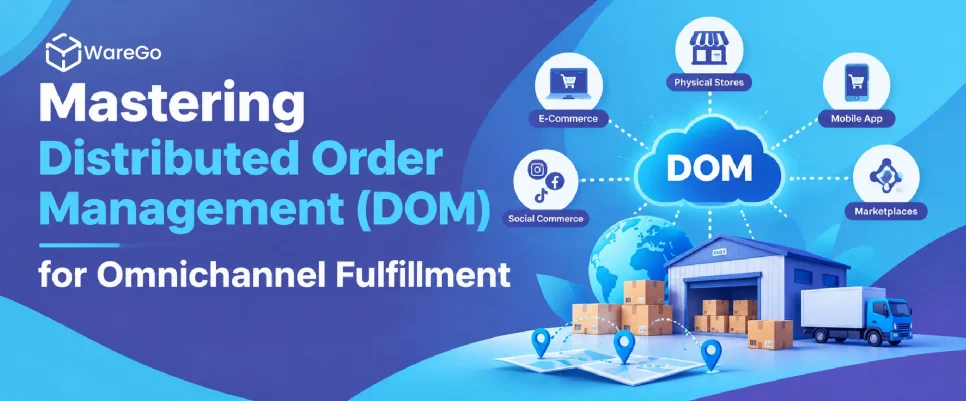
Among these advanced functionalities, a distributed order management system has emerged as a pivotal technology for retail e-commerce businesses. DOM uses automation to orchestrate multiple orders and inventory across several locations to take fulfillment to a whole new level.
Gain better control over your inventory and order delivery system through modern DOMs provided by WareGo.
Sign Up NowWhat is a Distributed Order Management (DOM) System
Distributed Order Management (DOM) is an order fulfillment optimization solution especially utilized by the retail industry to accelerate order processing and customer satisfaction. It brings a number of supply chain operations like inventory management, order status, and delivery to multiple locations under a unified framework with less work, time, and money.
DOM can also be considered a strategic advantage for warehouses and retail businesses to match the expeditious order handling of industry leaders. It also allows you to execute modern fulfillment strategies like omnichannel fulfillment and capitalize on different retail trends like BOPIS (Buy Online, Pickup In-Store) or BNPL (Buy Now, Pay Later) seamlessly.
DOM vs. Traditional OMS: What’s the Difference?
OMS is a traditional order management system that works in a linear way, meaning that it takes manual input of information and follows only those instructions regarding order processing and shipping routes. On the other hand, DOM (Distributed Order Management) is a smart and agile order fulfillment solution with web service-based integrations and a cloud-based infrastructure.
Modern DOM has broken all barriers constraining a traditional OMS. It automates customer order fulfillment by updating inventory, finding the most optimized route, and doing so in the shortest time possible, all in real time. Thanks to this, supply chain management can cater to dynamic growth demands while increasing precision, coordination, and efficacy.
Some differences at a glance are:
| Differences | DOM | OMS |
| Inventory Visibility | Real-time visibility across all sales channels | Lack of dynamic, multi-dimensional inventory visibility |
| Time Scale | Minutes to days | Daily to monthly |
| Channel Support | Single or limited support | Omnichannel (store, web, marketplace, B2B) |
| Integration | Integrates easily with existing tech systems | Will require a lot of restructuring |
3 Core Capabilities of a Modern DOM

The capabilities of a modern DOM are far greater than a simple, traditional OMS. A DOM expands itself to fulfill and automate order processing while continuing to grow as your brand scales to new heights. Some of its core capabilities are:
1. Intelligent Order Routing Logic
A modern DOM uses logic-based rules to optimize order fulfillment based on various factors such as delivery time, shipping cost, inventory availability, speed, proximity, priority, and other custom business requirements. The system scans out invalid nodes and categorizes others on the basis of essential factors while also equalizing staff saturation at each node to avoid bottlenecks.
2. Global Inventory Visibility
Track real-time stock data and inventory movement such as sales, returns, transfers, inbound shipments from every node, including retail stores, warehouses, 3PL providers, etc. Feeds this data into automated routing rules through logic-based deductions to orchestrate the optimal location to ship the goods from based on labor costs, taxes, shipping rates, and proximity for a satisfying fulfillment.
3. Automated Split Shipment Reduction
A DOM is designed to handle complex omnichannel fulfillment through fast and intelligent processors using real-time inventory visibility and ideal shipping routes. It monitors stock levels across all nodes and weighs the financial penalty of split orders against single ones, considering factors like urgency or stock depletion, with a smart order system to make lucrative choices. However, standard policies instruct DOM to prefer single-source fulfillment whenever possible.
How DOM Benefits Supply Chain & Fulfillment

Businesses reap a multitude of benefits through the latest high-tech DOMs. They utilize logic-based rules to generate the most cost-effective fulfillment alternative. Some of the benefits that can be gained are:
1. Enhanced Customer Experience
By increasing order lead time and fulfillment rate, you can easily gain customer loyalty. A DOM makes it easier to predict demand, automate stock replenishment, and foresee unpredictable bottlenecks to gain more control over supply chain distribution optimization.
2. Customizable Workflows
You can always adjust the approach to your DOM with a different set of rules to cater to your business requirements or needs. Besides, it is adaptable to new changes like different sales channels, regional expansions, and volume spikes without disrupting core operations.
3. Omnichannel Fulfillment
DOM Systems unites different channels like retail stores, warehouses, and ecommerce platforms under one roof for a single, seamless, and personalized experience. They also handle complex modern fulfillment trends like BOPIS (Buy Online, Pickup In-Store), ship-from-store, and split shipments.
4. Seamless System Integration
DOM works with the systems and networks you already have in place while enhancing their capabilities to work faster and more efficiently. It handles all supply chain operations in real time, such as gathering stock data, updating inventory, and coordinating with other systems like:
- ERP: Syncs financial and operating data with BAAN or QAD systems.
- TMS: Improves transport, route, and delivery options.
- WMS: Handles inventory management and order execution.
Why 3PLs and Brands Need a DOM-Enabled WMS
A DOM-enabled WMS leverages the features of both a warehouse management software and TMS to streamline supply chain operations, with DOM optimizing distribution through cost-effective fulfillment services for brands and 3PLs.
Why 3PLs Need a DOM-enabled WMS
- Multi-Node Network Coordination: 3PLs that handle multiple warehouses can unify the process in a single system to manage order volume across various facilities easily.
- Reduced Shipment Costs: A smart routing system of DOM coordinates shipping rates and inventory proximity of 3PL facilities before devising the best possible solutions.
- Client Scalability: With advanced features, 3PLs can easily onboard high-volume clients and optimize their shipping through live inventory visibility, smart routing, and automated alerts.
Why Brands Need a DOM-enabled WMS
- Omnichannel Order Precision: DOM eliminates stockouts or overselling by tracking inventory management in real time for brands integrated with e-commerce websites or retail stores.
- Organized Inventory Pool: Brands no longer have to manually plan order processing or stock replenishment because all of it can be done through a single DOM system.
- High-Value Deliveries: DOM systems automatically select the most cost-effective, fastest, and safest route for shipping deliveries, increasing both brand and customer satisfaction.
Speak with our WareGo specialist today to start your journey towards higher customer satisfaction.
Get StartedEssential DOM Metrics To Measure Success
Tracking the right metrics lets you decide if your DOM is meeting your business goals or needs more optimization.
Key Performance Indicators
- Low Shipping Expenses: Monitor shipping costs accrued across all nodes.
- Rapid Processing: Note any reductions in order lead times
- Service Excellence: Carefully analyze delivery speed and on-time performance.
- Improved Inventory Turnover: Optimize inventory and reduce stockouts.
Business Success Evaluation
- Boosted Customer Loyalty: Efficient order executions increase customer loyalty.
- Decreased Rates: Improve inventory management, labor efficiency, and shipping expenses.
- Streamlining Operations: Automate supply chain operations and reduce manual intervention.
- Growth Capacity Analysis: Determine growth opportunities for scalability.
The Bottom Line
Deploying a Distributed Order Management System is a strategic advantage that will revolutionize order fulfillment for businesses all over the world. By integrating DOM systems, brands can easily enhance customer service, reduce shipping costs, improve delivery routes, and coordinate distribution processes for more efficient order processing. Moreover, you can also track your DOM success by monitoring accurate metrics.
WareGo is a high-performing DOM-enabled 3PL WMS systems that gives a competitive edge to businesses wanting to streamline all of their retail operations. Built on the latest technologies and providing cutting-edge features; WareGo WMS strives to offer dynamic order volumes, increased scalability, and amplified customer satisfaction.
Frequently Asked Questions (FAQs)
What is the main purpose of the Distributed Order Management (DOM) System?
The main purpose of a DOM is to optimize customers’ orders for multiple locations (warehouse, retail store, or 3PL) through the most cost-effective and optimal delivery route.
How does a DOM reduce Shipping Costs?
A DOM monitors warehouse inventory in real time and automatically routes the order from a location thats closest to the customer for reduced shipping costs, quick delivery, and enhanced customer experience.
What is the main difference between OMS and DOM?
A traditional OMS works linearly by processing orders, updating inventory, and delivering through pre-planned routes. On the other hand, DOM works dynamically, using logic-based rules to intelligently plan out routes for multi-location fulfillment networks.
Do 3PLs need Distributed Order Management (DOM)?
Yes. 3PLs utilize DOM to serve multiple clients by automating orders through real-time inventory visibility from various warehouse locations through a single system for optimal order fulfillment.