The emergence of AI has brought disruption in the ecommerce sector, and now businesses are shifting their practices to adapt to it. Gone are the days when people only preferred Google to search for any product. They are now taking help from AI to make their searches faster and more accurate as compared to previous practices. Considering that, the onus is now on online stores to adapt to these changes. Besides using an advanced inventory management software, there are various other practices they can employ to get visibility in AI searches, as that is quickly becoming a need of the hour in the ecommerce sector.
The methods with which ecommerce businesses are finding a foothold in the AI era is called Agentic commerce. It is a practice in which the focus of stores has shifted to AI shopping agents that are now playing a big role in searching and even purchasing products for the customers from the internet. In this article, we will explore how ecommerce stores are ushering into this new era of agentic commerce that is quickly changing the way how people shop on the internet.
Table of Contents
What is Agentic Commerce?
Agentic commerce is a practice in which AI shopping agents act on behalf of real people to browse, research and buy products from the online stores. It is a completely automated method in which humans just need to use AI bots to give their shopping queries, as the rest depends totally on them. This method has brought strong disruption in the ecommerce sector, as consumers are now increasingly using tools like ChatGPT, Gemini and others to get instant shopping suggestions.
Speaking about AI shopping agents, they rely on particular practices to gauge the quality and efficacy of ecommerce stores. They do not provide random suggestions to the human queries, instead they dig deep into the store data to evaluate the trust factor. Different attributes such as pricing, product availability, order fulfillment and others often play a key role in this regard, allowing AI shopping agents to browse, select and show store results for relevant human searches accordingly.
Deploy WareGo today and automate all your inventory management operations with the power of AI.
Get Started with WareGoImportance of Building a Machine-Readable Inventory/Warehouse
To succeed in the AI commerce era, businesses need to understand how AI shopping agents work. Based on that, they need to optimize their store inventories accordingly, so that they could receive maximum visibility in AI searches. Whether they are using any conventional inventory management method or an advanced 3PL warehouse management software, there are some specific practices that can be used to take advantage of agentic commerce. Let’s take a look at them below.
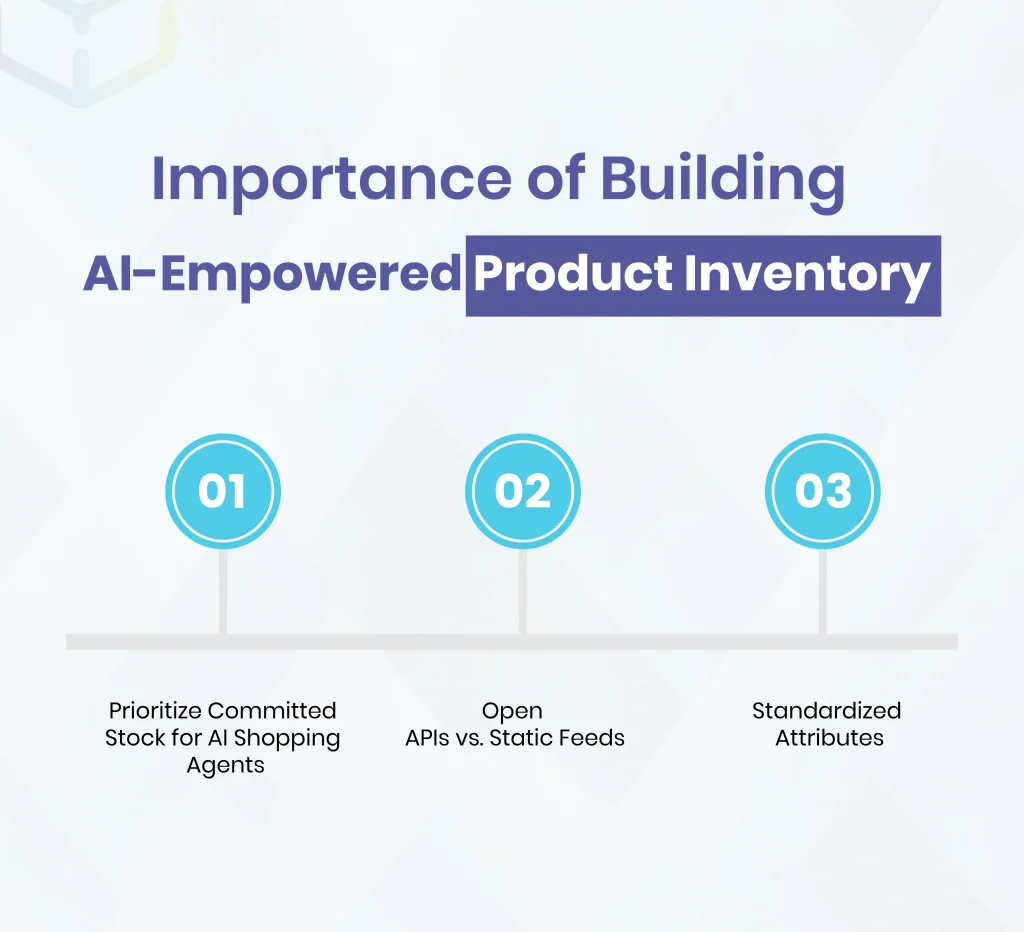
Prioritize Committed Stock for AI Shopping Agents
Segregating stock for AI searches is important because these agents often look for inventories that provide guaranteed fulfillment. They try to rank websites or product pages that have a separate available stock other than the default stock to fulfill customer orders. These autonomous agents process searches on the go, so they need accurate data to make decisions and bring the specific results quickly.
If the inventory of a store does not provide accurate stock information, the AI shopping agents quickly move forward without paying heed to other information. It is therefore important for store owners to maintain a correct inventory on their pages, so that it can guide AI shopping agents correctly about the potential of taking online orders.
Open APIs vs. Static Feeds
To make product pages visible on AI searches, ecommerce stores now need a live data synchronization to let the AI shopping agents know about their product inventory. The reason is that AI models do not look into static feeds, as they often provide outdated information. These models rely on live data to confirm the stock availability which ultimately matures the conversion.
Considering that, ecommerce businesses now need to utilize Open APIs to make the live data feed work. These are dynamic calls between the AI agents and the store’s inventory system that provides a real-time visibility of the available inventory. Once the AI shopping agents find detailed product stock in the inventory, they automatically tag the store as a reliable source to fulfill orders.
Standardized Attributes
It is important for ecommerce stores to maintain the product information consistent across all sales channels to make them visible in AI searches. From GTINs to materials specs and more, everything about the product should have standardized information, as that helps AI shopping agents to understand them quickly. If this information is incorrect or not consistent, the product pages will not get ranked in AI searches, no matter how detailed or creatively they are written.
The Physical Store: The “Trust Anchor” in a Digital World
AI shopping agents pay attention to those stores that have a physical footprint. It lets them know that a store can be easily reached out if any contingency related to the orders arises. This builds trust, encouraging them to show specific product pages in AI searches.
Sense of Instant Ownership
Ecommerce stores having physical outlets always helps to build trust, allowing AI shopping agents to include them in searches instantly. It basically signifies that a store takes ownership of orders, hence there will be less fraudulent activities involved in it. Due to that, the reliability of the store rises, making their websites or product pages appear in the searches. As per AI agents, these stores are often identified as micro fulfillment centers from where orders can be processed quickly.
Keeping in view the advantages of physical retail locations, AI bots build an understanding of frictionless shipping and fulfillment. This is the reason why they pay attention to those stores that fulfill this criterion perfectly. It lets them know that a store has reduced logistics complexity, which will allow it to fulfill orders quickly as compared to digital-only stores.
Digital-Physical Sync
AI shopping agents often check the combination of digital receipts and in-store checkpoints to validate the “Proof of Existence” of specific ecommerce stores. This is important information because it lets them know about the physical presence of a store that can fulfill orders. It ensures them about the safety of purchase decisions, because the in-store touchpoints act as a layer of trust for them. By combining both fronts, the AI shopping agents create a Verifiable Trust Score that helps them to select specific stores. That is how they refine their results after evaluating the authenticity and reliability of ecommerce stores at different levels.
Get the advantage of WareGo to automate and track product inventory like a Pro.
Book a FREE DemoHow to Prepare Your Online Store for Agentic Commerce 2026
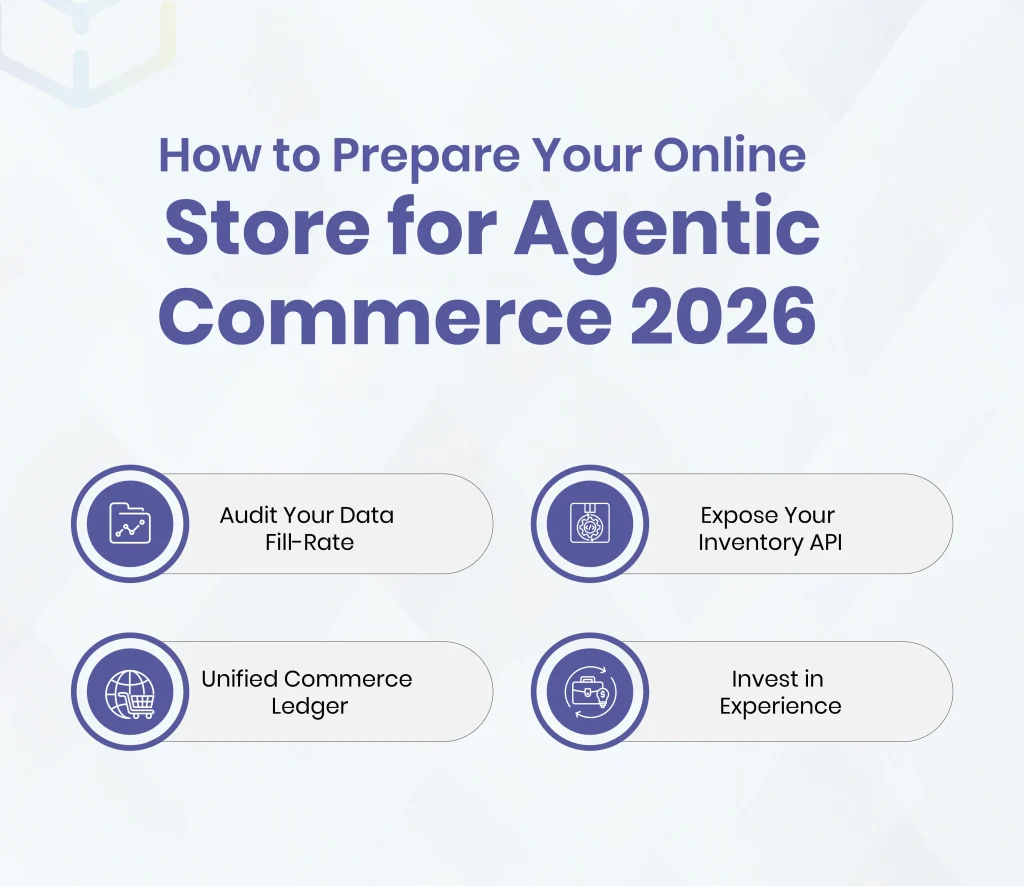
To prepare your store for agentic commerce, there are some specific steps you need to take to make your website visible in AI searches. Let’s take a look at them below.
Audit Your Data Fill-Rate
The first step you need to take to get your websites ranked is making sure that all its data presents structured and accurate information about the products to the AI agents. To do that, you need to ensure that specific attributes like SKU/ID, colors, size, etc., have correct and to-the-point information. These fields are read first by AI shopping agents whenever they research products, so maintaining their correct information is vital to gain an edge in searches.
Expose Your Inventory API
It is important to utilize Open APIs to keep your website data accessible for the AI shopping agents. As discussed above, agentic commerce relies a lot on accessing live feed of product inventory. It allows the AI agents to get a real-time visibility of the entire stock that helps them to make better purchasing decisions. Keeping that in view, it is important for you to utilize a warehouse management software that is powered by artificial intelligence, as that will give products in your inventory a better chance to get discovered by AI agents.
Unified Commerce Ledger
A lot of times, ecommerce businesses fail to match the synchronization between their physical stores and local digital inventory. This creates a big discrepancy in actual stock information, which basically goes against the core practices of agentic commerce. It is therefore recommended to connect the store’s POS system directly to the stock inventory, so that everything can be updated immediately once a purchase is made in the physical store. It provides AI shopping agents with up-to-date information, preventing them from promising a ghost item in the inventory.
Invest in Experience
Besides working on different practices to strengthen the AI reach, ecommerce business should also build a team of professionals who could manage customers efficiently. They should be able to build relationships, as that helps to enhance the trust factor. It is one of those factors that is closely watched by many AI shopping agents, as it provides them a viewpoint of different customers who have already purchased products personally from the store.
Try WareGo today and cut down your inventory management cost without compromising on stock tracking.
Talk to Our TeamFinal Words
Getting your store ready for the agentic commerce era is important, because traditional online shopping methods are quickly becoming outdated. Nowadays, people are using AI to refine their product searches, as it provides better and faster results as compared to using search engines. Keeping that in view, it is important for you to understand how AI shopping agents work and what should be done to give them better access over your website. With this information, you can make your online store future-ready and can drive more sales by getting instantly discovered by different AI-powered search streams.
Frequently Asked Questions
- How do AI shopping agents decide which retailers to recommend?
AI shopping agents evaluate various things before recommending retailers to the shoppers. They look into the operational reliability, order fulfillment ratios, trust signals and other attributes to refine their recommendations and results for the search queries.
- Will AI shopping agents completely replace online shopping?
It is a question that has different answers, because people have different viewpoints related to it. However, looking at the rapid emergence of agentic commerce, it can be anticipated that traditional shopping practices could soon become obsolete in the future.
- What’s the difference between agentic commerce and conversational commerce?
The difference between agentic commerce and conversational commerce is pretty thin, as both utilizes the power of AI to streamline online shopping. Conversational commerce uses AI to provide targeted results to the humans, whereas agentic commerce acts autonomously on behalf of humans to make product order decisions.
- Will AI replace inventory management?
AI has made a big breakthrough in inventory management, as it has automated several operations that once looked like a cumbersome task to the warehouse administrators. With powerful WMS systems like WareGo, warehouse businesses are already leveraging the advantages of AI to streamline tracking, order fulfillment and other inventory management operations effortlessly.