Stock is the primary asset for any business that sells physical products. Such businesses can be profitable only if they optimize their inventory. Among other things, you should have just enough inventory to meet demand – any more than this leads to excess stock that eats into profits.
Inventory management and inventory control both matter for efficient business operations. Although they feel somewhat similar, they do have unique functions that play a crucial role in optimizing your inventory. Understanding inventory control vs inventory management can improve inventory processes and fulfillment performance.
We will explore the following:
- The basics of inventory control and how inventory control systems work.
- The basics of inventory management and how inventory management systems work.
- The differences and similarities between inventory management and inventory control.
- How inventory management software simplifies inventory.
Table of Contents
Inventory Control Explained
Inventory control is concerned with tracking stock across different locations and warehouses. It aims to boost efficiency by ensuring just enough stock to fulfill demand, and not any more.
Inventory control goes beyond knowing exactly what you have in stock. It also streamlines inventory for faster and more accurate operations. Several tools are used for this process to efficiently track your inventory’s journey from receiving to shipping.
Inventory Control – Key Elements
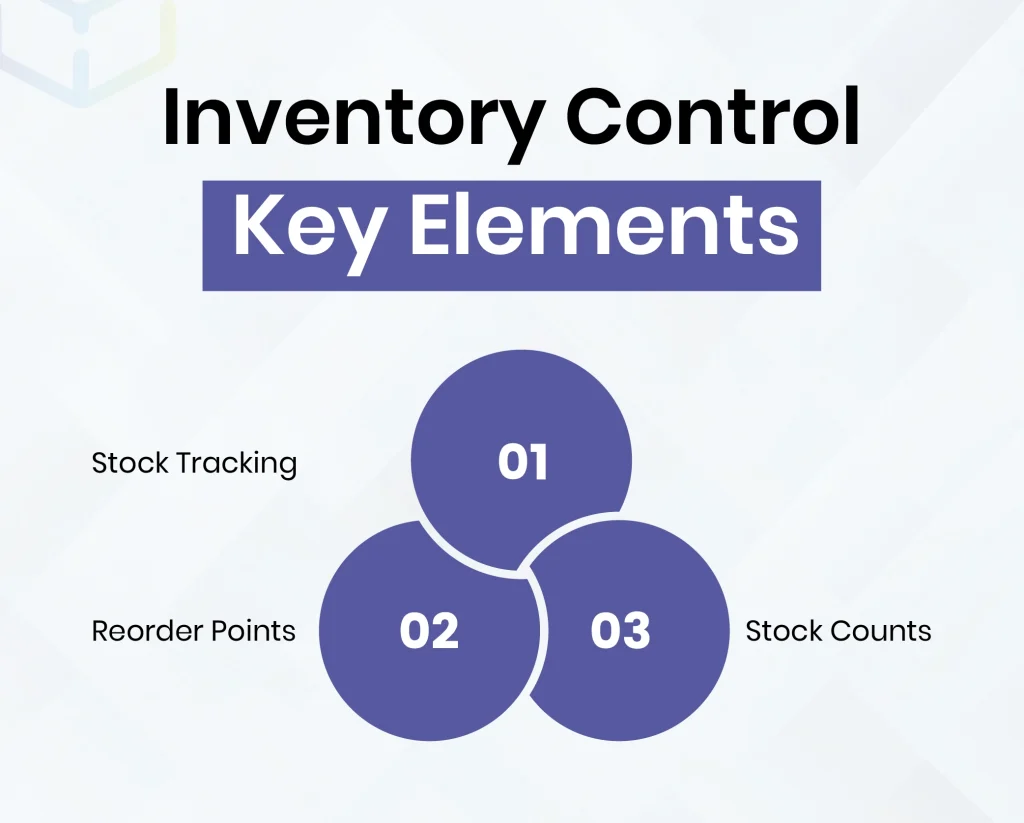
Here are some of the key elements of inventory control.
- Stock Tracking: Monitoring inventory at all stages of warehouse operations, including the quantity and location.
- Reorder Points: Deciding the minimum stock level for reordering is important since it prevents both stockouts and excess inventory.
- Stock Counts: Counting physical stock shows how closely actual stock levels match your inventory records. This reveals stock shrinkage and can uncover hidden problems such as damage or theft.
Inventory Control Systems

An inventory control system is designed to track inventory and simplify warehouse operations. Here are the key functions involved.
- Real-Time Tracking: Updated inventory is essential for preventing overstocking and stockouts.
- Automatic Reorder Points: The system triggers purchase orders whenever stock levels fall below certain preset levels. Ensures continuity, minimal disruption, and reduces manual work.
- Barcode and RFID Support: Inventory data updates automatically at the end of any process without manual data entry. Such technology minimizes human effort, errors, and delays.
- Reports and Analytics: Provide insights into your inventory and warehouse operations that reveal opportunities, reduce bottlenecks, and drive growth.
Inventory Management
Inventory management goes beyond inventory control since it covers everything related to inventory, from stock purchases to sales. The process oversees how goods flow to your warehouse and the sale of inventory at POS terminals. When done right, inventory management ensures that you have the right inventory in the right amount at the right time.
Inventory management is crucial since it has a direct impact on the financial status of a business. Data analytics, reports, and AI-powered forecasts empower you to predict trends and opportunities with greater precision, so you can grow your business.
Inventory Management – Key Elements
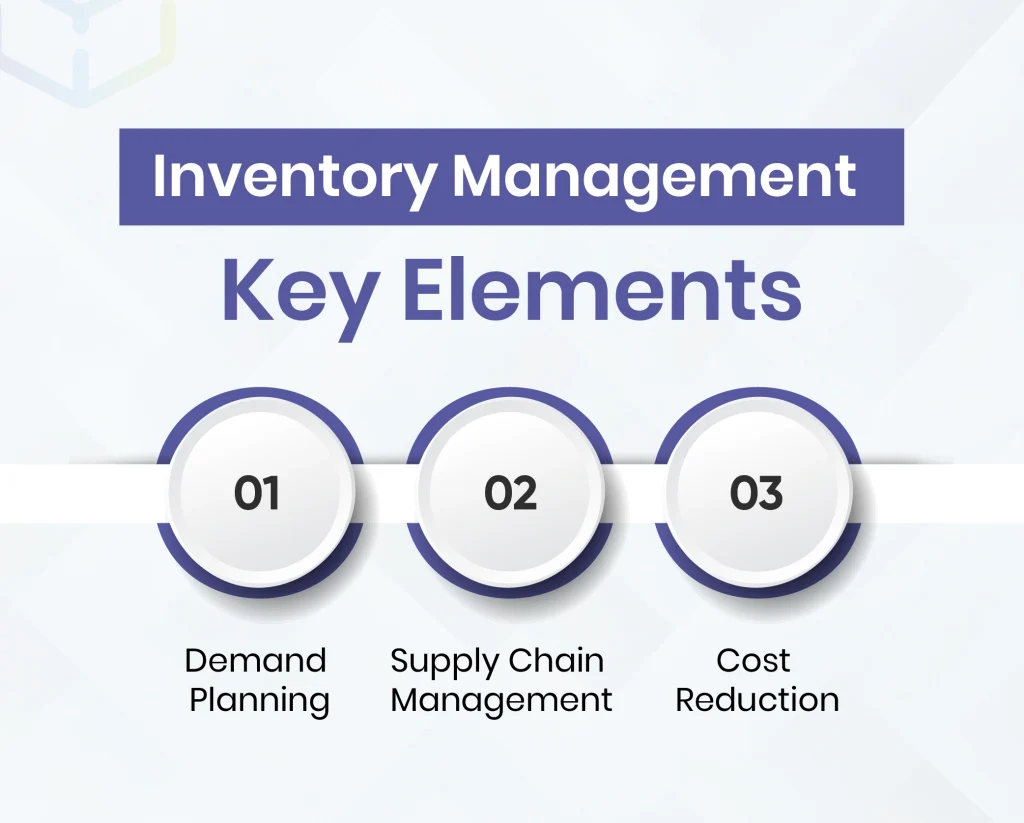
- Demand Planning: AI-powered forecasts level up the demand planning process. These smart tools can spot trends that humans might miss, and they can process more data points in less time, speeding up the process. Forecasts are more accurate thanks to cutting-edge technology.
- Supply Chain Management: The supply chain needs to be controlled closely, and greater coordination with supply partners is necessary to ensure timely shipments.
- Cost Reduction: Minimizing inventory costs is critical for high profit margins. Stockouts, overstocking, carrying costs, and so on need to be carefully managed so that costs go down.
Inventory Management Systems
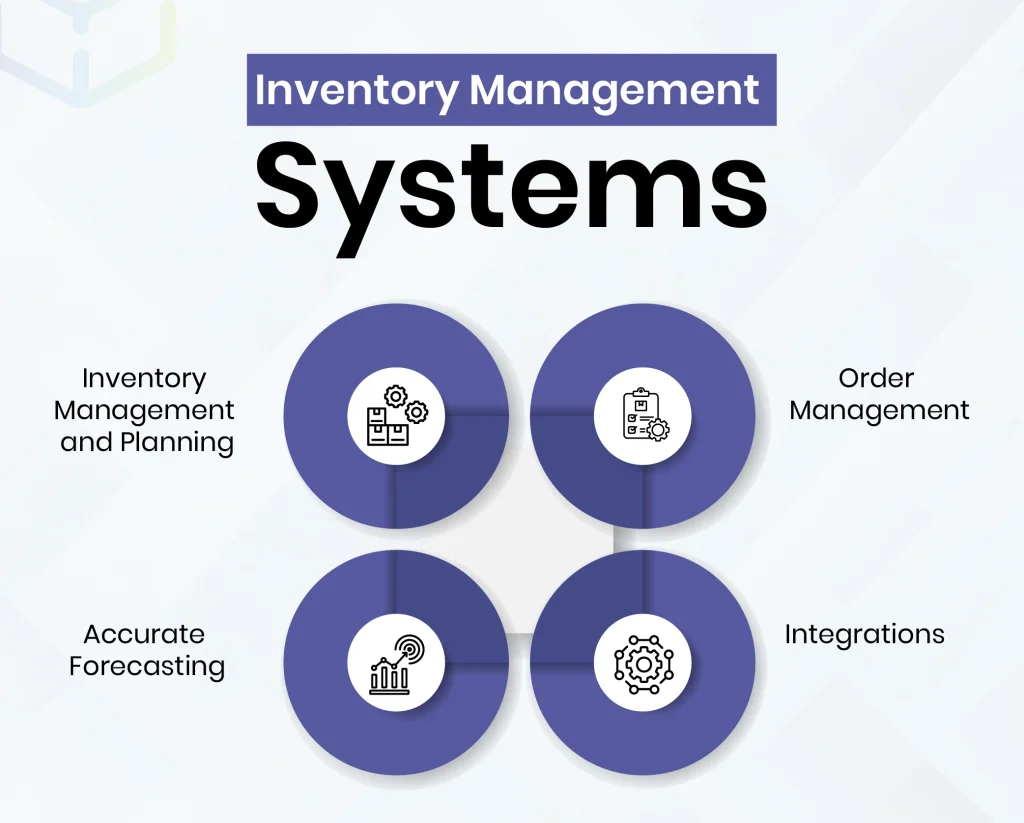
An inventory management system normally has a wider scope compared to inventory control systems. Thanks to these sophisticated features, you gain higher visibility and control over your inventory operations and supply chain. Here are the main elements of the inventory management system.
- Inventory Management and Planning: These are integrated with the procurement workflow to ensure reliable order placements and fulfillment based on AI-powered demand forecasting and predictive analytics.
- Order Management: Inventory management systems go beyond simply inventory tracking. They handle not only order processing and fulfillment but returns management as well.
- Accurate Forecasting: Machine learning tools and smart algorithms process historical data to accurately predict demand. More accurate forecasts prevent inventory surpluses and deficits.
- Integrations: The inventory management system connects with your ERP, CRM, accounts software, and other business tools to update inventory automatically on these tools without manual data entry. Human effort, errors, and delays go down.
Comparing Inventory Control with Inventory Management
Although they are closely related, there are some differences between inventory control and inventory management despite a strong overlap. Both have their place in supply chain management. Using both methods more effectively is easier once you understand their differences and similarities.
Similarities Between Inventory Control and Inventory Management

Inventory management and inventory control both:
- Optimize Stock Levels: Both methods focus on maintaining the right level of inventory that is neither too much nor too little. Keeping lean or optimal stock levels cuts costs and helps you avoid extra stock and stockouts.
- Rely on Specialized Technology: Inventory tracking, management, and control become much easier with technologies like RFID/barcode scanning support, POS terminal support, omnichannel support, multilocation management, and so on.
- Improve Customer Satisfaction: Since there are far fewer stockouts, lost sales, and cancelled orders with proper inventory management and control, customer satisfaction stays high.
- Improve Profit Margins and Cash Flow: Since stock levels are optimized, inventory costs decline, improving profit margins. Lean inventory levels mean that cash is not consumed by unnecessary stock items – this improves cash flow.
Differences Between Inventory Control and Inventory Management
The main difference between inventory control and inventory management is that the former is operational while the latter is more strategic in nature.
Inventory management and inventory control have the following differences.
- Management Scope: Inventory control largely deals with daily warehouse inventory operations. Inventory management, meanwhile, has a wider scope that includes supply chain management, procurement, production, and sourcing.
- Operational vs. Strategic: Inventory management can be described as more strategic since it deals with the bigger picture and involves other business functions to drive efficiency. Inventory control is by its very nature more focused on day-to-day operations, dealing with daily stock problems and workflows.
- Complexity: Although both have a lot in common, inventory management systems in general have more advanced tools than inventory control systems, which include multilocation management, integrations with business tools, and demand forecasting.
- Use Cases: Smaller businesses may find that inventory control systems are more suited for their daily inventory workflow. Bigger enterprises, on the other hand, will generally need something more advanced, like inventory management systems, to handle extensive supply chains, high-volume order fulfillment, multilocation management, and other needs.
Inventory Control Methods
Depending on your type of business, you will have to choose methods of inventory control that better suit your needs. This will depend on the product types you deal with, company size, and the industry in which you operate.
Here are some well-known methods to control inventory.
- Just-In-Time: Also called JIT, this inventory control method focuses on keeping the lowest possible inventory level for continuous production. There should be just enough inventory to fulfill demand and not any more than that. By reducing inventory to the bare minimum, just-in-time inventory management greatly improves cash flow and cuts inventory costs. That said, supply chain management must be top-notch for JIT to work well.
- First In, First Out: Also called FIFO, this technique is meant for perishable items, like cosmetics and foodstuffs. By processing older stock items first, this method reduces problems with perishable goods, like expiry, spoilage, and waste.
- ABC Analysis: Classifies goods into fast-moving and slow-moving goods for better management. It is based on the 80/20 rule, where 20% of goods (fast-moving) produce around 80% of your sales, while the rest (slow-moving goods) account for fewer sales. Fast-moving goods (class A) are placed close to workers, while slow-moving goods (class C) are placed deeper inside the warehouse. This reduces average worker travel distance and speeds up item picking, driving faster warehouse operations.
- Economic Order Quantity: Determines the optimal amount of stock that should be ordered at a time. By setting the right size and frequency of purchase orders, EOQ reduces holding costs and prevents extra stock.
Look no further than WareGo - the top choice for streamlined inventory control.
Start FREE Trial!Maintaining Optimal Inventory Level with Smart Forecasts
Harnessing historical inventory data gives you insights into how customer demand can vary. You can make more accurate forecasts by leveraging this data. Here are the factors you need to consider:
- Average Units Sold: Keep track of how many units are usually sold during a given time interval.
- Lead Time: The time it takes for a supplier to ship inventory following a purchase order.
- Working Capital: Understand how much cash is available for purchasing inventory.
When using this approach, consider seasonal opportunities, like the holidays and Black Friday, to plan for more effective demand planning. Inventory management software is a powerful tool for this process.
Forecasts are more accurate when you have more available data. You can accumulate more data if your business operates for a longer period. But till that happens, you may have to be more cautious because forecasts are less accurate with limited data.
It may be better in this case to err on the side of caution by ordering more safety stock. This way, you reduce the risk of stockouts, which leads to cancelled orders and unhappy customers. When more data becomes available, you can think of reducing your safety stock level.
Forecasting software is your go-to solution for preventing stockouts and overstocking with optimized inventory levels.
Optimize stock levels effortlessly with smart forecasting software
Let’s Talk!Managing Cash Flow for Stock Replenishment
Accurately forecasting demand is no doubt key to demand planning and control. However, even with the best forecasts, you can’t purchase inventory on time if you don’t have the necessary cash flow.
Hence, just like you have demand forecasting, you also need cash flow forecasting. With this tool, you can maintain the cash flow you need to purchase enough stock prior to peak demand.
WareGo – The Leading Inventory Management and Control Software
WareGo is emerging as the top choice for savvy brands looking for next-level inventory management and control.
Here is how this comprehensive system streamlines your inventory.
-
Barcode Scanning Support
Barcode scanning support greatly speeds up warehouse operations by automating data entry. To complete any inventory process, workers can update the system simply with a quick barcode scan instead of manually entering data. Reduces human effort, errors, and delays.
-
Smart Cycle Counts
Counting your physical stock is necessary to ensure your inventory records are accurate. However, counting each and every stock item is time-consuming. It is also highly disruptive, since all inventory processes must stop for stock counts to proceed.
-
Multilocation Management
Extends high visibility over inventory movement across all your locations. You gain a good view over inventory even if it is spread across multiple locations.
-
Automatic Stock Replenishment
When stock levels fall below a certain threshold, the system triggers automatic stock purchases to prevent stockouts.
-
Alerts and Notifications
The system automatically issues alerts and notifications when stocks go low. The team can then take timely action to prevent disruptions.
-
ABC Classification
Identifies fast-moving and slow-moving goods. Fast-moving goods are placed closest to workers so that the average travel distance falls. This speeds up picking and downstream warehouse operations.
-
Serialization
The system assigns unique codes to each inventory item to allow tracking and correct identification. This is useful since it prevents workers from picking the wrong item, which may be very similar to the ordered item.
-
Reports and Analytics
You gain actionable insights to streamline inventory operations with instant reports and advanced analytics.
-
Forecasts
AI-powered forecasts improve demand prediction. Overstocking is reduced, improving cash flow and reducing inventory costs.
-
Safety Stock
Optimizing the safety stock level keeps costs down and frees up precious cash while minimizing stockout risk.
-
Integrations
Integrations connect the inventory system with your business tools like the ERP, CRM, and accounts software. This way, the system can automatically update inventory on your business tools without the need for manual data entry.
-
3PL Monitoring
Streamlined coordination and real-time KPI tracking of supplier performance improve shipment times.
-
KPI Tracking
Track KPIs in real-time for all inventory, order fulfillment, and warehouse operations. The numbers provide the data you need to boost efficiency.
-
Returns Management
Automation reduces manual work while validation rules prevent errors in returns processing. Customer satisfaction remains high.
-
Customer Portal
Customers can use portals to place orders, initiate returns, provide feedback, and more. Customer experience improves.
-
Fleet Management
Optimized shipping routes and schedules enhance the performance of transport vehicles.
-
Omnichannel Support
Centralized inventory updates automatically whenever a transaction takes place on any sales channel. No need for manual inventory updates. This greatly simplifies ecommerce and multichannel inventory.
-
Automatic Billing and Invoicing
Your suppliers are paid on time with automatic billings. Automated invoices eliminate mistakes that can hurt customer experience. Your staff saves time, and productivity rises.
WareGo has everything you need for effortless inventory management and control.
Start FREE Demo!Bottom Line
Although there is much overlap, inventory control and inventory management have certain differences as explained above. Understanding the differences and similarities can inform your inventory strategy.
But whatever the differences and similarities, one thing is for sure. Powerful inventory software like WareGo is essential for stepping up inventory management and control. The software has everything needed to streamline and simplify inventory.
FAQs
What Is The Main Difference Between Inventory Control And Inventory Management?
The main difference between inventory control and inventory management is that the former focuses on daily operational tasks (like inventory tracking, storing, and receiving), while the latter looks towards broader long-term matters like supply chain management and demand planning.
Can a Business Use Inventory Control without Inventory Management?
While small businesses rely primarily on inventory control, it does not mean they can do without inventory management. Even small entities need some level of inventory management, like forecasts and supplier management.
Midsized and large enterprises need sophisticated inventory management to simplify complex inventory.
Can the same inventory management and inventory controlling tool be used?
Yes, WareGo has all the functions and features you need for effective inventory management and inventory control. It is the premier all-in-one solution for your inventory needs.
Can Technology Integrate Inventory Control and Inventory Management?
Powerful inventory solutions like WareGo offer both inventory control and inventory management features. What’s more, the system also has 200+ integrations that connect inventory data with your ERP, CRM, accounts software, and more to automatically update inventory on these business tools.