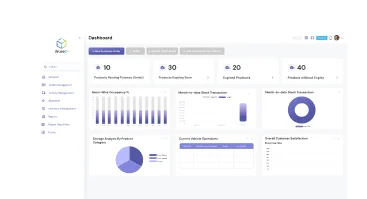
The warehouse receiving process is where your supply chain starts. Hence, it is unsurprising that the receiving process has a significant impact on your fulfillment performance. The right warehouse management software can streamline this critical process.
Receiving is vital because it covers so many crucial parts of your supply chain, like unloading goods, receiving purchases, and storing purchased goods in your warehouse.
Warehouse receiving requires effective execution to account for all purchased inventory and ensure it is ready for packing, picking, and shipping. Great care must be taken to avoid even minor errors, as they can negatively impact operations and customer satisfaction.
You should go the extra mile to enhance warehouse receiving since doing so can reduce costly mistakes, speed up warehouse processes, and cut costs. Doing so is vital, especially for competitive markets like the USA. Our comprehensive guide has all you need to enhance your warehouse receiving via best practices and proven strategies.
Table of Contents
Warehouse Receiving Defined
Warehouse receiving involves unloading, inspecting, and storing inventory that comes to your warehouse. Check received goods to ensure they have been delivered in the right amounts and specifications.
Confirm that the correct items have arrived in the proper quantities according to the purchase order. The condition of the received goods must also be satisfactory. All items must be free of damage or other defects.
The receiving process starts typically by confirming that the receiving documents match the purchase order. Once shipment accuracy is confirmed, the received items should be unloaded and then carefully inspected for damage or any discrepancies. After completing this step, all items are sorted and then organized by storing them in the correct warehouse locations.
Fast and accurate receiving is crucial for maintaining precise inventory records, preventing discrepancies in stock figures, and supporting fast, error-free order fulfillment. A stable receiving workflow ensures minimal errors in the early stages of the supply chain, allowing shipping, packing, and picking to proceed smoothly.
A robust WMS has all that you need in this regard and more.
Read More: Detailed Guide to Warehouse Management System
Our friendly experts can explain how WareGo supports your vital receiving function.
Start My FREE Consultation!Inventory Receiving Procedures
Inventory receiving procedures are necessary for reliable receiving, inspection, and storage of incoming goods. Here are the steps involved.
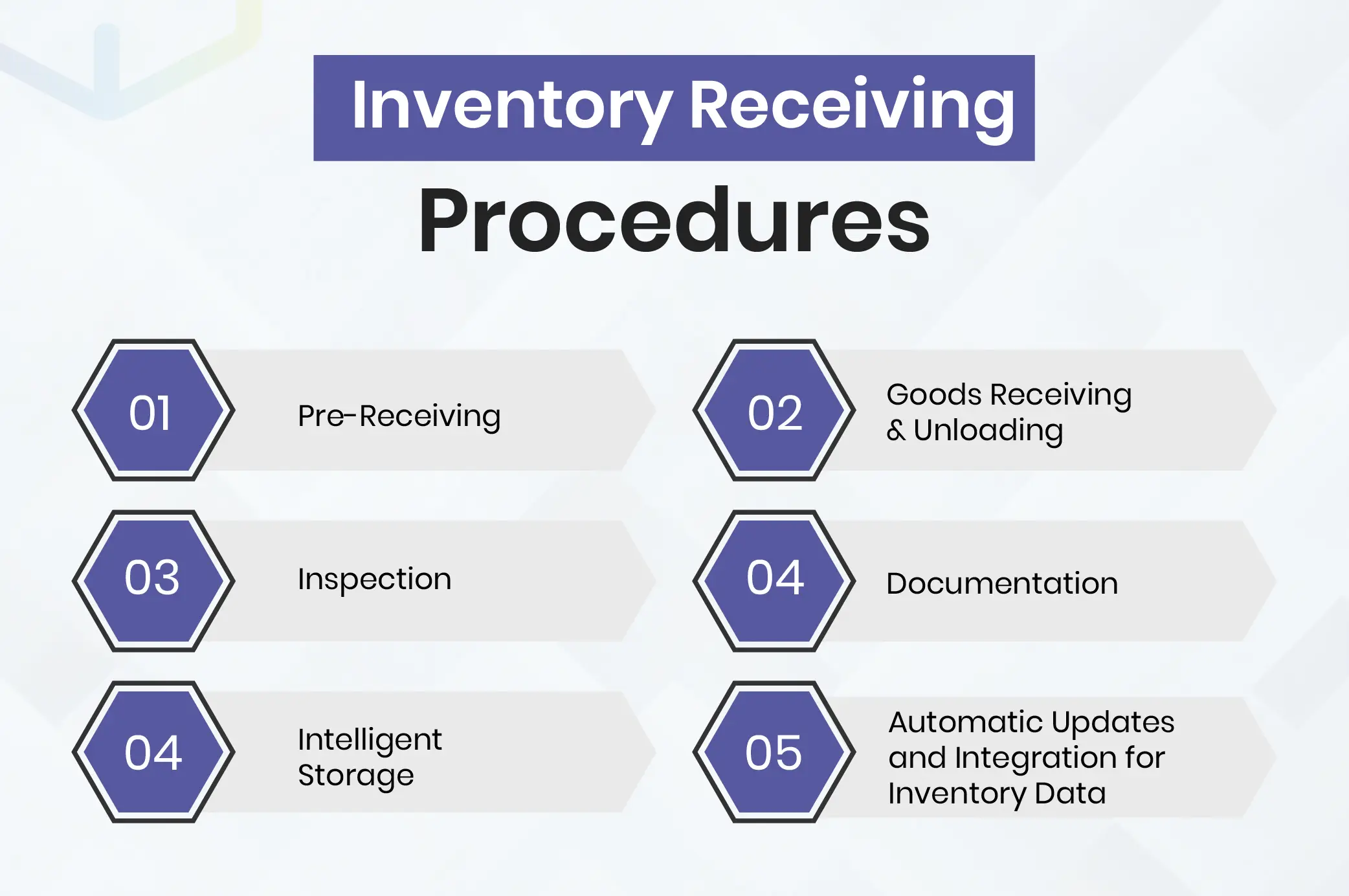
1. Pre-Receiving
The warehouse team will go through purchase orders and delivery deadlines to prepare for the incoming shipment. Labels and receiving should be ready, while shipment details must be confirmed with suppliers. The right level of personnel is allocated for efficient receiving, along with the necessary equipment to prevent delays when the inventory arrives.
The team will stand ready with scanners to read barcodes attached to goods received. Barcodes contain information about shipped inventory. The WMS receives this data and checks to confirm that the right items are present.
Best Practice: Use the receiving module of the WareGo WMS to easily schedule equipment and labor for receiving and to confirm the delivery of all goods in the right amount.
Example: The WMS allows warehouse personnel to track shipments in real-time and also issues notifications when deliveries are approaching completion. Warehouse management can arrange teams and equipment, such as forklifts and handheld barcode readers, to process incoming inventory.
2. Goods Receiving & Unloading
When the goods finally arrive, staff should unload them with care to prevent damage. The warehouse team will then check the receiving documents and purchase orders to confirm that the correct quantity of each item has been delivered. Safety precautions are necessary to prevent injuries, and careful unloading is needed to avoid damage to goods.
The right WMS, like WareGo, enables your workers to validate received items in real time with a scan. In case there is any discrepancy, the WMS will immediately alert the team via instant notifications. Receiving errors and slow manual processes can be avoided with a capable system.
Best Practice: For fast-moving goods, use WareGo’s cross-docking feature to process and ship received goods immediately. You can avoid storing and retrieving these goods later, saving your team a lot of time and effort whilst ensuring rapid deliveries to your waiting customers.
Example: FMCG (fast-moving consumer goods) are loaded immediately into waiting trucks for quick delivery as soon as they are received.
Try out the 100% free demo to see our cutting-edge platform live in action.
Start My FREE Demo!3. Inspection
The receiving team should thoroughly inspect shipped items thoroughly to make sure they are in good condition. They should look out for problems like broken seals and visible damage. The team should also check for incorrect or missing items. The warehouse team should also assist by comparing the quantities and types of items received against the information contained in their purchase orders. Any incorrectly delivered or damaged item should be stored safely for returns. Damaged or incorrect items should not be included in the warehouse inventory.
Best Practice: You can easily track the performance of 3PL partners and suppliers with WareGo. 3PL and supplier features are ideal for analyzing the causes behind longstanding supply problems. Use these features to streamline your supply chain and ensure reliable shipments.
Example: After reviewing reports and analytics data from the WMS, management discovers that picking errors are behind increased customer returns. They can now resolve the issue by coordinating with the concerned 3PL partner.
4. Documentation
Documenting received goods is necessary to maintain accurate inventory figures. Enterprise-grade WMSs like WareGo can record all key information concerning received goods, like discrepancies (if any), quantity, and item type. Traceability improves so you can find the root causes behind receiving errors and supplier issues.
Best Practice: Barcode/RFID scanning support in a modern WMS automatically captures and records received inventory information, eliminating paperwork and manual data entry and reducing errors.
Example: the cloud-based WMS WareGo automatically updates inventory information in real-time with each transaction. Built-in support for barcode/RFID scanning and POS terminals is core for automatic updates.
5. Intelligent Storage
After inspecting and documenting the shipment, warehouse staff store the inventory optimally inside the warehouse. Strategically placing inventory is a proven tactic for fast, error-free picking. A variety of inventory management techniques bolster warehouse productivity, such as ABC classification, serialization, slotting, and more.
Inventory techniques allow you to capitalize fully on your limited warehouse space. Picking speed goes up. Comprehensive inventory software factors in various metrics such as inventory turnover rate, demand, size, and SKU volume to determine optimal storage locations for each SKU.
For example, WareGo relies on ABC classification to place fast-moving goods closer to workers and packing stations, thereby accelerating pick and pack work. Slow-moving goods, on the other hand, are placed deeper in the warehouse, further away from both workers and packing stations.
The average travel time to pick an item goes down. Average item pick speed rises.
Serialization and slotting are also central to fast and hassle-free item picking. WareGo supports these and other inventory methods out of the box.
Best Practice: Complete your receiving process with an advanced WMS that supports ABC classification, slotting, serialization, and other proven inventory methods for fast order fulfillment.
Example: WareGo provides powerful inventory tools to optimize inventory storage for faster picking, packing, and shipping.
6. Automatic Updates and Integration for Inventory Data
A reliable WMS that supports barcode/RFID scanning will automatically update inventory data whenever staff scan barcodes on received goods. Manual data entry, errors, and delays decline while staff productivity improves by leaps and bounds.
WMS software is always a better option than spreadsheets, despite the latter’s popularity. Spreadsheets lack built-in support for RFID/barcode scanning and become increasingly chaotic as inventory grows. Spreadsheets were never designed to scale with growing inventory and complex operations.
WMS software, meanwhile, is ideally suited for real-time inventory tracking, automatically updating inventory data, providing complete visibility into complex warehouse activities, and more. Common warehouse problems, such as stockouts and overstocking, are easily mitigated with these cutting-edge features.
Powerful integrations in modern WMS solutions sync inventory data with your backend business systems, such as ERPs, CRMS, ecommerce platforms, accounts software, and more. Integrations reduce manual work, errors, and delays while raising accuracy and productivity.
Best Practice: Cut manual work with RFID/barcode scanning support and integrations.
Example: WareGo saves time, effort, and money with support for RFID/barcode scanning and 200+ integrations that sync your inventory data with widely used business software.
Receiving Warehouse Problems
Certain receiving warehouse problems are found across the board. Here are some of them.
- Incoming delivery trucks often undergo long wait times before they can unload their shipments.
- Suboptimal inventory placement prevents the best use of limited warehouse space.
- Subpar work scheduling can reduce team productivity.
- Lack of training and experience prevents team members from doing their very best.
- Lost or misplaced items slow down order fulfillment.
Warehouse Receiving Best Practices

Warehouse receiving best practices provide numerous benefits for businesses of all types. Manufacturing firms can meet their manufacturing targets and maintain lean inventory with reliable receiving.
Retail and ecommerce businesses can maintain higher customer satisfaction with improved order lead times through efficient receiving.
Here’s how organizations can bolster their receiving workflows for fast, error-free warehouse operations.
1. Deploy a Proven WMS
Receiving goods can be tedious, time-consuming, and prone to errors if you don’t use a reliable WMS. Legacy systems, and worse, spreadsheets, lack several key features that modern WMS solutions use to boost your receiving process. Manual documentation and monitoring of inventory, equipment, and labor are slow and error-prone.
Advanced warehouse software gives you the functionality you need to optimize such tedious tasks, slash errors, and save time. Accurate forecasts can prevent overstocking, while automatic inventory reordering can reduce stockouts.
Get your answer with a 100% FREE trial.
Start My FREE Trial!2. Track Key Metrics
Collecting data to track key metrics of your warehouse receiving is vital for improving receiving performance. Whatever data is collected needs to be carefully analyzed to find room for improvement. Tracking key metrics in real-time is a great way to improve receiving.
The good news is that modern WMS solutions provide in-depth analytics, as well as instant reports from which you can follow the metrics that really matter, such as:
- Dock-to-stock time
- The hourly rate at which items are received
- Average cost of storage per item
- Truck wait times
- The rate at which items are stored
Monitoring such information is crucial for improving your receiving function.
3. Use Clear Labeling
Use barcode labeling so your workers can process inventory without manually entering data. RFID tags are even more efficient. Hence, if you have the budget, it may be worth investing in RFID inventory tracking. Modern technologies, including barcode scanners and RFID tags, are now essential for rapid receiving activities.
Overall warehouse performance will improve significantly since the problems that slow down fulfillment, like misplaced items and lost units, are eliminated.
4. Efficient Labor Scheduling
Labor costs account for well over half of warehouse expenses on average. You should find ways to improve labor productivity to reduce labor costs.
A dependable warehouse system lets you schedule labor tasks and activities to make the best use of this vital resource. Productivity goes up, which increases profit margins, and labor costs decline. Your workers benefit since they can achieve more with less effort, thereby improving their overall job satisfaction. You retain more of your best workers when satisfaction is higher.
5. Carry Out Regular Inspections
Conduct regular inventory audits and inspect the warehouse floor and activities firsthand. Carrying out physical counts gives you confidence that your inventory information is accurate and up to date. Increased vigilance allows you to spot inventory issues before they snowball into costly problems. Based on information gained from these audits, you can bolster warehouse receiving processes.
WareGo provides smart cycle counts for inventory audits. While physically counting inventory is vital, it is time-consuming and highly disruptive. Counting all inventory will consume excessive time and bring all other warehouse operations to a standstill.
Getting around this problem is easy. Smart cycle counts target only the most critical parts of your overall inventory. You gain almost all the benefits of counting inventory without going through each unit.
WareGo uses smart cycle counts for the right SKUs and units. You can gain certainty about inventory accuracy without wasting time or causing disruptions.
Our price plans offer the most affordable rates for enterprise software.
Check price plans!6. Check All Documents
You can confirm accurate receipt by matching the goods received with the purchase order. Make sure that all product types and their respective quantities are correct.
A well-designed WMS is highly helpful in this regard since it will have barcode/RFID scanning support along with automatic inventory updates. With just a scan, workers can quickly capture received inventory data. The WMS will then update its inventory information and also check items and their quantities to ensure they match the purchase order. In case of any discrepancy, the system issues alerts and notifications to inform your team.
WareGo has this functionality and can hence streamline the receiving process in your warehouse.
How Optimized Warehouse Receiving Process Flow Benefits You
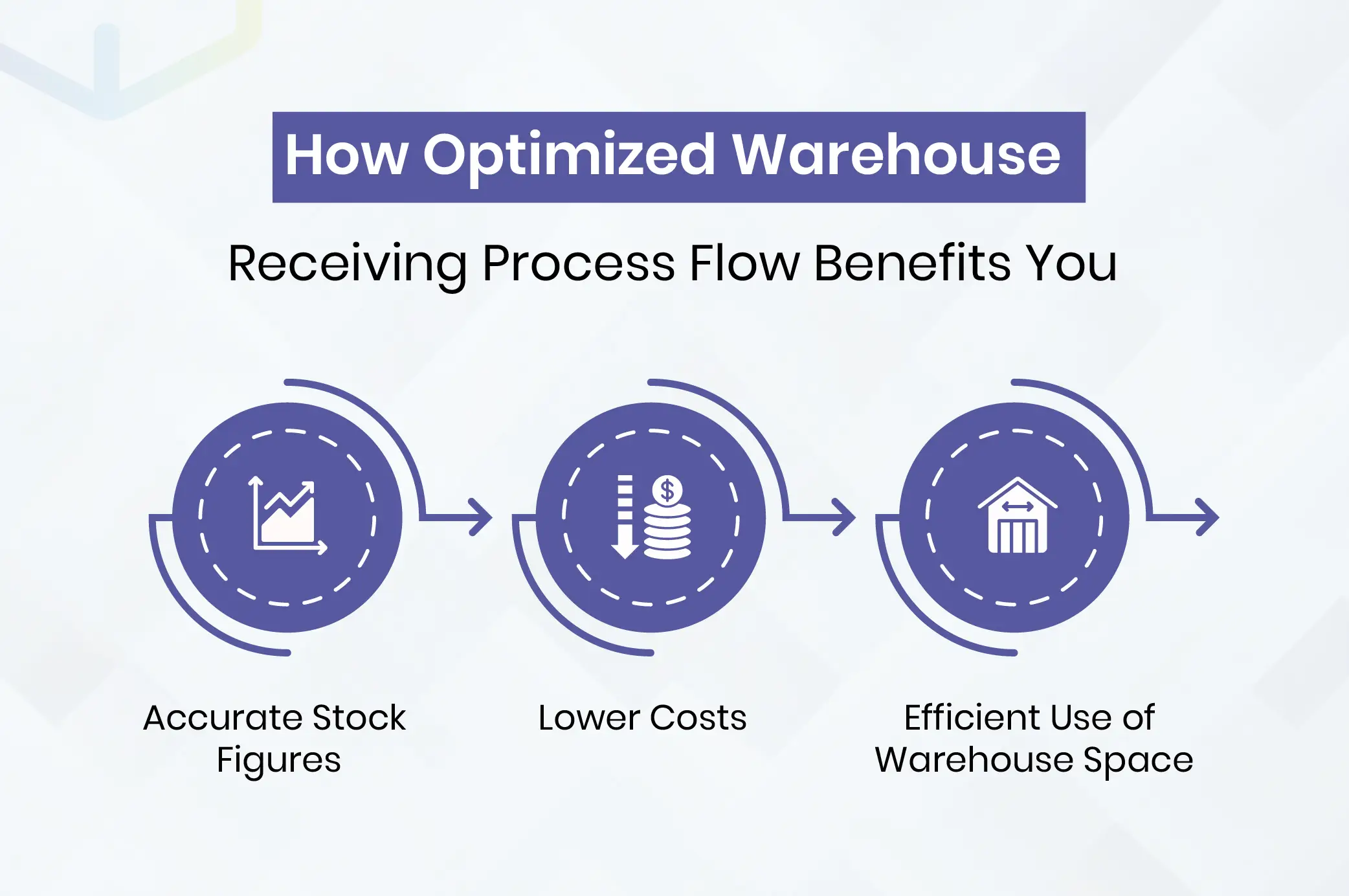
A highly optimized warehouse receiving process flow gives you high confidence that suppliers will deliver the right items on time in the correct quantities. You can also be sure that goods received thus will be in good condition and not damaged in transit.
Slow receiving, on the other hand, can significantly slow warehouse operations since this function is at the very start of all warehouse activities. Unreliable receiving will also mean that damaged goods make it to the warehouse floor. Incorrect quantities can create stockouts and fulfillment errors, leading to dissatisfied customers.
Here are the benefits of optimized receiving.
1. Accurate Stock Figures
Maintaining accurate stock figures is of great help in avoiding stockouts, shrinkage, and other inventory problems that can set you back. Inaccurate stock figures lead to stockouts, subsequent lost sales, and disappointed customers. Effective receiving is vital for fulfilling customer orders quickly and accurately.
Precise numbers are crucial for accurate forecasts. Forecasting is all about how much inventory to buy for your current inventory. That is, current inventory data is a key input for your projections. If current inventory data is inaccurate, then subsequent forecasts will lack precision.
2. Lower Costs
Efficient receiving reduces the chances of stockouts and excess inventory. Hence, inventory costs go down. Streamlined receiving also requires fewer person-hours due to automatic inventory data updates that eliminate manual data entry. Hence, labor costs also go down.
3. Efficient Use of Warehouse Space
Limited warehouse space can be used more effectively with smooth receiving. Received goods can be organized intelligently to allow for faster operations.
A feature-rich WMS can give you complete visibility of the warehouse floor so you can improve its layout and how inventory is organized. Warehouse space utilization improves as a result.
The right WMS will improve all warehouse operations, beyond just receiving.
Shipping and Receiving Process Checklist
The shipping and receiving process checklist shows all necessary tasks, verifications, and checks that staff need to carry out when the shipment arrives.
A complete checklist will enable the correct receiving, inspection, documentation, and storage of shipped items. The list will have all the necessary steps, precautions, and best practices to improve the receiving function.
The checklist enables the team to optimize inventory flow inside the warehouse, follow safety precautions, ensure inventory accuracy, and maintain an orderly workflow. It includes all the necessary checks and instructions to minimize oversights that lead to errors and subsequent delays, discrepancies, and wasted time.
Warehouse Receiving Process Checklist – What It Contains
Here is what the warehouse receiving process checklist should contain.
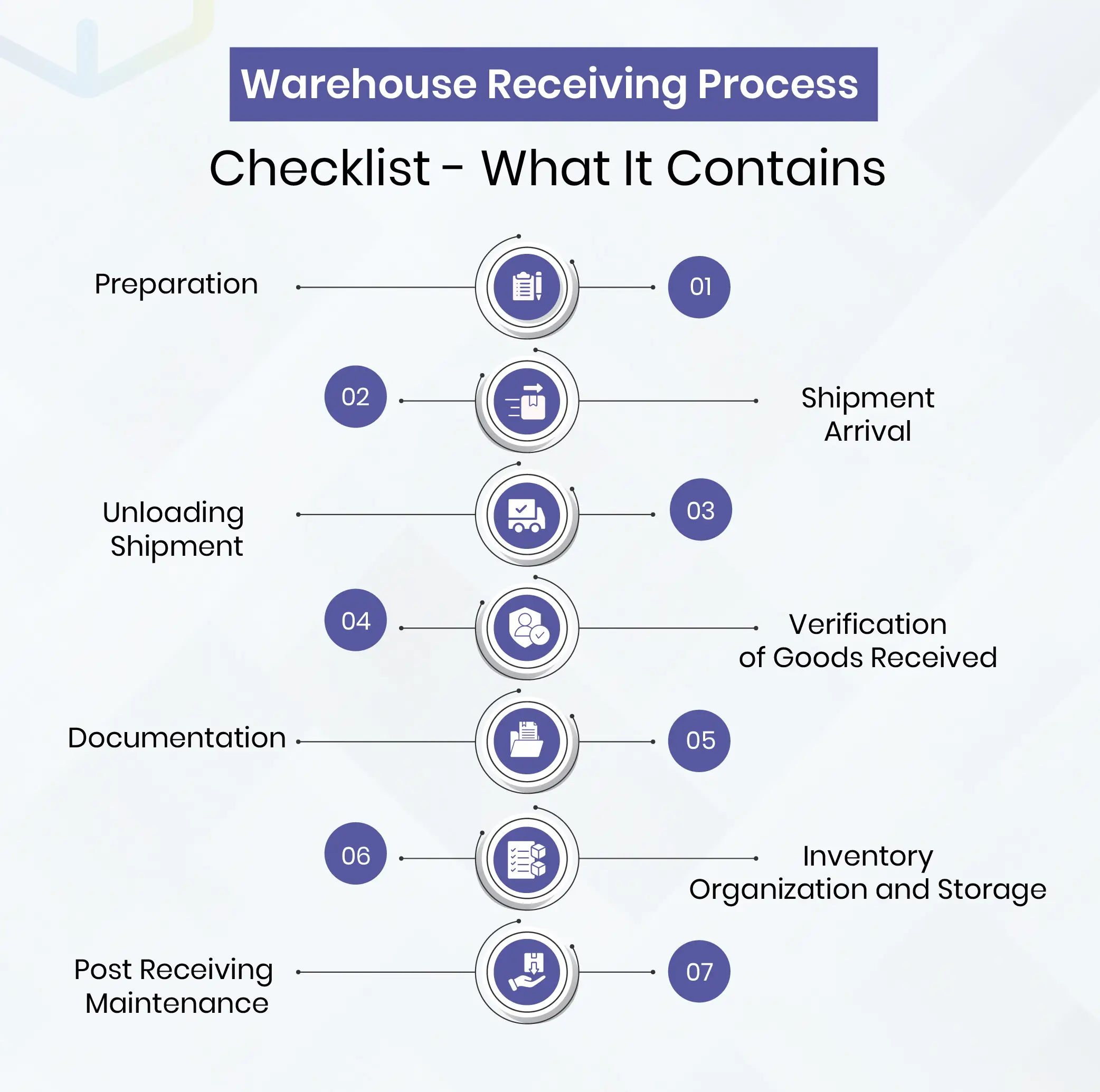
1. Preparation
Maintaining proactive communication with your supply partners is essential for timely shipments. Confirm and review shipments regularly to be sure that there will be no unexpected delays or other such problems. Acting proactively in this way minimizes late shipments and allows you to stay ready in case of delays.
A schedule of key tasks should be available in advance of incoming shipments. You can use modern tools contained in a sophisticated WMS to balance work, prioritize shipments, and process received goods effectively.
Prepare the receiving section to allow ample room for shipped items. Remove all obstructions to minimize the risk of accidents and to enable the uninterrupted movement of goods and labor.
Provide staff with all necessary equipment. Safety comes first, so equip staff with the necessary safety gear to ensure well-being for everyone. Also, ensure the availability of scanners, pallet jacks, forklifts, and so on to process inventory quickly and accurately.
Provide special instructions in case fragile or hazardous goods are being received. Staff should be trained in the safe and effective handling of such goods to prevent damage and injuries.
2. Shipment Arrival
For incoming shipments, provide ample parking space for freight trucks. Designate the parking spot for each vehicle to maximize both efficiency and safety. Allocating parking spots individually allows free traffic flow, easy unloading, and higher efficiency. High-throughput warehouses with plenty of incoming and outgoing trucks need such an organized approach.
Precise and thorough documentation is vital for traceability, analytics, and insights. The documentation process can reveal any discrepancies in goods received and purchase orders. Noting such issues at the earliest stage prevents bigger problems down the line.
3. Unloading Shipment
Since all items being received provide value for the receiving warehouse, take full care when unloading these goods. Careful handling is needed so that customers can obtain goods in the best possible condition.
Separate all items into logical categories to enable efficient handling. When categorized correctly and organized well, received goods become easier to manage and process. Workers will have an easier time finding items they need to prioritize.
Check goods for any signs of damage. Early identification of damaged goods is necessary to file insurance claims, return items to suppliers, or find another resolution. Checking goods and documenting them can help you identify patterns that need attention, like frequent damage to goods, incorrect items, and so on.
4. Verification of Goods Received
Check goods received against your purchase order to confirm seamless logistics performance.
Detailed verification of goods is necessary beyond just surface-level checking. Taking meticulous care in this way prevents problems like receiving items with incorrect specifications. Finding problems early on can let you determine whether these issues are the responsibility of the supplier or the result of rough transit conditions.
Note discrepancies and problems immediately so that these issues can be resolved at the earliest. Operational disruptions can be minimized with quick action early on. Instant reporting sets the tone for efficient supply chain performance and paves the way for deeper collaboration with suppliers.
WareGo has the full suite of 3PL WMS features to facilitate 3PL coordination at another level – perfect for enhancing supply chain performance.
5. Documentation
State-of-the-art WMS will minimize data entry for your staff, thus saving your team plenty of time, money, and effort. Barcode/RFID scanning support and automatic inventory updates are key in this regard.
Automatic documentation and updates for your inventory lead to improved forecasts, optimized procurement, and lean inventory levels.
Enterprise WMS will also provide you with the necessary documents and forms to record all necessary details. You can minimize paperwork this way, including the hassle that comes with handling large volumes of paper files and documents. Physical copies of these require filing cabinets and occupy large amounts of precious space. A good WMS minimizes these problems by providing a data storage solution that makes data retrieval much easier compared to paper files and cabinets.
Keep a complete record of everything, be it damage to goods, incorrect shipments, or any other problem, for future reference. Well-organized records are critical for key matters like improving internal workflows, resolving supplier issues, and filing claims with insurers.
6. Inventory Organization and Storage
Optimal inventory organization and storage enable quick retrieval, easy operations, and high productivity. Workers can significantly reduce the average travel time and the rate of order fulfillment when goods are intelligently organized inside the warehouse.
Perishable and fragile goods need extra care and attention. Temperature and humidity must be within a narrow range for such goods to prevent damage. Good storage conditions can minimize spoilage, maintain product quality, and ultimately provide high value for your customers.
Clear labels allow easy and quick identification of required items. Good labeling proves its worth during peak seasons and demand surges when it maximizes order fulfillment rates. Simple labels and signs allow workers to retrieve necessary items quickly. Lead times go down, and productivity rises.
7. Post Receiving Maintenance
Keeping the receiving area in a clean condition, free of clutter and obstructions, following goods receiving is vital for safety and efficiency. Cleaning up the area instills a sense of responsibility among workers and creates a good brand image. The risk of tripping and falling declines with this practice. Regular cleanup is vital for the receiving and storage of perishable goods since it prevents contamination and infestation.
All equipment, tools, and gear must be stored in the right place following the end of goods receiving. Doing so ensures that workers can find these essential items quickly when the next shipment arrives. Each tool should be in good condition and well-maintained to facilitate warehouse operations.
Tracking key performance metrics in real-time is necessary for maximizing warehouse productivity. As you would expect, well-designed WMS solutions are your best bet for following these key metrics. Regularly analyzing these metrics via reports and analytics helps identify bottlenecks that need to be resolved and opportunities that should be exploited for more effective operations.
Our experts show the proven solution to revolutionize your warehouse.
Chat with Us!Why the Receiving Checklist is Vital
Here is how a receiving checklist brings real value to your warehouse operations.

1. Streamlines Operations
A comprehensive checklist is the ideal tool for standardizing the entire receiving process from start to finish. The same level of efficiency can be maintained even if workers change.
2. Improves Accuracy
Since workers need to take care of so many things, they can easily miss out on one or two key steps that may lead to wasted time. A checklist prevents this from happening since there is virtually no risk of forgetfulness even during the busiest times. Errors go down, and inventory mismatches decline.
3. Safety Assurance
All safety procedures should be mentioned in the checklist so that they are all followed without exception. There also needs to be a step-by-step procedure for handling hazardous or fragile items.
4. Better Accountability
In case of any mistake or oversight, the root cause can be determined, and corrective steps can be implemented when a well-defined checklist guides the workflow.
5. Strong Communication
Checklists significantly reduce the possibility of oversight or misunderstandings. Verbal orders are not ideal since either the receiver or giver of the order can forget what was said in the order. A checklist prevents such confusion.
6. Beginner Friendly
Novice team members can learn the complete procedure and become fully productive with clear checklists in place. Complete checklists with simple instructions reduce the amount of assistance that newcomers may require. Training can finish much faster. Even with large numbers of incoming recruits, warehouse performance stays high when checklists are available to guide all newcomers.
7. Reduced Costs
Checklists reduce errors, prevent damage to goods, and minimize wasted time, thus saving costs in the long term.
In short, the humble checklist is more than just another list. It is a key tool for effective warehouse operations. It is hard to imagine operational excellence without good checklists in place.
Bottom Line
Receiving is a critical first step of the supply chain, due to which it has a powerful effect on downstream warehouse processes. Firms seeking efficient order fulfillment should pay close attention to the quality of their receiving workflow. The proper receiving process can greatly reduce errors, heighten productivity, and accelerate order fulfillment.
For your receiving process to reach new heights, deploying a really good WMS is imperative. Comprehensive management, optimization, and automation features can significantly improve each step of the receiving process, reduce manual work, and save time for your whole team.
Hence, you should settle for nothing short of the very best. WareGo has the ideal depth of features for most businesses and is the most affordable enterprise software by far. Cheaper solutions lack depth, while enterprise systems are overly costly and far too complex for most companies. WareGo is second to none when it comes to functionality and cost effectiveness.
Find out the many ways it delivers real value to your business operations.
Start My FREE Consultation!FAQs
What are 5 steps in the receiving process in order?
The 5 steps of the receiving process are:
- Preparation – the receiving area is prepared for the shipment, purchase orders are kept ready, and labor and equipment are scheduled.
- Shipment Arrival – when the shipment arrives, the shipper’s documents are checked against purchase orders to identify any discrepancies. Goods are unloaded carefully.
- Verification – unloaded goods are counted and their quantities compared against purchase orders.
- Quality Checking – samples are checked for any signs of damage or quality issues. If any problem is found, the shipper is immediately notified.
- Storage and Documentation – a modern WMS is used for arranging received inventory intelligently in the warehouse for fast retrieval operations and easy documentation.
What is the process of receiving?
The receiving process is a critical first step in your supply chain that verifies incoming shipments for the right quantity and quality. Efficient and accurate receiving sets the stage for fast order fulfillment.
What are the receiving procedures?
The receiving procedures are as follows.
- Preparation for receiving shipment
- Shipment arrival and unloading
- Counting of goods shipped
- Quality inspection of goods
- Goods storage and documentation
What is a receiving warehouse?
A receiving warehouse is the facility that manages the flow of incoming shipments and confirms the correct quantity and quality of shipped goods.
What is the warehouse receiving process?
The warehouse receiving process is all about efficiently managing the arrival of shipped goods, making sure that shipped goods have been delivered in the correct quantity and condition, and then documenting and storing these shipped items inside the warehouse.
What are the key steps in the warehouse receiving process?
The key steps in the warehouse receiving process are:
- Preparation for incoming shipments
- Unloading goods received
- Counting goods received
- Inspecting goods received for quality
- Storing and documenting these goods
How can technology improve the warehouse receiving process?
A reliable WMS with RFID/barcode scanning support can greatly improve the warehouse receiving process by allowing workers to record inventory received without manual data entry. Errors go down, and the process speeds up significantly. The system automatically orders when stocks fall low. It also intelligently organizes inventory storage for fast picking and thus speedier order fulfillment.