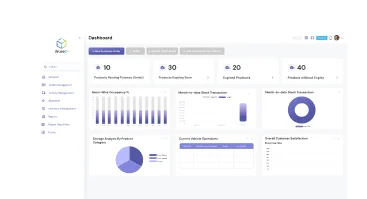
Working with an advanced warehouse management software is becoming important for companies, because it helps them to streamline various operations. It allows them to become more proactive in managing inventories, so that the products and customer orders can be managed side by side efficiently. It is especially beneficial for retail companies because they often struggle to manage their stock due to rising order volume and supply chain issues.
Currently, there are many WMS systems available in the market offering a variety of features. Selecting any one of them needs a delicate approach, because you need to evaluate different factors before making any final decision. The most important thing you need to consider is the requirements of your business, as that plays a major role in selecting any WMS. It lets you know what type of solution should be deployed that can support not just inventory management, but other critical processes as well.
In this article, we will discuss some of the top warehouse management software that should be picked by retail and ecommerce businesses in 2026. These tools are currently considered best in the industry, because they provide customizable workflows to support the warehouse management needs of every business. Let’s start from the basics understanding why businesses need a WMS to manage their day-to-day operations in a warehouse.
Switch to WareGo and manage your stock effortlessly with intelligent automation.
Try WareGo TodayTable of Contents
Understanding the Role of a WMS
Businesses need a warehouse management software due to a variety of reasons. Primarily, they are used to simplify inventory management processes, so that companies can track every product that is available on the shelf. It is one of those things that cannot be monitored manually, because long and complex inventories often create misunderstandings among the warehouse workers.
By employing a warehouse management system, administrators get real-time visibility of every stock that is available in the facility. This lets them know how much items are currently stored, and how much more will be needed to accommodate customer orders. This is basically the core advantage of a WMS that gives businesses a clear view of the inventory, so that they can manage the orders and supply chain efficiently.
By using a WMS, businesses also find ease in managing the internal operations of a warehouse. It is a tool that keeps track of every item from the moment they enter the warehouse. From receiving to shipping goods, every movement is tracked through the WMS, which keeps administrators updated at all times. It eventually helps them to keep a correct count of inventory, so that errors in stock counts can be reduced.
How to Evaluate the Best WMS for Your Business?
Choosing a WMS is not an easy task, as you need to consider some specific points before making any decision. If you do not know what type of factors should be kept in mind before choosing a warehouse management software, take a look at the pointers given below.
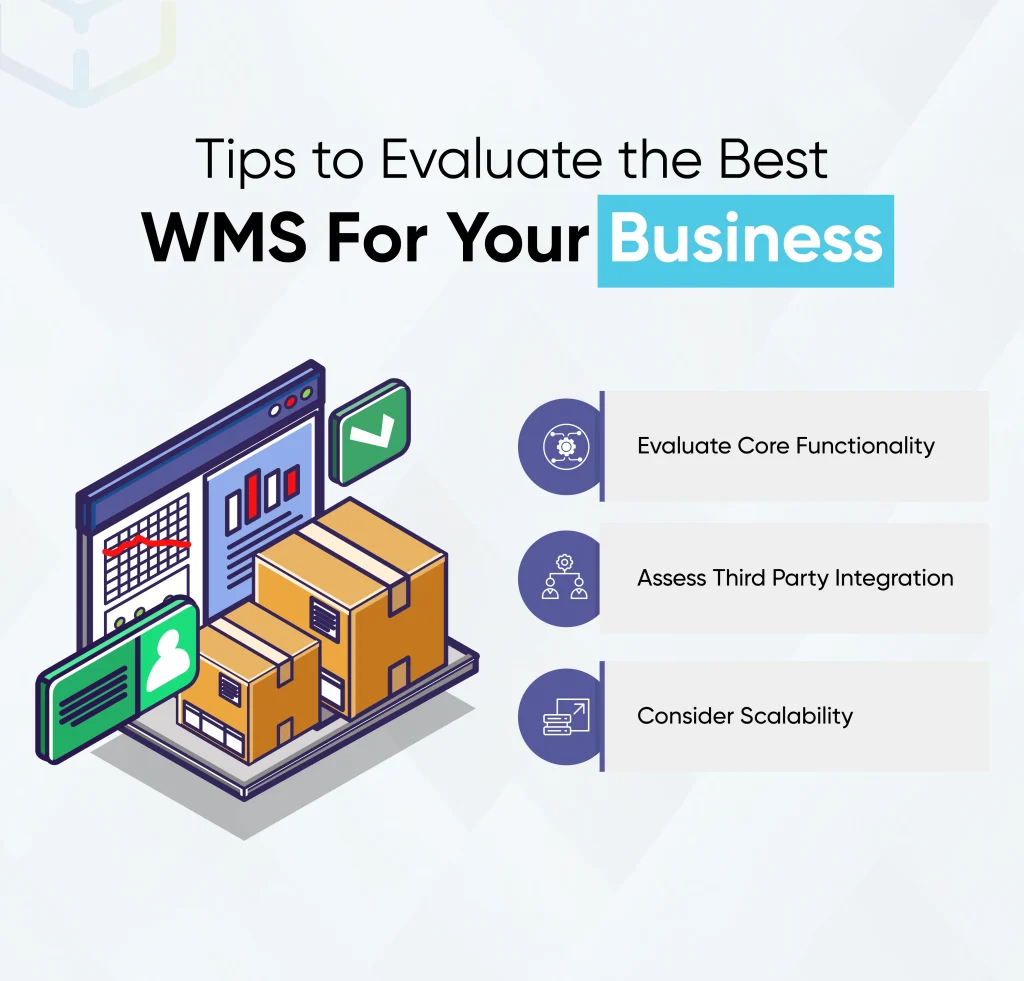
Evaluate Core Functionality
Before buying any WMS software, you need to first evaluate its core features. This is one of those things that will let you know whether the system is the right fit for your business or not. You need to check what key features are offered in its dashboard, and how your warehouse can take advantage from that. If the WMS offers proper inventory and order management solutions, then you can make up some mind about its acquisition, as these core features usually define the efficacy of a warehouse management software.
Assess Third Party Integration
The second thing you need to check in a WMS is that how much flexible it is in integrations. Nowadays, businesses want to work with multiple tools to streamline their operations. Keeping this in view, many WMS systems are built to support the integration of third party tools like ERPs, ecommerce platforms are more others. Having them in a single system allows businesses to keep all their tasks aligned, which in turn results in better productive performances.
Consider Scalability
Businesses should try to use those WMS software that can be scaled easily as per the needed demands. It is an important requirement that needs to be considered, because retail companies often struggle due to sudden spikes in sales. Their conventional systems fail to accommodate the surge in orders, which eventually results in cancellations and loss of important revenue. It is therefore recommended to always choose a warehouse management software that can be easily scaled, so that you can manage rising order volume during the peak sales season.
Types of WMS You Should Know About
Having a firm knowledge about the types of warehouse management software is important, because it lets you know what kind of solution will fit best for your business. If you do not know about the types of WMS that are currently available in the market, take a look at the classifications given below.
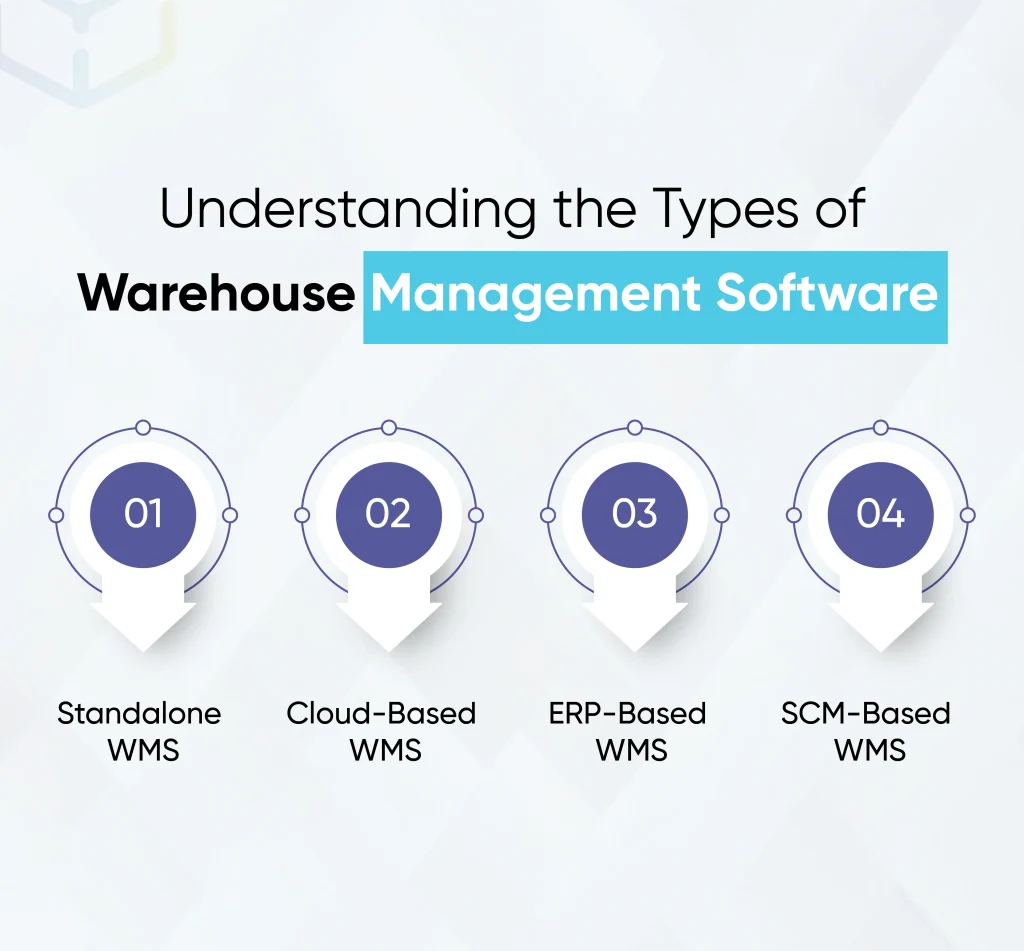
Standalone WMS
Standalone WMS are primarily built to support specific warehouse operations. They are just like a software that is deployed on a physical machine, so that users can access them directly from a system. These standalone solutions provide limited warehouse management features, which is why businesses often struggle with them while managing big inventories and orders. Besides that, they cannot integrate third-party tools, making the collaboration with different channels quite difficult for the warehouse administrators.
Cloud-Based WMS
Warehouse management software that are powered by cloud are more flexible and smart as compared to standalone systems. They are not dependent on any physical machine, as everything related to them is deployed on cloud. The biggest advantage of these systems is that they are highly scalable, meaning their resources can be easily adjusted as per the needed requirements. This is the key reason why retail businesses are advised to choose these systems, as they provide better flexibility in managing the order volume.
ERP-Based WMS
Warehouse management software that comes with features to manage key business processes like finance, HR, and customer management are called ERP-based WMS. They are also a good option for those companies that are looking to control everything from one place. These software have separate modules for every department, which makes them quite organized and easy to use for professionals from different backgrounds. Some of these systems also offer integration for other tools, which is why they are considered a good choice for retail and ecommerce businesses.
SCM-Based WMS
These software are built to handle broader supply chain operations, so that warehouses can manage every order from source to destination. They are largely used by 3PL and 4PL providers, as they need such solutions to keep track of everything. These systems provide complete supply chain visibility to the warehouse administrators, which helps them to make better stock management decisions in a timely manner.
Try WareGo today and handle your complex inventory with speed and accuracy.
Book a Free DemoRanking the Top WMS Systems in 2026
Right now, there are many WMS systems available in the market, but not all of them are recommended to use. Being a business stakeholder, you need to choose the correct WMS wisely, as the management of your warehouse and supply chain depends a lot on it.
If you do not know about the WMS solutions that are trusted more in the industry, take a look at the list given below. It will simplify your selection hassles, allowing you to pick those systems that have a proven name in the market.

1. WareGo: Best Overall WMS for SMBs & Mid-Market
WareGo is the market-leading warehouse management software that is trusted and endorsed by many businesses in the market. It is a cloud-based solution that lets you manage everything from a single dashboard. From inventory to order fulfillment, WareGo gives administrators a leverage to streamline different processes with complete accuracy.
Harnessing the power of cloud, WareGo is a cutting-edge WMS that can be scaled easily as per the evolving requirements. This means that businesses can manage the surge in orders effectively through WareGo, as it provides an advantage to scale resources without putting pressure on the management of existing inventory.
See WareGo in action within your workflows. Validate inventory accuracy, picking speed, and multi-warehouse control.
Book Live Demo2. Manhattan Active Warehouse Management
Manhattan Active WMS is one of the top solutions in the market that simplifies critical warehouse processes. Being a cloud-native product, it guarantees zero downtime and ensures to handle all processes with complete automation. Retail businesses from different backgrounds can use this WMS to gain control, as it provides end-to-end visibility of the entire supply chain.
Over the years, Manhattan Active WMS has built a strong name in the industry, as many top companies have endorsed its quality in managing warehouse inventory, shipping and other processes. It is therefore a good pick for stock management if you are looking for complete automation, as Manhattan’s cloud technology ensures to oversee every process with perfection.
3. SAP Extended Warehouse Management
SAP Extended Warehouse Management is a powerful solution that helps you to automate all warehouse operations with ease. It is built to support a high volume of orders, so that businesses can facilitate multiple clients effectively. It not only improves inventory management, but also provides real-time visibility of every stock across different locations, allowing businesses to keep track of everything.
With the help of SAP EWM, warehouse administrators can effectively monitor the inbound and outbound processes, making the entire supply chain quite smooth. It is therefore a top choice for those businesses that not only want to automate tracking, but also speed up the overall logistics process to facilitate clients quickly.
4. NetSuite WMS
NetSuite WMS is a powerful solution that allows retail companies to manage different warehouse processes with ease. Built into the Oracle NetSuite ERP, it provides a complete solution to not just manage warehouse inventory, but other critical business functions as well.
Keeping this in view, NetSuite WMS is an all-in-one-solution to handle warehouse, as well as backend operations of a business. Primarily, it is built to support warehouse processes, but its integration with the core Oracle NetSuite ERP platform makes it a good choice to support other functions like HR, CRM and others effectively.
Get started with WareGo and simplify your inventory processes using smart AI automation.
Try WareGo Now5. Oracle Warehouse Management Cloud
Oracle Warehouse Management Cloud gives you the advantage to track inventory and movement of goods in real-time. It helps administrators to monitor every process from a single dashboard where data related to inventory, order fulfillment and resource utilization are displayed in an organized manner.
With automated reports, Oracle Warehouse Management Cloud lets you know about the status of every inventory. This greatly helps in order management, allowing you to facilitate every client without worrying about stockouts. Integrated with Oracle Cloud, the WMS is also highly secure, making sure to keep all your warehouse data safe from external attacks.
6. Infor WMS
Infor WMS is a cutting-edge solution that helps businesses to manage warehouse and retail supply chains effectively. It gives them a complete solution that brings automation in routine warehouse tasks, ranging from order receiving to inventory management and more. This eliminates the need of manual tracking, as the WMS takes care of everything with complete accuracy.
Infor WMS comes with a variety of features that simplifies complex warehouse workflows. This allows in-house processes to become more efficient, as everything is managed by the platform effectively. Meanwhile, the on-demand reporting tools of the WMS are also great, providing administrators timely reports about the stock levels, surge in orders and more other critical warehouse processes.
7. Microsoft Dynamics 365 SCM (WMS)
Microsoft Dynamics 365 SCM is a leading edge supply chain management software that helps administrators to track everything from source to destination. Being a part of the larger Microsoft Dynamics 365 platform, it is a tool that allows you to align core warehouse operations with other business processes like finance, customer services and more others effortlessly.
Unlike different standalone warehouse management software, Dynamics 365 SCM is built on Microsoft’s Azure cloud platform. This gives the SCM an ability to scale quickly as per the evolving requirements which you can implement via a trusted Dynamics 365 partner, offering administrators complete peace of mind in managing order spikes.
Use WareGo to streamline your operations and stay in control with AI-driven tools.
Watch WareGo in Action8. Omniful WMS
Omniful WMS is an emerging solution that provides a variety of features to transform in-house warehouse management processes. It provides complete control to the administrators over key warehouse functions, so that they can create their own workflows and methods as per the needed requirements.
From real-time inventory tracking to returns management, everything can be managed effectively through Omniful WMS without going into any technical hassles. The platform also provides automated reports, including alerts about stock levels, so that administrators can manage their inventory and customer orders in an organized manner.
9. Fishbowl Inventory
Fishbowl inventory is a new-age WMS that handles end-to-end warehouse operations with ease. It is largely preferred by small and midsized businesses for managing inventory, sales, returns and other processes. The platform provides different modules inside a single dashboard to manage all these things, so that administrators can keep track of every operation.
Talking about integrations, Fishbowl can be easily integrated with QuickBooks to simplify accounting. This brings a big advantage for retail businesses that want to manage everything from a single dashboard, so that tracking of products and management of finances can become straightforward for them.
10. ShipHero WMS: Best for Fast eCommerce Rollout
ShipHero is a highly reputed WMS that helps businesses of all sizes to manage inventories and customer orders effortlessly. Powered by cloud, ShipHero offers complete automation of inventory management, order fulfillment and other processes, so that retail businesses can scale their operations with ease.
ShipHero is one of those WMS systems that is not just preferred by retailers, but also by big logistics providers like 3PLs and 4PLs. This suggests it is a complete solution for managing the end-to-end supply chain, offering businesses a potent way to streamline shipping and logistics at every phase.
Unsure if WareGo suits your mix of orders and SKUs? Get a 20-minute assessment against your top three flows.
Check Your FitA Quick Comparison of Top WMS Systems
Choosing a warehouse management system can be confusing if you don’t have exact requirements in mind. A lot of businesses make this mistake and end up with the wrong tools that do not fulfill their demands. The best way to avoid this problem is by first understanding the use cases for which you need a warehouse management software. This will bring clarity in your mind, allowing you to pick precise products that fit more according to your operational needs.
| Scenario | Primary fit | Backup fit | Deployment | Standout Capability | Notes |
| Fast SMB setup | WareGo | ShipHero | SaaS | Simple onboarding | Transparent pricing |
| 3PL multi-client | WareGo | Infor WMS | SaaS | 3PL billing | Client-level rules |
| Complex automation | Manhattan Active WMS | WareGo | SaaS | Orchestration, WES | Longer rollout |
| SAP enterprise | SAP EWM | Manhattan | SaaS/on-premise | Deep SAP tie-in | Partner critical |
| ERP standardization | NetSuite WMS | D365 SCM | SaaS | Native ERP flows | Validate warehouse depth |
| Global distribution | WareGo | Oracle WMS Cloud | SaaS | Analytics, scale | Enterprise pricing |
| DTC multichannel | Omniful | ShipHero | SaaS | Channel sync | Returns workflows |
| SMB manufacturing | WareGo | Fishbowl | SaaS | Accounting link | Scalability limits |
| Multi-hub retail | WareGo | Omniful | SaaS | Multi-warehouse | RF scanners |
| Cost-sensitive growth | WareGo | Fishbowl | SaaS | Included implementation | Phase features |
Cost Factors to Consider Before Choosing Any WMS
It is important to consider different types of cost factors before choosing any warehouse management software. It lets you know how much budget you will require to deploy any system, and whether that fits feasible for your business.
Keep in mind that the cost of WMS deployment differs on the basis of cloud and standalone systems. Usually, cloud-powered WMS systems like WareGo are cheaper to work with as compared to on-premise solutions. They provide more flexibility in scaling resources, which is why businesses often find them more lucrative to manage end-to-end warehouse operations.
Cost Components & Drivers
| Cost item | Typical driver | Cloud impact | On-premise impact |
| License/subscription | Users, features | Monthly | Perpetual or annual |
| Implementation | Sites, integrations | Fast, Hassle-free | Higher, longer |
| Devices | Scanners, printers | Similar | Similar |
| Integrations | ERP, TMS, carriers | API first | Middleware |
| Training | Roles, shifts | Remote options | On-site more common |
| Infrastructure | Servers, DB | Included | Hardware, OS, DB |
| Support | SLAs, hours | Vendor helpdesk | Internal plus vendor |
Budgeting Tip: Create a simple model for year 1 and year 2. Include growth in order lines, facilities, and users. Add 15% buffer for change requests.
Final Words
Warehouse management systems have become an important need for retail businesses to keep their inventory and logistics management processes on track. They simplify various warehouse operations that enhance the productivity of overall business. Keeping that in view, it is important to choose the correct WMS wisely that can fulfill your functional demands.
This blog has listed different types of WMS that are currently popular in the industry. By using them, you can not only automate inventory and order management, but can also bring huge transformation in workflows to enhance the overall operations. They offer complete solutions to manage warehouse supply chains, allowing you to become more efficient in handling end-to-end processes.
Use WareGo and bring order to your operations with powerful AI-based management.
Get Started with WareGoFAQs
How long does WMS implementation take?
It ranges from weeks to months depending on site count, integrations, and data quality. Cloud projects often move faster than on-premise solutions. Ideally, try to plan a focused pilot first, then a phased rollout across facilities.
Why do businesses need a WMS solution?
Businesses need a WMS system to automate different critical warehouse processes. From inventory management to order fulfillment, a WMS provides better efficiency in handling different processes to optimize the overall warehouse operations.
Can a WMS be customized to fit our workflows?
Yes, advanced WMS systems like WareGo provide customizable workflows to support the dynamic operational needs of businesses. They can be used to facilitate different requirements, making sure to keep the core warehouse processes on track without compromising the quality.
What security safeguards should we expect?
Encryption in transit and at rest, role-based access, audit logs, and regular updates. Ask vendors for compliance mappings and incident playbooks. Manage identity and device policies across scanners and desktops consistently.
Is cloud-based WMS better than on-premise solutions?
For most teams, yes. Cloud improves elasticity, reduces upgrade effort, and speeds feature delivery. On-premise solutions fit when isolation and very low latency are mandatory. Ideally, businesses should move towards cloud-based WMS systems, as they are more scalable and easy to use.
What’s the top pick among the above listed WMS solutions?
Looking at the features and functionalities, WareGo is by far the most optimal WMS solution for retail and ecommerce businesses. It combines real-time control, straightforward integrations, simple training, and transparent pricing with implementation included. For SMBs and many 3PLs, that mix shortens payback and reduces risk compared with enterprise-grade suites.