Table of Contents
TL;DR
Many businesses often remain confused while picking a warehouse management system for their storage facilities. WareGo is by far the best choice in the market that provides a plethora of features to simplify warehouse management. From SMBs to enterprises, WareGo is built for all types of businesses, offering cutting-edge functionalities to streamline different domains.
Speaking about Zoho Inventory, it is a modest WMS platform that comes with basic functionalities to manage warehouse inventory. It is therefore not an advanced platform like WareGo, which offers a wide range of operational benefits. The pricing and customer support of both platforms also have plenty of differences, due to which businesses usually prefer to go with WareGo for warehouse management.
Introduction
Choosing WMS software can be tricky if you don’t have much knowledge about your business requirements. Many companies make mistakes in this area, due to which they often end up with the wrong WMS systems. Speaking about the best platforms, WareGo is widely preferred by many businesses due to its cutting-edge features. It is one of the best warehouse management solutions available in the market that allows businesses to simplify different in-house jobs, so that they can fulfill orders at a rapid rate.
Besides WareGo, Zoho is also another option that is preferred by many businesses. It offers a separate module for warehouse management that helps administrators to handle different jobs on the go. However, working with Zoho also brings some drawbacks that many people do not know at the start. This blog is written to let you know about them, so that you can understand why WareGo is considered a better option than Zoho.
Let’s first take a look at the basics of both platforms to understand what type of features and functionalities they offer to warehouse managers.
Key Takeaways
- When opting for a WMS, you need to look into various factors before making a final decision. It helps you to pick the best platform that suits right according to your business requirements.
- WareGo is one of the top 3PL WMS systems in the market that provides various features to streamline warehouse management. Besides conventional facilities, the platform also offers tailor-made functionalities for 3PL providers who work with multiple client inventories regularly.
- Zoho also offers a warehouse management module with the name of Zoho Inventory, which helps businesses to manage different in-house jobs easily. However, the platform lacks in various technical areas, which makes it a less preferred option for big enterprises.
- When comparing WareGo with Zoho, you can find clear differences between both platforms. WareGo is by far a much better WMS than Zoho, as it offers different cutting-edge functionalities to manage all warehouses.
- From multi-client architecture to customer support, WareGo excels in different areas, which makes it a high-quality warehouse management pick as compared to Zoho Inventory.
| Key Features | WareGo | Zoho |
| AI-Powered Demand Planning | Yes | X |
| Dynamic Inventory Scaling | Yes | X |
| Integration Options | Yes | X |
| Free Migration | Yes | X |
| Dedicated Support | Yes | X |
| Multi-Client Architecture | Yes | X |
| Live Inventory Tracking | Yes | Yes |
| Data Security | Yes | Yes |
What is WareGo?
WareGo is a cloud-based warehouse management system that allows businesses to monitor and manage different in-house jobs. It comes prebuilt with a variety of features that streamline various processes, allowing warehouse administrators to complete different jobs quickly. The live inventory tracking feature offers plenty of benefits to businesses in terms of keeping their stock updated. Because of this, they always keep their fulfillment on track, as the inventory stays operational without any errors.
Besides this, WareGo also offers other functionalities that make it highly recommendable over other systems. From on-demand scaling to automated inventory reports, the platform provides different key benefits that help administrators to manage warehouses effortlessly. This is the key reason why many companies have recommended WareGo, as it suits best to fulfill the needs of different facilities.
What is Zoho Inventory?
Zoho Inventory is a cloud-based inventory and order management software designed to help businesses track stock levels, manage sales channels, and streamline fulfillment. It provides a centralized platform where users can monitor inventory across multiple warehouses, set reorder points, and automate everyday workflows from a single interface. The application supports advanced tracking capabilities to minimize human error and keep physical and digital stock counts aligned in real-time.
The platform integrates smoothly with major e-commerce marketplaces like Amazon, Etsy, and Shopify, as well as shipping carriers and accounting tools like Zoho Books. This multi-channel connectivity allows business owners to synchronize product availability automatically across different selling platforms, generate shipping labels, and analyze sales reports without manual data re-entry.
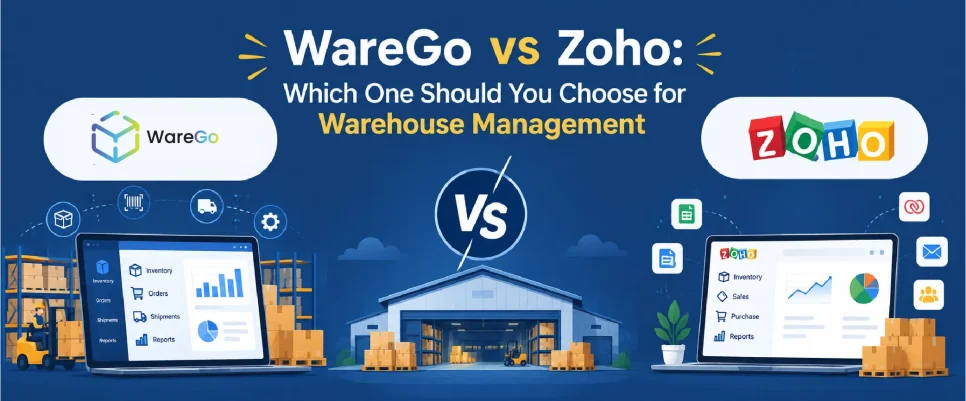
WareGo vs Zoho: Which is the Best Warehouse Management Software
Before choosing Zoho, you need to understand the areas where it seriously lacks. A lot of warehouse managers do not look into this part before purchasing the WMS, which eventually creates difficulties for them after the deployment. It is therefore recommended to first understand the differences between WareGo vs Zoho, so that you can make the selection decision wisely.

1. Multi-Client Architecture
Businesses that work in the 3PL sector need a system that can manage multiple clients effectively. Keeping this in view, WareGo comes prebuilt with a multi-client architecture that helps administrators to segregate client data. It simplifies management of different inventories, so that nothing gets mixed while fulfilling orders.
On the other hand, Zoho does not offer a multi-client architecture, which keeps the operations of 3PLs limited. It works with a conventional architecture in which only one client dashboard can be managed at a time. Due to this, it is not a recommended option for those businesses that are required to handle multiple clients simultaneously.
2. On-Demand Scaling
WareGo helps businesses to scale resources on demand. This is an important feature with which companies can scale their operations during the peak sales season. The platform helps to increase inventory count whenever needed, making sure that all customer orders can be facilitated without facing any stock shortage issue.
Speaking about Zoho, it does not offer adequate features to scale inventory on demand. Due to this, businesses often struggle to meet customer orders when the volume remains high. With this operational drawback, no company in the retail or wholesale sector can meet the changing market demands, which eventually leads to order cancellations.
3. AI-Powered Demand Planning
Being a business stakeholder, it is important for you to plan for sales before the orders arrive. To manage this, WareGo provides AI-powered demand planning to let you know how much stock would be needed for a particular season or sales drive. It is usually generated in the form of reports through which you can get a complete picture of the needed stock.
Zoho Inventory, meanwhile, does not provide any AI-based functionality to evaluate the stock demand. It is therefore not a recommended option for businesses that want to manage the stock in a proactive manner, as Zoho does not provide timely updates to keep the inventory on track.
4. Dedicated Support
WareGo offers dedicated tech support around the clock to resolve all types of customer queries. This is one of the key features of our platform that makes it a preferred choice in the market. The technical support team at WareGo makes sure to assist users at all stages of deployment, so that migration can be done smoothly without any issues.
The customer support of Zoho is also pretty good; however, it does not provide dedicated assistance like WareGo offers at every stage. Furthermore, the response time of Zoho support is also a bit long, which has often frustrated many customers. Due to this, several complaints about the platform have surfaced on the internet, making its WMS not a recommended option.
Final Words
Picking the correct WMS software is important for businesses because the efficacy of their in-house operations depends a lot on it. These systems are responsible for managing the whole supply chain of a company, so picking them correctly after evaluating all the features is very important.
Speaking about the best WMS systems in the UAE, the name of WareGo always comes out on top due to offering multiple advanced functionalities. It is one of those platforms that is built for all types of companies, ranging from small to mid-sized and more. Furthermore, the platform can facilitate businesses from different backgrounds, as its dashboard can be scaled and configured as per the needed requirements.
Keeping all these benefits in view, WareGo is a far better choice than Zoho in different areas. The latter has serious issues in inventory management, due to which its services for warehouses are not recommended. The platform can perform steadily for small businesses; however, its application for big enterprises cannot meet the required demands.
Frequently Asked Questions
- What is WareGo?
WareGo is a WMS software that helps businesses to streamline different warehouse jobs. From inventory tracking to shipment management, it can be used to monitor everything, giving administrators an easy way to manage all operations.
- What is Zoho Inventory?
Zoho Inventory is a module offered in the broader Zoho Books suite. It works well to manage different warehouse processes, allowing businesses to complete different jobs quickly. It can also be integrated with other Zoho tools, which further enhances its usability for warehouses.
- Why is WareGo a better option than Zoho Inventory?
WareGo is considered a much better option than Zoho because it provides various advanced features. From live inventory visibility to AI-demand planning, WareGo comes prebuilt with various unique functionalities that make it a preferred choice for many businesses.
- What is the pricing plan of WareGo?
WareGo offers an affordable pricing plan that helps every business to get started with the platform easily. Starting from just $350/month, it is the most cost-effective WMS in the industry that provides enterprise-grade features at minimal pricing.