Many retail businesses struggle to scale their warehouse operations due to limitations in resources. They face this problem largely due to working with a simple WMS system that does not provide scaling according to the evolving demands. This type of warehouse management software is pretty generic, meaning it is built to support basic inventory management operations, and not scale the overall system when needed. Unfortunately, these WMS solutions are not recommended for growing businesses, because they don’t have the capability to grow when a company starts to get more orders from the market.
The best way to meet this challenge is by using cloud-based WMS, a system that is designed specifically for those companies that are destined to grow rapidly in the market. They are built with a different approach that helps them to easily scale according to the business requirements. They are more secure and agile as compared to conventional WMS systems that lack to adapt to the changing demands of clients.
In this article, we will discuss why growing businesses should always opt for cloud-based WMS systems. We will discuss the challenges they face working with generic systems, and how cloud-based WMS systems resolve them by providing several cutting-edge warehouse management features. Let’s first understand what a cloud-based WMS is and how it differs from conventional on-premise solutions.
Switch to WareGo and unlock efficient, hassle-free inventory management.
Get Started NowTable of Contents
What is a Cloud-Based WMS?
Cloud-based WMS software runs precisely on cloud infrastructure to execute routine warehouse management operations. It is not like any standalone system that can be manually deployed on a machine to oversee the warehouse functions. It takes the leverage of the cloud to run daily processes, ensuring that warehouse administrators can access the system from anywhere. This is indeed a big advantage that reduces the dependency of using a single machine, as cloud-based WMS systems can be accessed from any device that has the required credentials.
The most important thing about cloud-based WMS systems is that they update the information in real-time. This brings a huge advantage for retail businesses that usually need quick updates in their warehouse management system. Cloud technology helps them to keep track of everything in real-time, which enhances their monitoring of the overall warehouse inventory. This helps them to make quick decisions related to inventory and order management, which enhances the productivity of their operations. It is therefore considered the best solution for retail businesses that look for a platform that can manage their large and complex inventories in real-time.
Cloud-Based WMS vs On-Premise WMS
Many businesses are rethinking whether on-premise WMS solutions have the ability to support their growing warehouse operations. These legacy systems lack in different areas where cloud-based WMS solutions excel strongly. Considering these features, retail businesses have started to deploy cloud-based WMS systems to scale their services quickly. It comes up with a variety of features that simplify not only their warehouse processes, but also allow them to experience strong growth in the market.
Those who want to know how cloud-based WMS are better than on-premise systems, take a look at the short comparison table given below. It will let you know the key features that make cloud systems a much better choice for companies working in the retail and wholesale sectors.
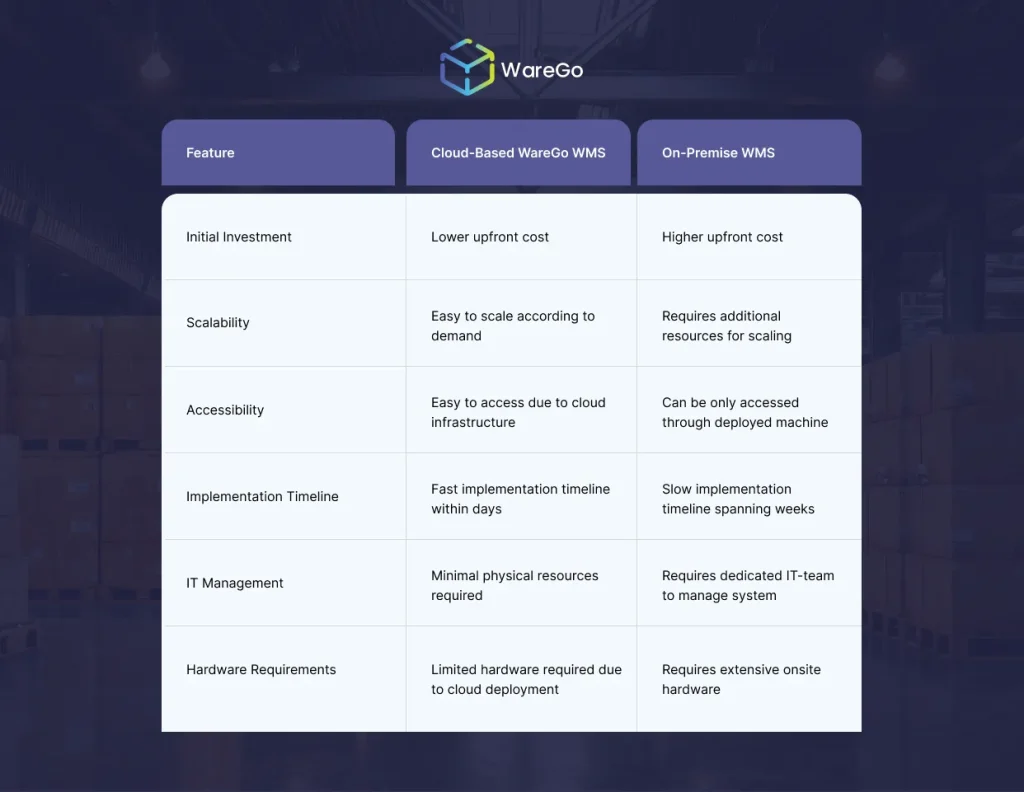
| Feature | Cloud-Based WMS | On-Premise WMS |
| Initial Investment | Lower upfront cost | Higher upfront cost |
| Scalability | Easy to scale according to demand | Requires additional resources for scaling |
| Accessibility | Easy to access due to cloud infrastructure | Can be only accessed through deployed machine |
| Implementation Timeline | Fast implementation timeline within days | Slow implementation timeline spanning weeks |
| IT Management | Minimal physical resources required | Requires dedicated IT-team to manage system |
| Hardware Requirements | Limited hardware required due to cloud deployment | Requires extensive onsite hardware |
Key Features of Cloud-Based Warehouse Management Software
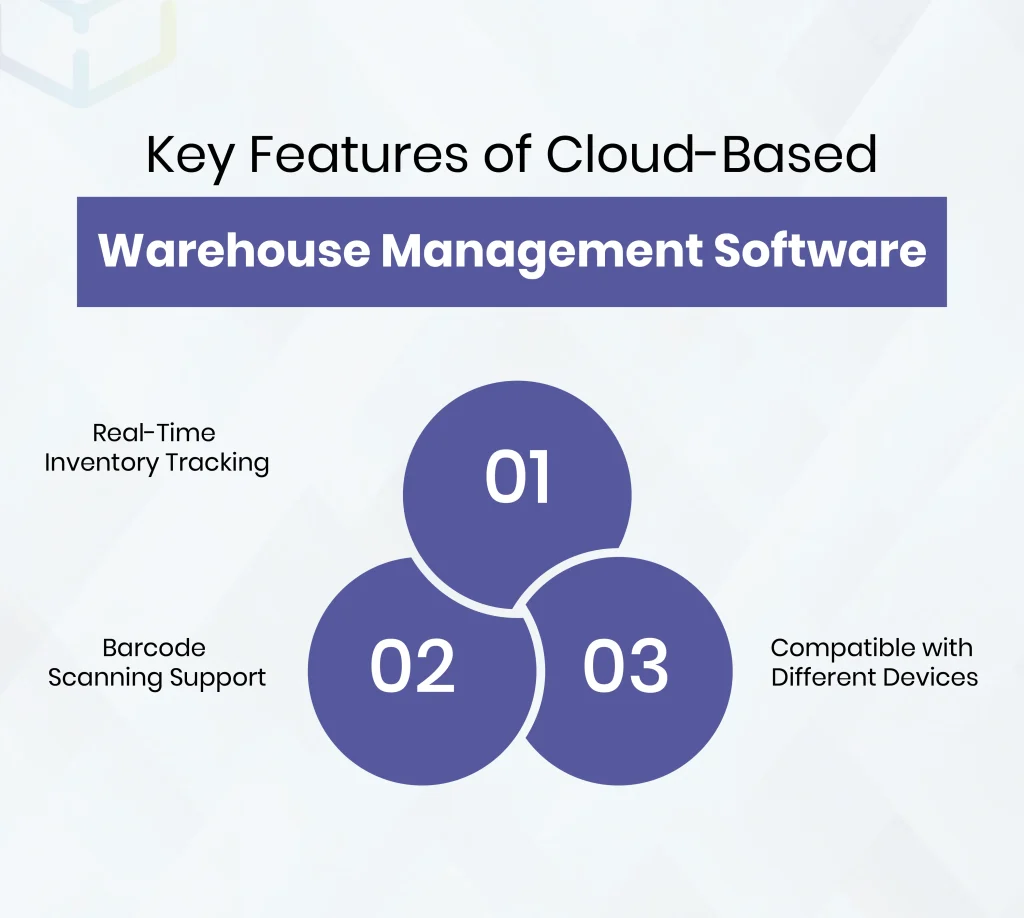
Cloud-based WMS solutions come with plenty of features that help to simplify different types of warehouse processes. From inventory tracking to automated alerts, these systems provide various functionalities that make them a complete warehouse management tool for retail companies. Let’s take a look at some of these features below.
Real-Time Inventory Tracking
Cloud-based WMS systems help warehouse administrators to keep track of inventory in real-time. It is the most important feature that makes cloud solutions an important need for retail businesses. They get real-time visibility on the entire stock through this, which allows them to make different decisions in a timely manner. Whether a product is added or removed from the inventory, everything gets updated immediately on the WMS, giving administrators a clear view of what’s currently available on the shelf.
By having a live view of the inventory, businesses get more ease in fulfilling orders without any delays. Besides that, real-time tracking also helps to improve inventory accuracy by keeping the stock information correct at all times. This reduces the administrator’s job to monitor items manually, as the system automatically updates everything whenever any change occurs in the inventory.
Barcode Scanning Support
A lot of times, warehouses struggle in order fulfillment due to faulty picking and packing processes. It certainly looks like a difficult task if there is no WMS deployed in a warehouse. The reason is that floor workers cannot guarantee perfection in checking every product, as it can have some errors. Luckily, cloud-based WMS systems simplify this issue by providing barcode scanning support, so that products can be identified quickly in the inventory.
With barcode scans, there are minimal chances of human errors, as the system takes care of all identification. It specifically works well for those companies which deal with a high volume of orders every day. By getting the advantage of barcode scans, they expedite the picking and packing process, which eventually results in faster order fulfillment. That is why using cloud-based WMS is recommended for retail businesses, so that they can manage the processing of various orders efficiently.
Compatible with Different Devices
Cloud-powered WMS can be accessed from different devices. This is one of those features that help warehouse workers to access the system from anywhere. They are not dependent on using a precise machine to log into the system, meaning they can use their smartphones or laptops to work with WMS. The cloud architecture enables the platform to share data in real-time, allowing warehouse administrators to update inventories from anywhere.
Besides being compatible with different devices, the cloud technology allows the WMS to scale resources quickly. This is one of those things that is impossible to achieve with standalone systems, as they have limited physical capacity. Therefore, cloud-based warehouse management software provides better compatibility in usage, as well as scaling resources.
Major Benefits of Cloud-Based WMS for Growing Businesses
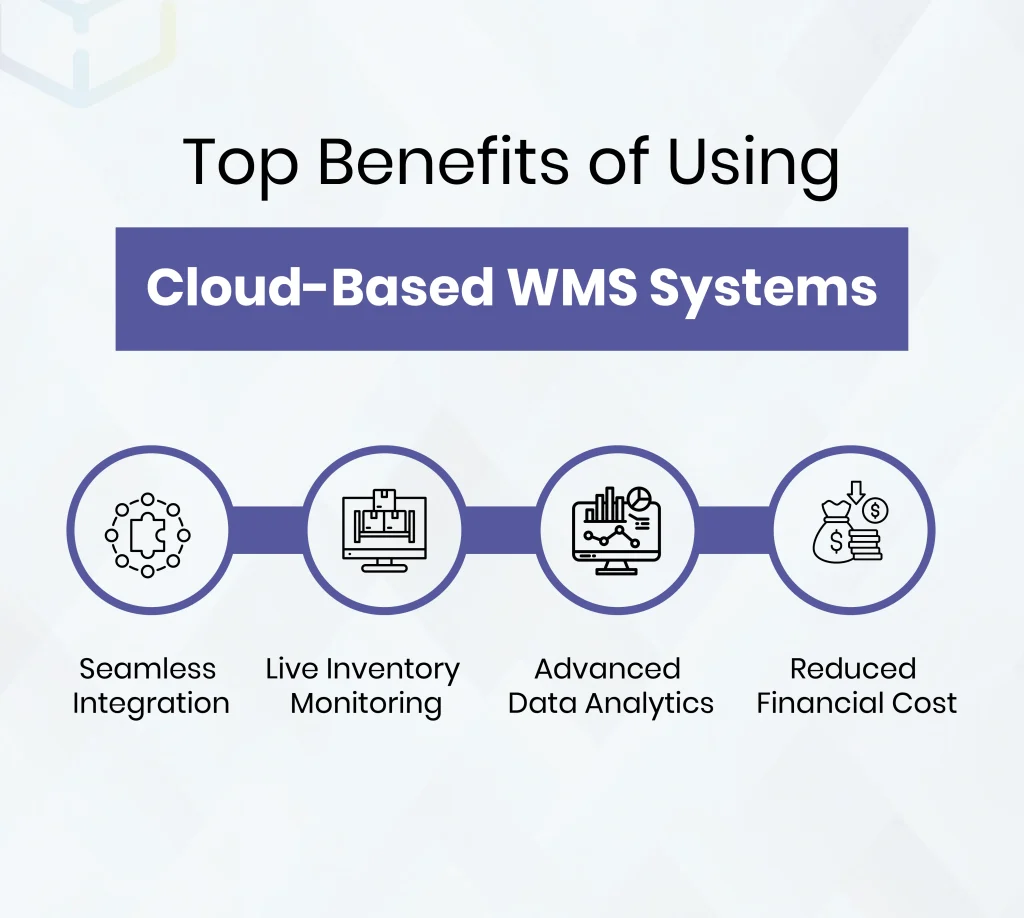
Warehouse management systems powered with cloud technology are becoming essential for growing businesses. They are not just an inventory management tool, but a complete solution to scale their business towards new heights. Here are some of the key factors that make these systems important for growing businesses.
Seamless Integration
Warehouse management software built on cloud can be easily integrated with different third-party tools. From ecommerce platforms to CRM solutions, these WMS can integrate various tools to enhance the productivity of operations. It gives administrators an opportunity to manage different tasks from one platform, as that helps to keep their focus intact.
Most cloud-based WMS provide quick integration with ecommerce tools like Shopify, Amazon, WooCommerce and more others. By using them inside one platform, managing inventory and orders side by side becomes really easy. This is the reason why many retail companies are quickly moving towards cloud-powered solutions, as that enhances their ability to synchronize different channels.
Live Inventory Monitoring
With real-time inventory tracking, cloud-based WMS provides updated visibility of the entire stock to the warehouse administrators. This helps them to know how many products are currently available and how much more are needed to meet the sales forecast. By using this information, they can not only fulfill orders smartly, but can also avoid stockouts. It simplifies inventory management across the warehouse, allowing administrators to make key calls in a timely manner.
Another major benefit of real-time tracking is that it brings accuracy in managing the inventory. It always keeps the stock information updated, which reduces the chances of having excessive backorders. This greatly helps to avoid order cancellations, allowing businesses to facilitate customers within the given time period.
Advanced Data Analytics
Advanced warehouse management software like WareGo provides detailed reports about inventory on demand. Evaluating these reports is important for businesses, because it helps them to make different decisions in a timely manner. It keeps them updated about everything, ranging from warehouse inventory to shipping details and more.
Working with precise analytics helps retail businesses to make data-driven solutions. They become more efficient in optimizing different workflows, which then results in better productivity. For growing businesses, working with accurate data is very important, as it enables them to become proactive in making different sales-related decisions.
Reduced Financial Cost
Working with a cloud-based WMS helps businesses to save plenty of money. Unlike on-premise solutions, these systems do not require expensive resources for on-site setup. They are completely deployed on the cloud, which means businesses do not have to worry about installing anything physically. This saves a lot of money, as companies just have to pay the subscription fees to keep using the platform.
By reducing costs on the operational front, cloud-based WMS allows businesses to use those funds on other key areas. Another good thing about these systems is that their versions are updated automatically by the vendor. This means that clients do not have to worry about any migration cost, as the regular upgradation charges are already included in the subscription fees.
Final Words
In the ever-evolving retail industry, businesses need a solution that can help them navigate the tough challenges of warehouse management. They need a platform that can simplify not just inventory management, but order fulfillment and shipping processes as well. That is where cloud-based WMS comes into the picture, as they provide a one-stop solution for all these challenges. They are built to streamline every process, so that businesses can drive more sales in the market. These systems are especially beneficial for growing businesses, as they provide plenty of features that scale operations without affecting the quality of warehousing services.
Get started with WareGo and take advantage of AI-powered inventory control.
Try WareGo NowFrequently Asked Questions
- What is a cloud-based WMS?
Cloud-based WMS is a solution that runs on the infrastructure of the cloud. It makes them quite different from the standalone systems that are deployed on machines. Cloud-based WMS are therefore considered more powerful, as they can scale quickly according to the evolving demands.
- What are the key features of cloud-based WMS?
Cloud-based WMS provides different types of features to simplify warehouse management. From real-time inventory tracking to detailed analytics, cloud-powered systems offer tailored functionalities that help retail businesses to optimize their warehousing operations.
- Why growing businesses should use cloud-based WMS?
Growing businesses need a platform that can scale as per their evolving requirements. Cloud-powered WMS are built to support this need, which is why they are considered a perfect fit for small and growing retail businesses.
- Can cloud-based WMS integrate third-party tools?
Yes, cloud-based WMS can integrate with third-party tools effectively. From ecommerce platforms to ERP solutions, advanced WMS systems like WareGo allow clients to integrate top business tools to enhance operational efficiency.